

5 crowns – Hungary
Add to wishlist
Hungary
Context
Years: 1900–1909
Issuer: Hungary
Ruler: Francis Joseph I
Currency:
(1892—1918)
Demonetization: 1 January 1927
Total mintage: 7,386,676
Material
References
KM: #
Numista: #12866
Value
Bullion value: $54.22
Obverse
Description:
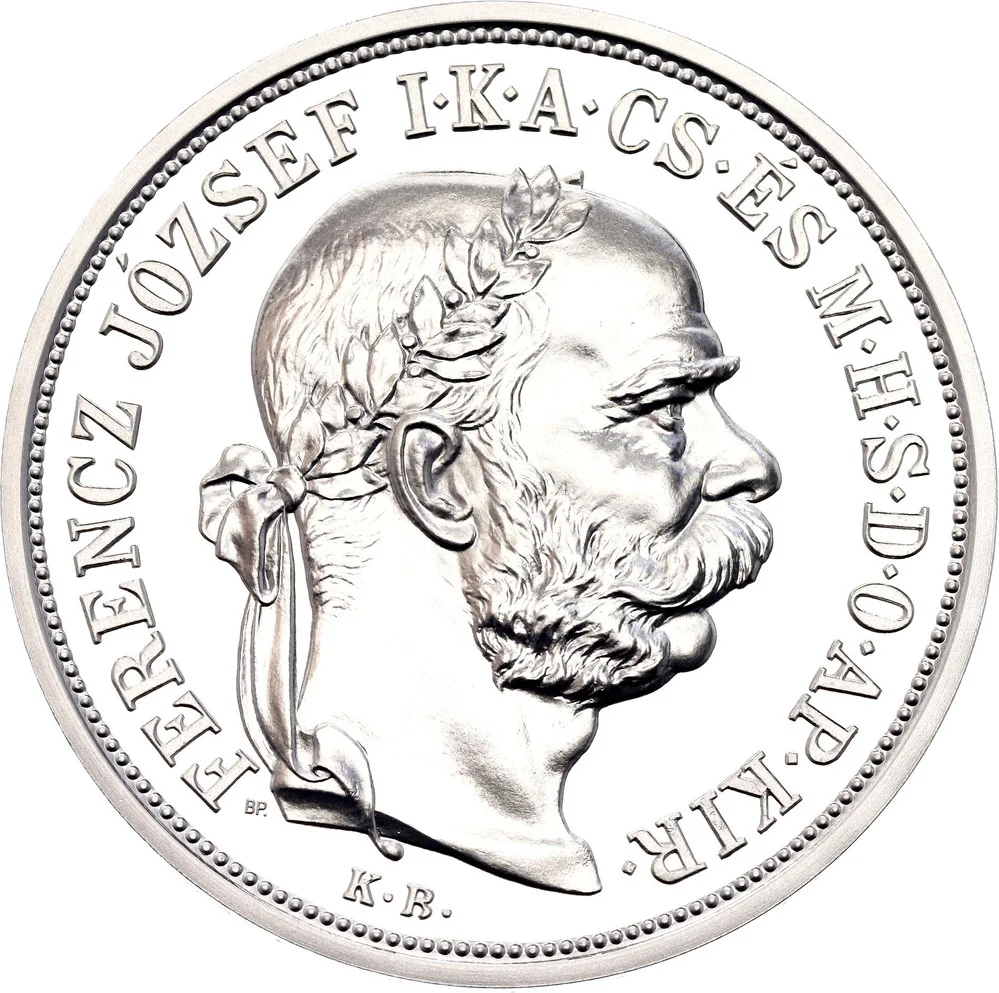
Laureate head facing right
Inscription:
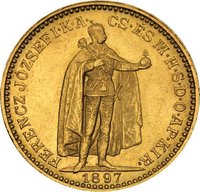
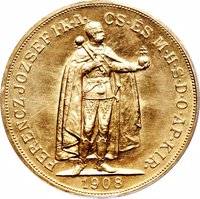
FERENCZ JÓZSEF I·K·A·CS· ÉS M·H·S·D·O·AP·KIR·
K.B.
K.B.
Translation:
Francis Joseph I, Emperor of Austria, Apostolic King of Hungary.
Script: Latin
Engraver: József Reisner
Reverse
Edge
Inscription
Legend:
BIZALMAM AZ ŐSI ERÉNYBEN
Translation:
My trust is in ancient virtue.
Language: Hungarian
Categories
| Person> Military leader |
| Mustache/Beard |
| Symbol> Crown |
Mints
| Name | Mark |
|---|---|
| Kremnica | KB |
Mintings
Historical background
In 1900, Hungary existed as one of two constituent kingdoms within the Dual Monarchy of Austria-Hungary, established by the Compromise of 1867. While politically autonomous in domestic affairs, the country operated within a shared economic and monetary union. Consequently, Hungary did not have an independent currency; the official legal tender was the Austro-Hungarian gulden (or florin), issued by the Austro-Hungarian Bank, a central institution with headquarters in both Vienna and Budapest. This system bound Hungary's financial fate to the broader policies and fiscal health of the empire.
The late 19th century was a period of significant economic modernization and growth for Hungary, fueled by agricultural exports and budding industry. This expansion increased the demand for a stable and uniform currency to facilitate trade and investment. The gulden, which was on a silver standard, served this purpose but was increasingly seen as part of an outdated bimetallic system. By 1900, pressures were mounting for a transition to a modern gold standard, a move already undertaken by most major European powers and seen as crucial for international financial credibility and stability.
Thus, the Hungarian currency situation at the turn of the century was one of impending transition. The existing gulden was stable but emblematic of an older economic order. Underpinning daily commerce, it was nevertheless part of a system facing reform. This change materialized just a few years later with the introduction of the Austro-Hungarian krone in 1892, which fully replaced the gulden by 1900 as the empire's new gold-standard currency. Therefore, the year 1900 marked the very end of the gulden era and the consolidation of the gold-based krone, aligning Hungary's monetary system with contemporary European practice while maintaining its integral place within the imperial financial framework.
The late 19th century was a period of significant economic modernization and growth for Hungary, fueled by agricultural exports and budding industry. This expansion increased the demand for a stable and uniform currency to facilitate trade and investment. The gulden, which was on a silver standard, served this purpose but was increasingly seen as part of an outdated bimetallic system. By 1900, pressures were mounting for a transition to a modern gold standard, a move already undertaken by most major European powers and seen as crucial for international financial credibility and stability.
Thus, the Hungarian currency situation at the turn of the century was one of impending transition. The existing gulden was stable but emblematic of an older economic order. Underpinning daily commerce, it was nevertheless part of a system facing reform. This change materialized just a few years later with the introduction of the Austro-Hungarian krone in 1892, which fully replaced the gulden by 1900 as the empire's new gold-standard currency. Therefore, the year 1900 marked the very end of the gulden era and the consolidation of the gold-based krone, aligning Hungary's monetary system with contemporary European practice while maintaining its integral place within the imperial financial framework.
🌱 Common