

5 gulden – Netherlands
Add to wishlist
Netherlands
Context
Years: 1987–2001
Issuer: Netherlands
Ruler: Beatrix
Currency:
(1817—2001)
Demonetization: 28 February 2002
Total mintage: 214,454,002
Material
References
KM: #
Numista: #1283
Value
Exchange value: 5 NLG
Inflation-adjusted value: 11.32 NLG
Obverse
Description:
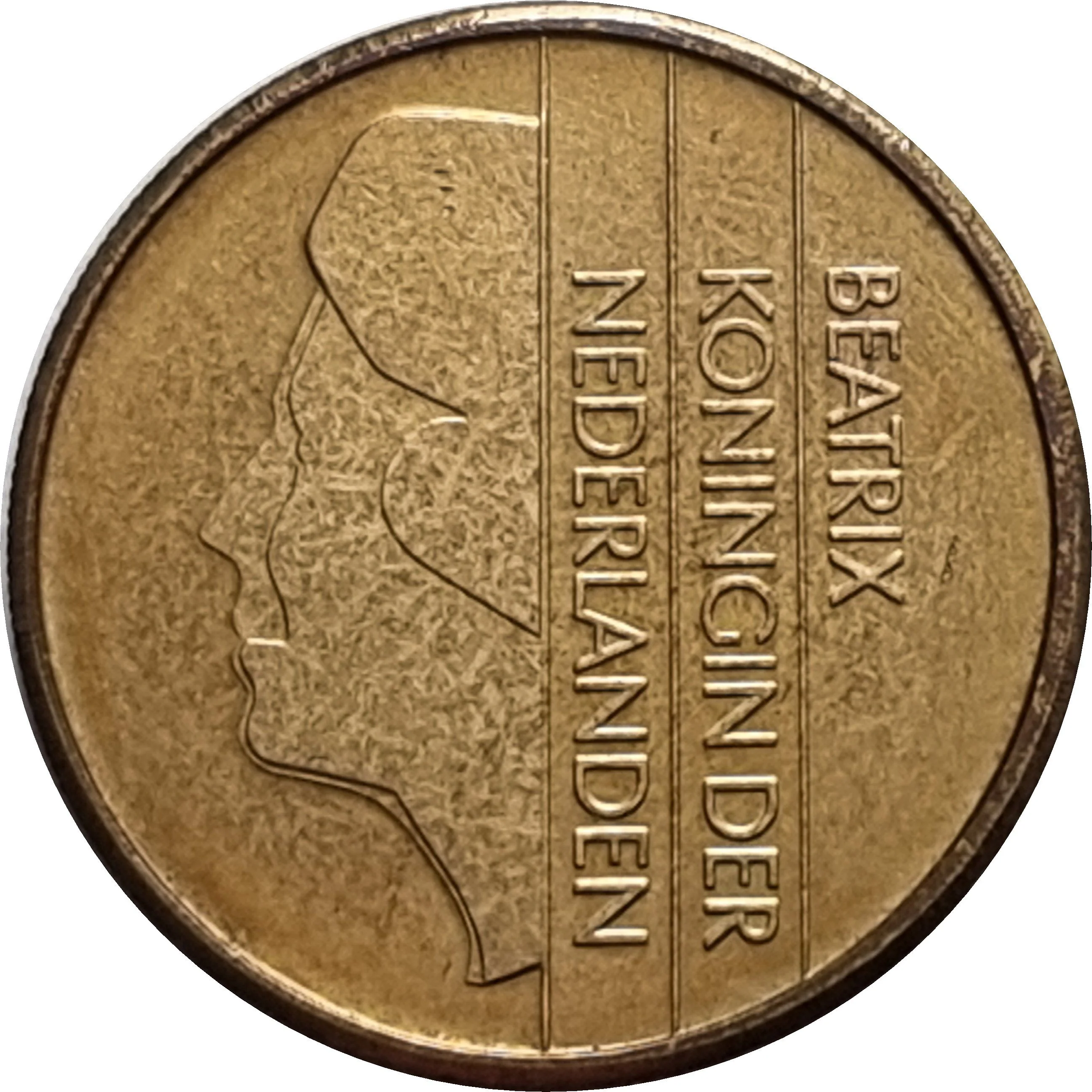
Left-profile portrait of Beatrix of the Netherlands with vertical inscription at right.
Inscription:
BEATRIX
KONINGIN DER
NEDERLANDEN
KONINGIN DER
NEDERLANDEN
Translation:
Beatrix
Queen of the
Netherlands
Queen of the
Netherlands
Script: Latin
Language: Dutch
Engraver: Bruno Ninaber van Eyben
Reverse
Description:
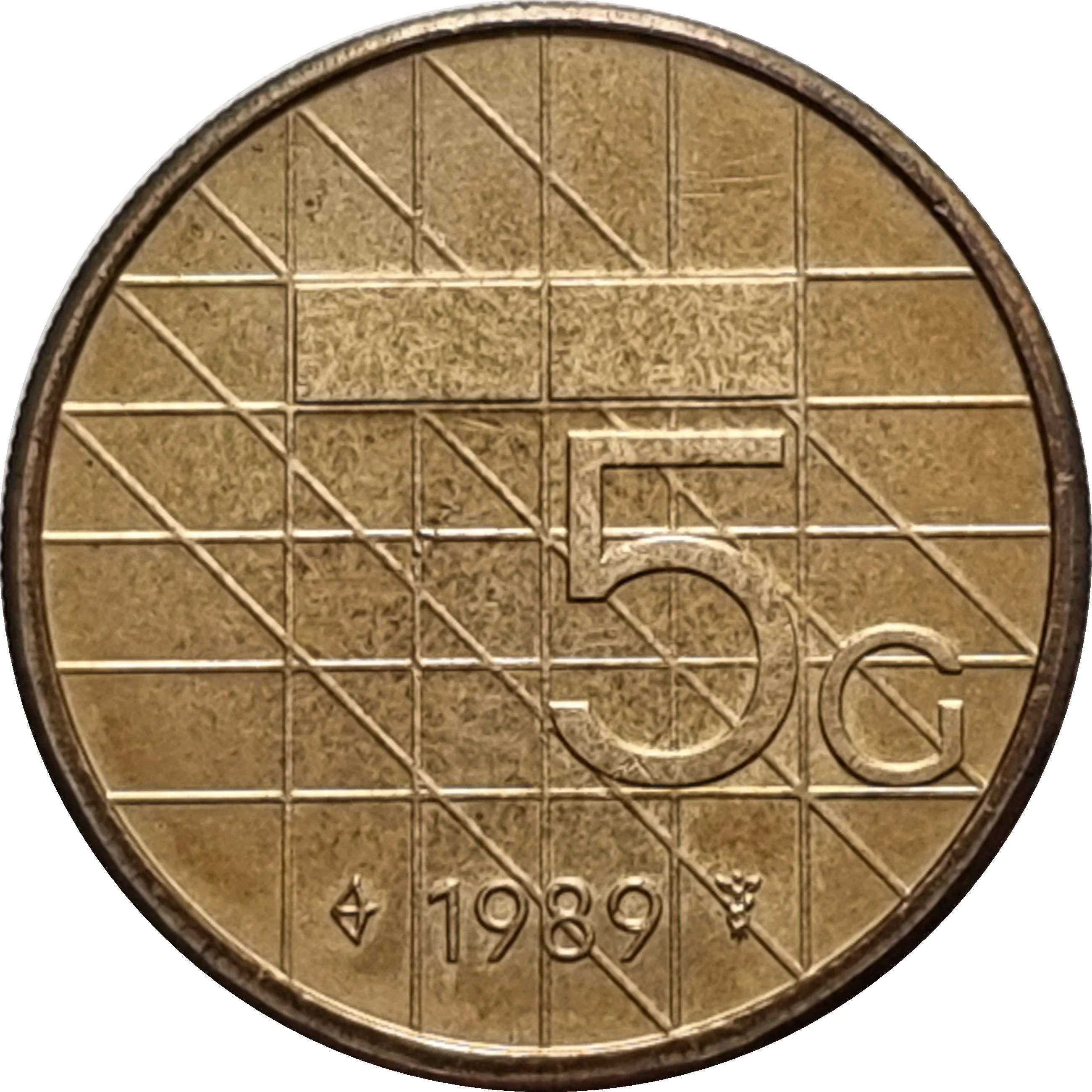
Value over date, denomination on grid.
Inscription:
5 G
1989
1989
Script: Latin
Engraver: Bruno Ninaber van Eyben
Edge
Mints
| Name | Mark |
|---|---|
| Royal Dutch Mint | — |
Mintings
| Year | Mint Mark | Mintage | Quality | Collection |
|---|---|---|---|---|
| 1987 | — | 2 | Proof | |
| 1988 | — | 73,600,000 | ||
| 1988 | — | 20,000 | Proof | |
| 1989 | — | 69,000,000 | ||
| 1989 | — | 15,000 | Proof | |
| 1990 | — | 47,200,000 | ||
| 1990 | — | 15,000 | Proof | |
| 1991 | — | 17,000,000 | ||
| 1991 | — | 14,000 | Proof | |
| 1992 | — | 400,000 | ||
| 1992 | — | 13,000 | Proof | |
| 1993 | — | 5,400,000 | ||
| 1993 | — | 12,000 | Proof | |
| 1994 | — | 400,000 | ||
| 1994 | — | 13,000 | Proof | |
| 1995 | — | 400,000 | ||
| 1995 | — | 12,000 | Proof | |
| 1996 | — | 150,000 | ||
| 1996 | — | 14,000 | Proof | |
| 1997 | — | 170,000 | ||
| 1997 | — | 12,000 | Proof | |
| 1998 | — | 100,000 | ||
| 1998 | — | 12,000 | Proof | |
| 1999 | — | 120,000 | ||
| 1999 | — | 15,000 | Proof | |
| 2000 | — | 200,000 | ||
| 2000 | — | 15,000 | Proof | |
| 2001 | — | 115,000 | ||
| 2001 | — | 17,000 | Proof |
Historical background
In 1987, the Netherlands operated within the European Monetary System (EMS), a framework established in 1979 to reduce exchange rate volatility and foster monetary stability in Europe. The Dutch guilder was a central pillar of this system, renowned for its strength and stability. It was firmly anchored to the Deutsche Mark through a tight fluctuation band within the EMS Exchange Rate Mechanism (ERM), effectively shadowing the monetary policy of the Bundesbank. This close alignment, often termed the "hard guilder" policy, was a cornerstone of Dutch economic philosophy, prioritizing low inflation and exchange rate stability over independent monetary maneuvering.
The domestic economic context of 1987 was one of gradual recovery following the hardships of the early 1980s. The "Wassenaar Agreement" of 1982 had set a course for wage moderation and fiscal reform, which helped restore competitiveness and reduce unemployment. However, the guilder's strength presented a double-edged sword: it cemented low inflation and low interest rates but also created persistent pressure on export-oriented sectors. Dutch authorities, led by the Nederlandsche Bank, were unwavering in their commitment to the guilder-DM peg, viewing it as an essential anti-inflationary anchor, even as it constrained other policy options.
Internationally, 1987 was a year of significant currency market tensions, most notably the Louvre Accord in February, where G7 nations attempted to stabilize the US dollar after its sharp decline. While this focused on the dollar, yen, and Deutsche Mark, it underscored the global interdependence of exchange rates. For the Netherlands, the year passed without the severe ERM crises that would erupt in the early 1990s, but it solidified the country's role as a dependable and disciplined partner within the European exchange rate mechanism, a position that would seamlessly guide it toward European Economic and Monetary Union and the eventual adoption of the euro.
The domestic economic context of 1987 was one of gradual recovery following the hardships of the early 1980s. The "Wassenaar Agreement" of 1982 had set a course for wage moderation and fiscal reform, which helped restore competitiveness and reduce unemployment. However, the guilder's strength presented a double-edged sword: it cemented low inflation and low interest rates but also created persistent pressure on export-oriented sectors. Dutch authorities, led by the Nederlandsche Bank, were unwavering in their commitment to the guilder-DM peg, viewing it as an essential anti-inflationary anchor, even as it constrained other policy options.
Internationally, 1987 was a year of significant currency market tensions, most notably the Louvre Accord in February, where G7 nations attempted to stabilize the US dollar after its sharp decline. While this focused on the dollar, yen, and Deutsche Mark, it underscored the global interdependence of exchange rates. For the Netherlands, the year passed without the severe ERM crises that would erupt in the early 1990s, but it solidified the country's role as a dependable and disciplined partner within the European exchange rate mechanism, a position that would seamlessly guide it toward European Economic and Monetary Union and the eventual adoption of the euro.
🌱 Very Common