

100 francs – Monaco
Add to wishlist
Non-circulating coins
Commemoration: Heir Apparent Prince Albert
Monaco
Context
Year: 1982
Issuer: Monaco
Ruler: Rainier III
Currency:
(1960—2001)
Demonetized: Yes
Total mintage: 30,000
Material
References
KM: #
Numista: #10132
Value
Exchange value: 100 MCF
Bullion value: $33.02
Obverse
Description:
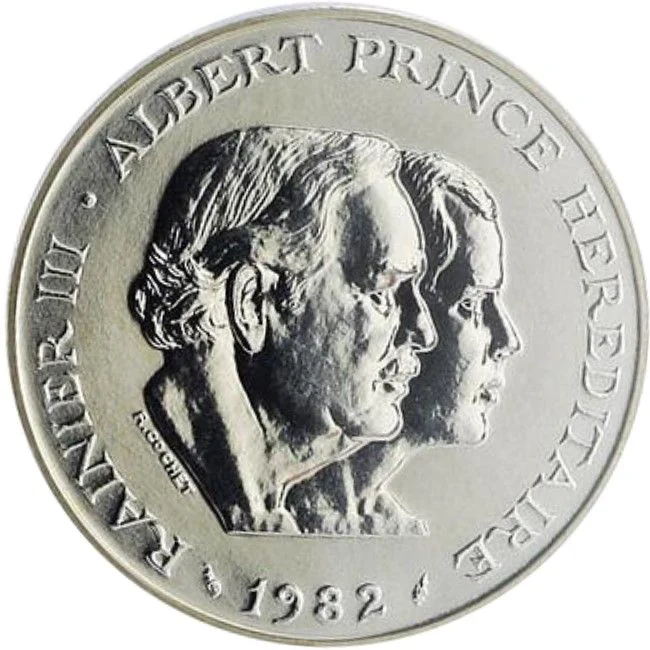
Portrait of Prince Rainier III and Hereditary Prince Albert facing right.
Inscription:
RAINIER III · ALBERT PRINCE HEREDITAIRE
R.COCHET
1982
R.COCHET
1982
Script: Latin
Engraver: Robert Cochet
Reverse
Description:
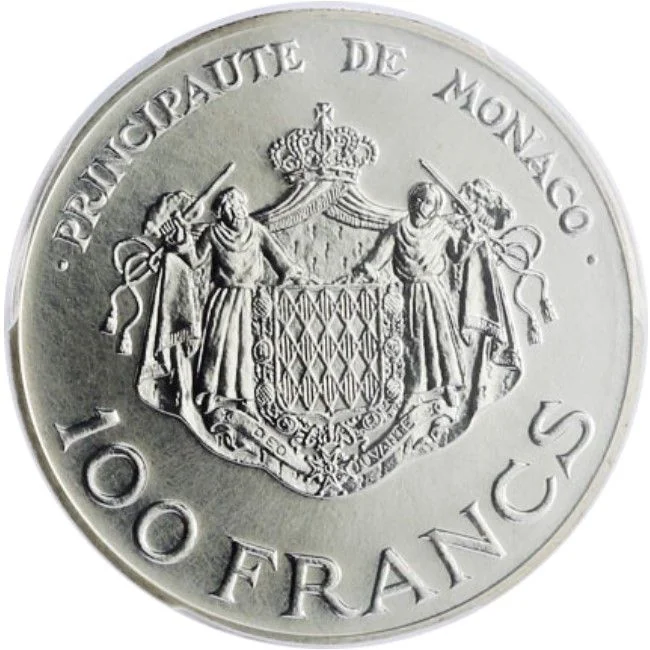
Monaco's coat of arms.
Inscription:
. PRINCIPAUTE DE MONACO .
100 FRANCS
100 FRANCS
Script: Latin
Engraver: Robert Cochet
Edge
Plain
Mints
| Name | Mark |
|---|---|
| Monnaie de Paris | — |
Mintings
| Year | Mint Mark | Mintage | Quality | Collection |
|---|---|---|---|---|
| 1982 | — | 30,000 |
Historical background
In 1982, Monaco's currency situation was fundamentally defined by its unique political and monetary relationship with France, established by the 1963 Monetary Convention. This treaty granted Monaco the right to issue its own coinage, the Monegasque franc, which was pegged at a strict 1:1 parity with the French franc (FRF) and considered legal tender within the principality. However, France retained control over the issuance of banknotes, meaning all paper currency in circulation was French. This arrangement effectively placed Monaco within the French franc zone, making its monetary policy entirely dependent on decisions made by the Banque de France and the French government.
The broader economic context of the early 1980s was challenging, marked by the aftermath of the second oil shock, high inflation, and the European Monetary System's (EMS) struggles with currency instability. France, under President François Mitterrand, initially pursued expansive fiscal policies before implementing a sharp austerity turn in 1982, including a devaluation of the franc within the EMS. Consequently, Monaco's currency was indirectly affected by these turbulent European exchange rate mechanisms and France's domestic battle against inflation. The principality had no independent leverage, as its economic and monetary sovereignty was ceded to French authorities.
Therefore, the "currency situation" in Monaco in 1982 was one of stability on the surface, due to the fixed peg, but of complete vulnerability beneath. The principality passively experienced the consequences of France's economic policies and the franc's fluctuations within the European Monetary System. This period underscored Monaco's status as a de facto user of the French franc, with its own coinage serving as a symbolic rather than a functional monetary instrument, leaving its financial stability inextricably tied to the economic decisions made in Paris.
The broader economic context of the early 1980s was challenging, marked by the aftermath of the second oil shock, high inflation, and the European Monetary System's (EMS) struggles with currency instability. France, under President François Mitterrand, initially pursued expansive fiscal policies before implementing a sharp austerity turn in 1982, including a devaluation of the franc within the EMS. Consequently, Monaco's currency was indirectly affected by these turbulent European exchange rate mechanisms and France's domestic battle against inflation. The principality had no independent leverage, as its economic and monetary sovereignty was ceded to French authorities.
Therefore, the "currency situation" in Monaco in 1982 was one of stability on the surface, due to the fixed peg, but of complete vulnerability beneath. The principality passively experienced the consequences of France's economic policies and the franc's fluctuations within the European Monetary System. This period underscored Monaco's status as a de facto user of the French franc, with its own coinage serving as a symbolic rather than a functional monetary instrument, leaving its financial stability inextricably tied to the economic decisions made in Paris.
🌟 Uncommon