

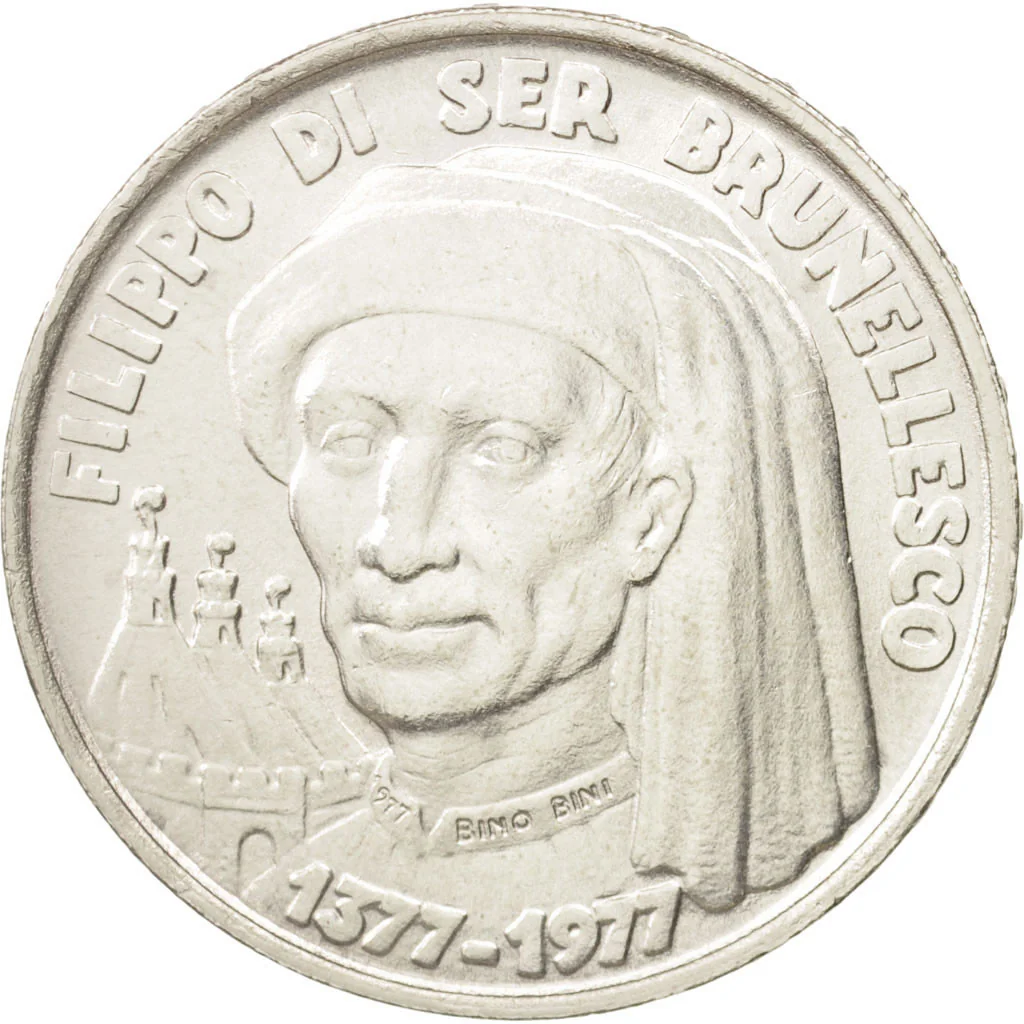
1000 Lire (Brunelleschi) – San Marino
Non-circulating coins
Commemoration: 600th Anniversary of the Birth of Brunelleschi
San Marino
Context
Year: 1977
Issuer: San Marino 
Period:
(since 301)
Currency:
(1864—2001)
Demonetization: 1 March 2002
Total mintage: 180,000
Material
References
KM: #Click to copy to clipboard72
Numista: #12700
Value
Exchange value: 1000 SML
Bullion value: $35.31
Obverse
Reverse
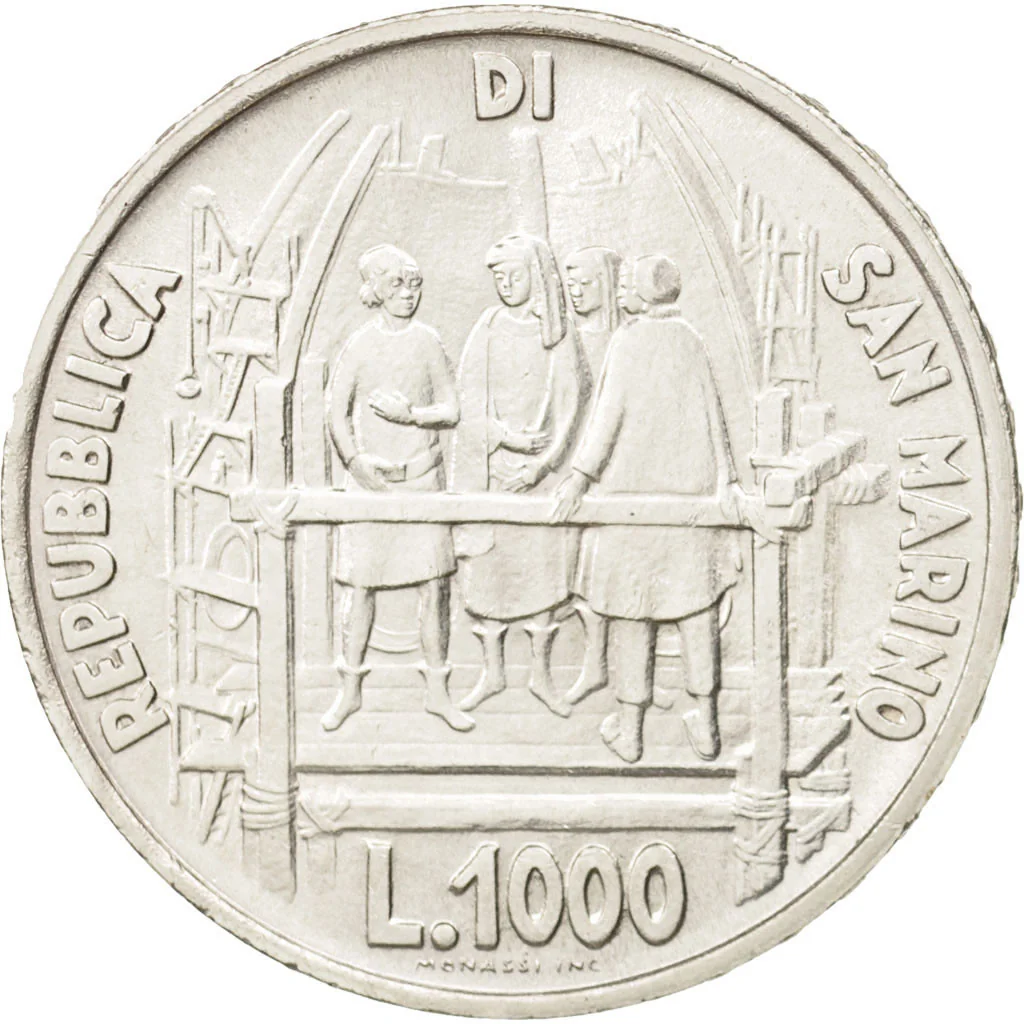
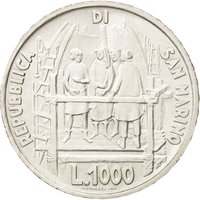
Description:
Crowd on a railed platform, denomination below.
Inscription:
REPUBBLICA DI SAN MARINO
L.1000
L.1000
Translation:
Republic of San Marino
L.1000
L.1000
Script: Latin
Language: Italian
Engraver: Guerrino Mattia Monassi
Edge
Plain with raised edge inscription
Legend:
VI CENTENARIO DELLA NASCITA DI FILIPPO BRUNELLESCHI
Categories
| Event> Birth anniversary |
| Person> Artist |
Mints
| Name | Mark |
|---|---|
| Rome | — |
Mintings
| Year | Mint Mark | Mintage | Quality | Collection |
|---|---|---|---|---|
| 1977 | — | 180,000 |
Historical background
In 1977, San Marino's currency situation was intrinsically linked to that of Italy, operating under a de facto monetary union long before the euro. The Republic used the Italian Lira as its official legal tender, a relationship formalized by a series of post-war conventions. This arrangement provided monetary stability and facilitated seamless trade with its encircling neighbor, which accounted for the vast majority of its economic activity. However, it also meant San Marino had no independent monetary policy, its financial system entirely subject to the decisions of the Banca d'Italia and the turbulent economic climate of 1970s Italy.
That decade presented significant challenges, as Italy grappled with high inflation, labor unrest, and currency instability following the collapse of the Bretton Woods system. San Marino, while somewhat insulated by its smaller, more controlled economy, was nonetheless directly impacted by the lira's depreciation and inflationary pressures. These external forces strained domestic prices and complicated economic planning. In response, the Sammarinese government sought limited autonomy through the issuance of distinctive commemorative coinage, the scudi, which had a fixed conversion rate to the lira but were intended primarily for collectors and as a symbolic assertion of sovereignty rather than for daily circulation.
The year 1977 fell within a period of renegotiation of San Marino's economic treaties with Italy. Discussions were ongoing regarding the terms of the monetary convention, including the right to issue coinage and the allocation of seigniorage revenue. The outcome, finalized in the 1979 Monetary Agreement, confirmed the lira's role but granted San Marino expanded rights to mint its own limited-edition gold and silver coins. Thus, the 1977 currency landscape was one of dependent stability, characterized by a search for minor fiscal levers and symbolic monetary identity within the constraints of a necessary and dominant partnership with Italy.
That decade presented significant challenges, as Italy grappled with high inflation, labor unrest, and currency instability following the collapse of the Bretton Woods system. San Marino, while somewhat insulated by its smaller, more controlled economy, was nonetheless directly impacted by the lira's depreciation and inflationary pressures. These external forces strained domestic prices and complicated economic planning. In response, the Sammarinese government sought limited autonomy through the issuance of distinctive commemorative coinage, the scudi, which had a fixed conversion rate to the lira but were intended primarily for collectors and as a symbolic assertion of sovereignty rather than for daily circulation.
The year 1977 fell within a period of renegotiation of San Marino's economic treaties with Italy. Discussions were ongoing regarding the terms of the monetary convention, including the right to issue coinage and the allocation of seigniorage revenue. The outcome, finalized in the 1979 Monetary Agreement, confirmed the lira's role but granted San Marino expanded rights to mint its own limited-edition gold and silver coins. Thus, the 1977 currency landscape was one of dependent stability, characterized by a search for minor fiscal levers and symbolic monetary identity within the constraints of a necessary and dominant partnership with Italy.
🌱 Fairly Common