

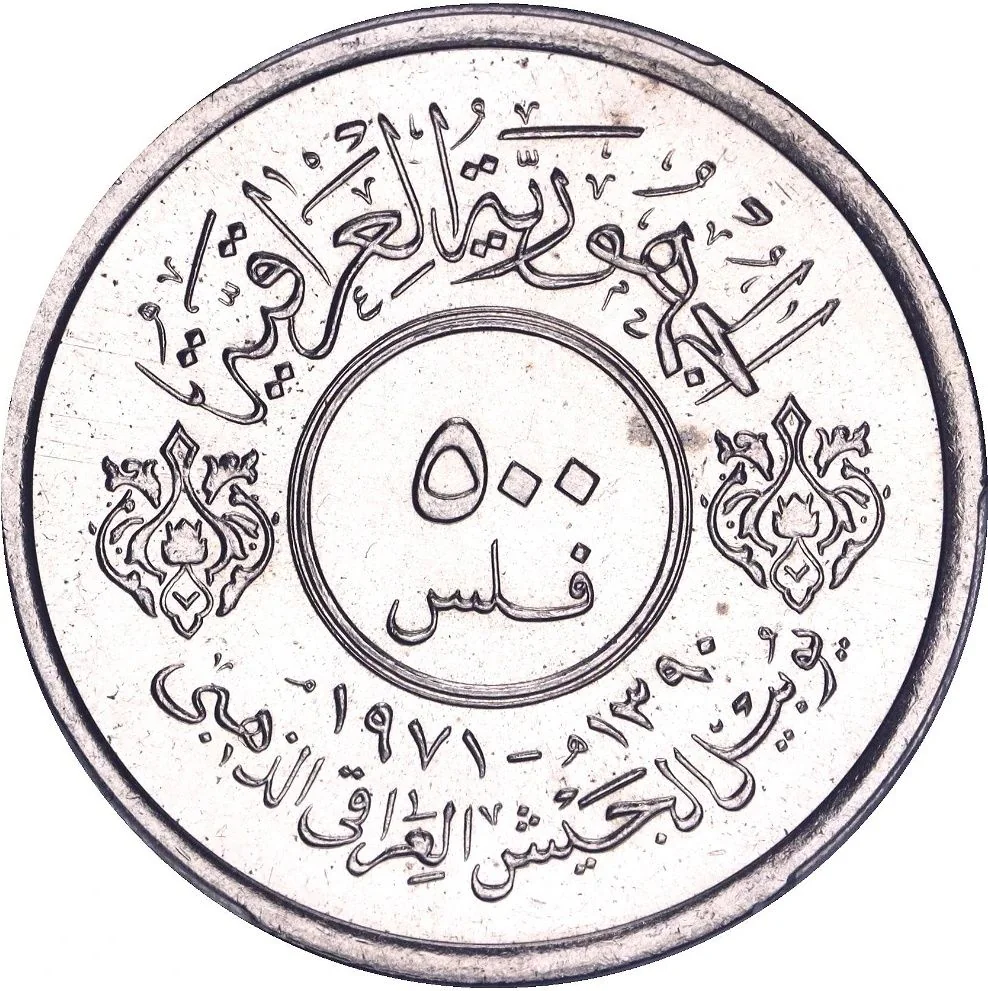
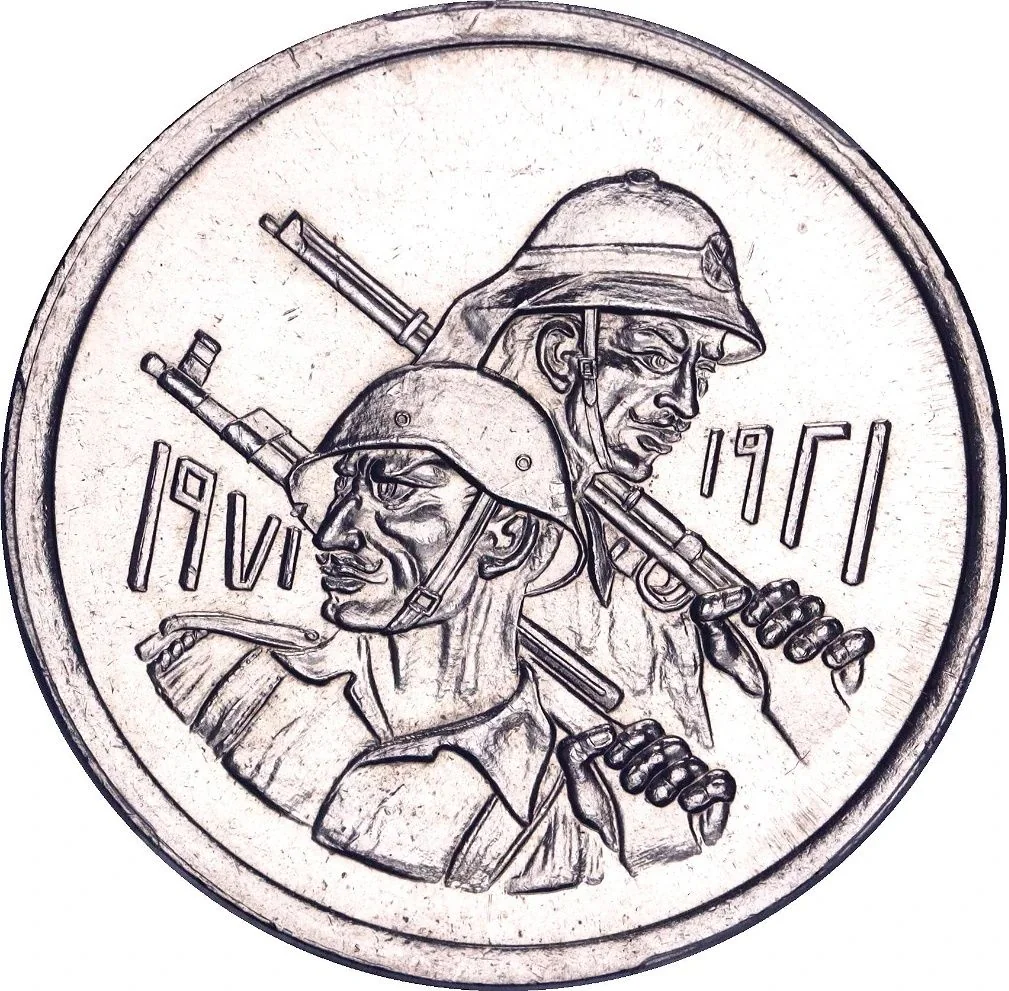
500 fils (Iraqi Army) – Iraq
Add to wishlist
Circulating commemorative coins
Commemoration: 50th Anniversary of the Iraqi Army
Iraq
Context
Year: 1971
Islamic (Hijri) Year:: 1390
Issuer: Iraq
Period:
(since 1958)
Currency:
(since 1931)
Demonetized: Yes
Total mintage: 105,000
Material
References
KM: #
Numista: #12688
Value
Exchange value: 0.500 IQD
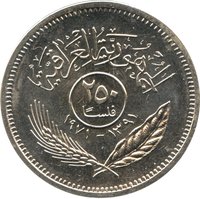
Obverse
Edge
Reeded
Mints
| Name | Mark |
|---|---|
| Royal Mint | — |
Mintings
| Year | Mint Mark | Mintage | Quality | Collection |
|---|---|---|---|---|
| 1971 | — | 100,000 | ||
| 1971 | — | 5,000 | Proof |
Historical background
In 1971, Iraq's currency situation was characterized by stability and confidence, underpinned by the nation's booming oil economy. The Iraqi dinar, introduced in 1932 to replace the Indian rupee, was pegged to the British pound sterling until 1959, after which it was pegged to the U.S. dollar at a strong and fixed rate of 1 dinar = 2.8 dollars. This peg, managed by the Iraqi Currency Board (later the Central Bank of Iraq), provided predictability for international trade and investment. The dinar was considered one of the strongest and most stable currencies in the Middle East, bolstered by rapidly increasing oil revenues following the nationalization of the Iraq Petroleum Company in 1961 and the rising global oil prices of the era.
This monetary stability occurred within the context of the Ba'ath Party's consolidation of power, having taken control in 1968. The government, led by President Ahmed Hassan al-Bakr with Saddam Hussein as his deputy, leveraged oil wealth to fund large-scale development projects and a growing public sector. The strong dinar facilitated imports of machinery and goods necessary for industrialization and infrastructure, supporting the regime's ambitions for modernization and economic independence. There was little to no foreign debt, and the country accumulated substantial foreign exchange reserves.
However, this apparent stability was not without underlying pressures. The economy was overwhelmingly dependent on a single commodity—oil—making it vulnerable to external market shocks. Furthermore, the government's increasing expenditure on military and security apparatus, alongside ambitious state-led projects, sowed the seeds for future fiscal strain. While the currency itself faced no immediate crisis in 1971, the centralized economic model and political priorities of the Ba'athist regime would later contribute to significant financial challenges, especially following the Iran-Iraq War in the 1980s, which ultimately led to the dinar's dramatic devaluation.
This monetary stability occurred within the context of the Ba'ath Party's consolidation of power, having taken control in 1968. The government, led by President Ahmed Hassan al-Bakr with Saddam Hussein as his deputy, leveraged oil wealth to fund large-scale development projects and a growing public sector. The strong dinar facilitated imports of machinery and goods necessary for industrialization and infrastructure, supporting the regime's ambitions for modernization and economic independence. There was little to no foreign debt, and the country accumulated substantial foreign exchange reserves.
However, this apparent stability was not without underlying pressures. The economy was overwhelmingly dependent on a single commodity—oil—making it vulnerable to external market shocks. Furthermore, the government's increasing expenditure on military and security apparatus, alongside ambitious state-led projects, sowed the seeds for future fiscal strain. While the currency itself faced no immediate crisis in 1971, the centralized economic model and political priorities of the Ba'athist regime would later contribute to significant financial challenges, especially following the Iran-Iraq War in the 1980s, which ultimately led to the dinar's dramatic devaluation.
🌟 Uncommon