

10 Fils – Hashemite Kingdom
Jordan
Context
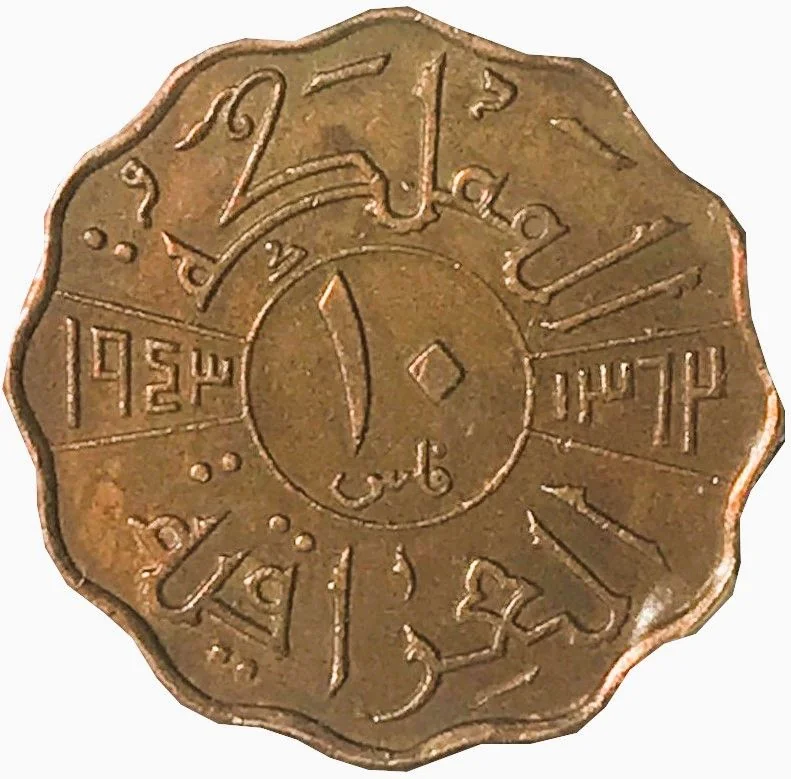
Year: 1943
Islamic (Hijri) Year: 1362
Country: Jordan 
Issuer: Hashemite Kingdom
Ruler: Faisal II
Currency:
(since 1931)
Demonetization: 6 January 1961
Total mintage: 1,500,000
Material
References
KM: #Click to copy to clipboard108
Numista: #12674
Value
Exchange value: 0.010 IQD
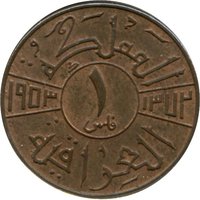
Obverse
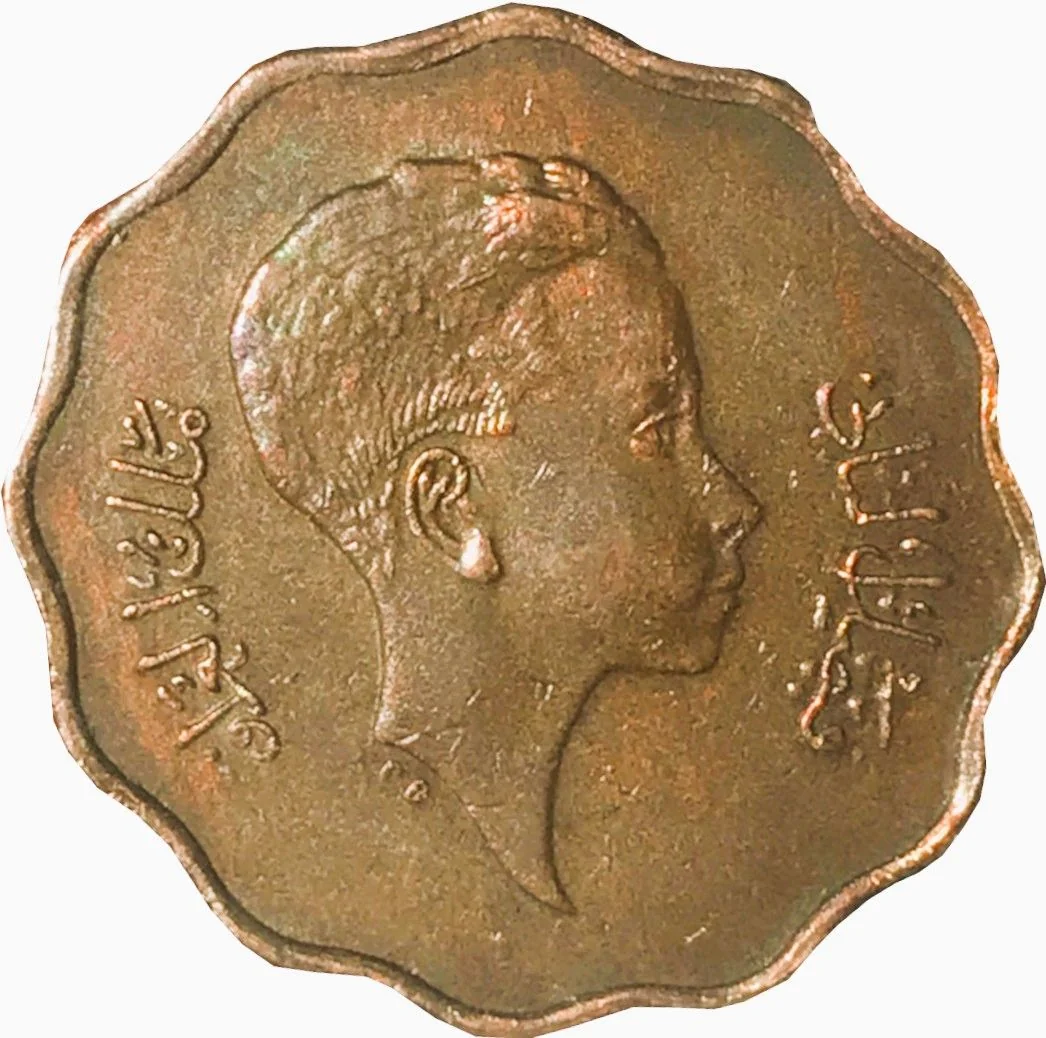
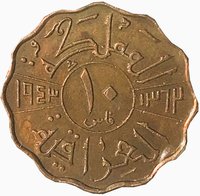
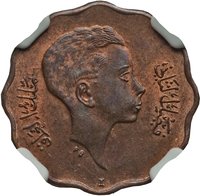
Inscription:
فيصل الثاني
ملك العراق
ملك العراق
Translation:
Faisal the Second
King of Iraq
King of Iraq
Script: Arabic
Language: Arabic
Engraver: Patrick Brindley
Reverse
Edge
Plain
Mints
| Name | Mark |
|---|---|
| Mumbai / Bombay | I |
Mintings
| Year | Mint Mark | Mintage | Quality | Collection |
|---|---|---|---|---|
| 1943 | — | 1,500,000 |
Historical background
In 1943, the Hashemite Kingdom of Jordan was still in its formative years, operating under the British Mandate for Palestine and Transjordan. As a result, it did not possess an independent national currency. The official legal tender was the Palestinian pound (₤P), a currency issued by the Palestine Currency Board in London. This board maintained a strict currency board system, pegging the Palestinian pound at par with the British pound sterling and fully backing it with sterling reserves held in London. This arrangement provided monetary stability but offered Transjordan no control over its own monetary policy, tying its economy directly to British fiscal priorities.
The currency in circulation was a practical reflection of the region's complex political landscape. Banknotes featured inscriptions in English, Arabic, and Hebrew, serving the wider Mandate territory. Alongside these notes, British gold sovereigns and Egyptian coins were also commonly used in daily transactions, illustrating the area's economic integration with the broader Middle East and the British Empire. This monetary system functioned adequately for a largely agrarian and pastoral economy, where major financial transactions and government expenditures were heavily reliant on British subsidies and administration.
This dependent currency situation underscored Transjordan's transitional status in 1943. While the Emirate had gained a measure of administrative autonomy, its economic sovereignty remained constrained. The use of the Mandate's currency was a tangible symbol of the pending questions of full statehood and independence, which would be resolved only after World War II. The establishment of a distinct Jordanian dinar would not occur until a decade later, in 1949, following the kingdom's full independence in 1946.
The currency in circulation was a practical reflection of the region's complex political landscape. Banknotes featured inscriptions in English, Arabic, and Hebrew, serving the wider Mandate territory. Alongside these notes, British gold sovereigns and Egyptian coins were also commonly used in daily transactions, illustrating the area's economic integration with the broader Middle East and the British Empire. This monetary system functioned adequately for a largely agrarian and pastoral economy, where major financial transactions and government expenditures were heavily reliant on British subsidies and administration.
This dependent currency situation underscored Transjordan's transitional status in 1943. While the Emirate had gained a measure of administrative autonomy, its economic sovereignty remained constrained. The use of the Mandate's currency was a tangible symbol of the pending questions of full statehood and independence, which would be resolved only after World War II. The establishment of a distinct Jordanian dinar would not occur until a decade later, in 1949, following the kingdom's full independence in 1946.
🌟 Uncommon