

50 Korun (Slovak Uprising) – Czechoslovakia
Non-circulating coins
Commemoration: 3rd Anniversary - Slovak Uprising
Context
Year: 1947
Issuer: Czechoslovakia 
Period:
(1945—1948)
Currency:
(1945—1953)
Demonetization: 30 May 1953
Total mintage: 1,000,000
Material
References
KM: #Click to copy to clipboard24
Numista: #12634
Value
Bullion value: $14.30
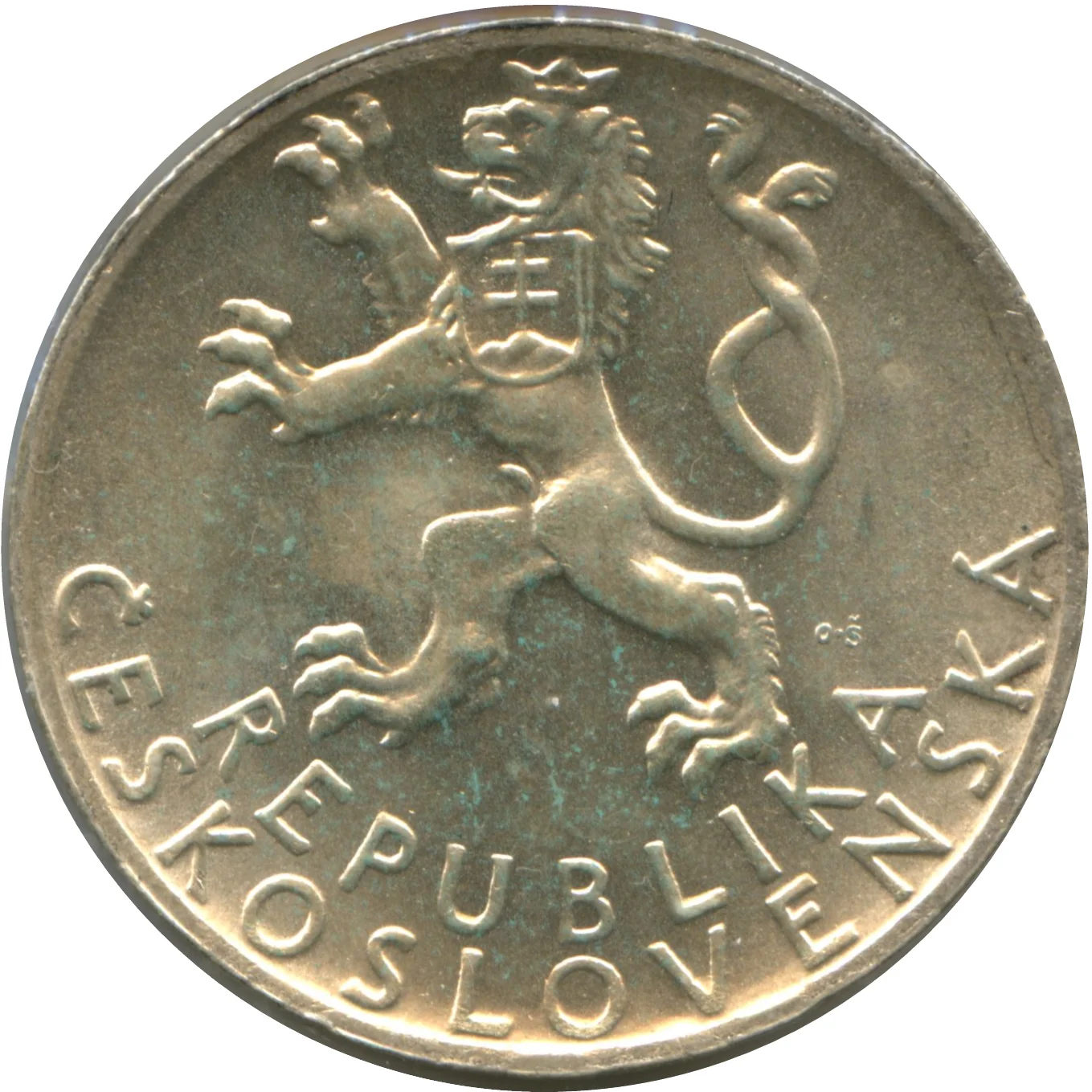
Obverse
Description:
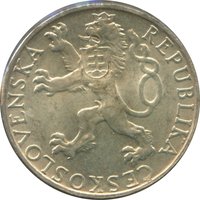
Czech lion bearing Slovak shield.
Inscription:
REPUBLIKA ČESKOSLOVENSKÁ
O · Š
O · Š
Translation:
REPUBLIC OF CZECHOSLOVAKIA
O · Š
O · Š
Script: Latin
Engraver: Otakar Španiel
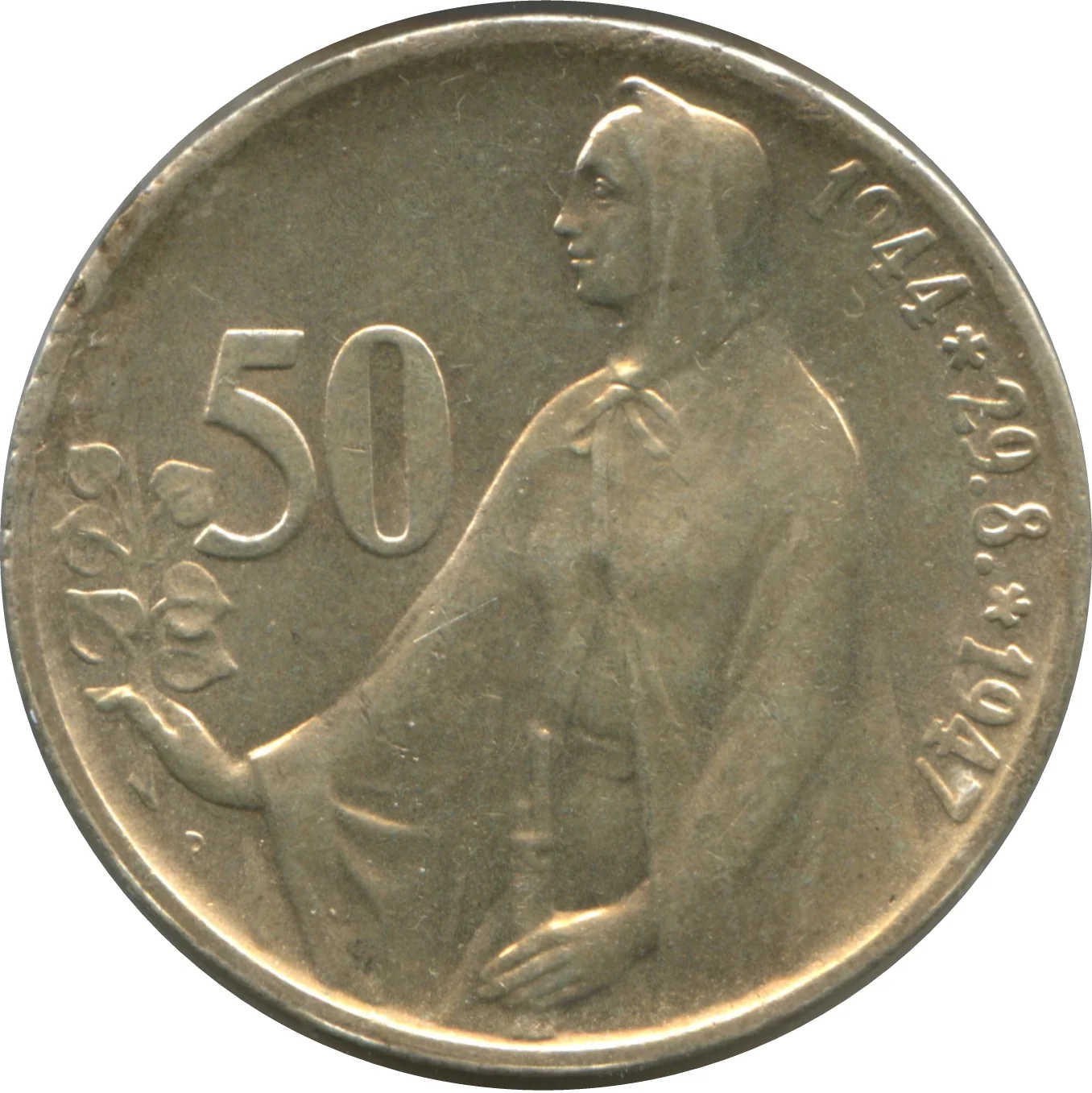
Reverse
Description:
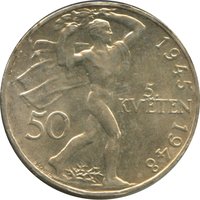
Veiled woman with a linden sprig and a gun.
Inscription:
1944*29.8.*1947
50
P
50
P
Script: Latin
Engraver: Rudolf Pribiš
Edge
Plain with stars and waves.
Mintings
| Year | Mint Mark | Mintage | Quality | Collection |
|---|---|---|---|---|
| 1947 | — | 1,000,000 |
Historical background
In the aftermath of World War II, Czechoslovakia in 1947 faced a severe and multifaceted currency crisis that threatened its post-war recovery and political stability. The core of the problem was a massive monetary overhang: a vast amount of occupation currency (Reichsmarks and Protectorate crowns) circulated alongside pre-war and resistance-issued notes, leading to rampant inflation, a crippling black market, and a severe erosion of public confidence in the koruna. The government's initial attempts at a limited currency reform in 1945 had been insufficient, failing to mop up excess liquidity while simultaneously fueling social discontent by unevenly penalizing certain groups.
Economically, the situation was exacerbated by the devastating physical damage of the war, the loss of traditional export markets, and a painful transition to a centrally planned economy under growing Soviet influence. Shortages of basic consumer goods were widespread, and the official prices and rationing system were increasingly circumvented by a black market where goods traded for multiples of their state-set price. This created a dual economic reality that undermined state planning and rewarded hoarding and speculation, further straining the social fabric.
Politically, the currency chaos became a key battleground in the escalating struggle between democratic and communist forces within the governing National Front. The Communist Party, holding the crucial Ministry of Finance, strategically delayed a comprehensive reform while blaming capitalist "speculators" and "reactionaries" for the economic distress. This crisis atmosphere was deliberately leveraged to argue for more radical state control of the economy. Thus, by late 1947, the unresolved monetary situation was not merely an economic issue but a potent political tool, setting the stage for the communist coup in February 1948, after which a harsh, confiscatory currency reform was swiftly implemented to consolidate their power.
Economically, the situation was exacerbated by the devastating physical damage of the war, the loss of traditional export markets, and a painful transition to a centrally planned economy under growing Soviet influence. Shortages of basic consumer goods were widespread, and the official prices and rationing system were increasingly circumvented by a black market where goods traded for multiples of their state-set price. This created a dual economic reality that undermined state planning and rewarded hoarding and speculation, further straining the social fabric.
Politically, the currency chaos became a key battleground in the escalating struggle between democratic and communist forces within the governing National Front. The Communist Party, holding the crucial Ministry of Finance, strategically delayed a comprehensive reform while blaming capitalist "speculators" and "reactionaries" for the economic distress. This crisis atmosphere was deliberately leveraged to argue for more radical state control of the economy. Thus, by late 1947, the unresolved monetary situation was not merely an economic issue but a potent political tool, setting the stage for the communist coup in February 1948, after which a harsh, confiscatory currency reform was swiftly implemented to consolidate their power.
🌱 Common