

20 korun – Czechoslovakia
Add to wishlist
Non-circulating coins
Commemoration: Centennial - Death of Andrej Sladkovic
Context
Year: 1972
Issuer: Czechoslovakia
Period:
(1960—1990)
Currency:
(1953—1992)
Demonetization: 30 September 2000
Total mintage: 60,000
Material
References
KM: #
Numista: #12631
Value
Exchange value: 20 CSK
Bullion value: $11.48
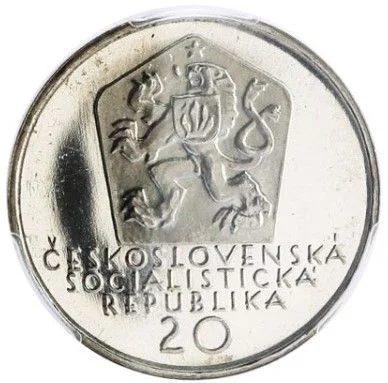
Obverse
Description:
Socialist coat of arms with state name and value below.
Inscription:
ČESKOSLOVENSKÁ SOCIALISTICKÁ REPUBLIKA
20
20
Translation:
Czechoslovak Socialist Republic
20
20
Script: Latin
Engraver: Ján Kulich
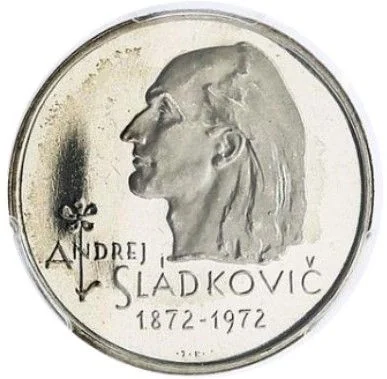
Reverse
Description:
Portrait of Andrej Sladkovič.
Inscription:
ANDREJ SLADKOVIČ
1872 - 1972
1872 - 1972
Translation:
Andrej Sládkovič
1872 - 1972
1872 - 1972
Script: Latin
Language: Slovak
Engraver: Ján Kulich
Edge
Smooth with waves and crosses
Mintings
| Year | Mint Mark | Mintage | Quality | Collection |
|---|---|---|---|---|
| 1972 | — | 55,000 | ||
| 1972 | — | 5,000 | Proof | |
| 1972 | — | — | BU |
Historical background
In 1972, Czechoslovakia operated under a rigid, centrally planned economy where the Czechoslovak koruna (Kčs) was a non-convertible "soft" currency. Its value and exchange were entirely controlled by the state, with an official rate set artificially high for political prestige, bearing little relation to its real purchasing power or market value. Internally, this meant chronic shortages of consumer goods, as price controls and state subsidies distorted the economy, while externally, it severely limited foreign trade with Western market economies due to a lack of hard currency reserves.
A critical feature of the monetary landscape was the existence of a separate, parallel currency system designed to extract hard currency from foreign visitors and privileged citizens. The Tuzex voucher system, established in the 1950s, allowed individuals to purchase Western goods and select high-quality domestic products in special stores using vouchers bought for hard currencies like US Dollars or Deutsche Marks. This created a two-tiered society where access to desirable goods was dependent on access to foreign currency, often through remittances from relatives abroad or work in tourism, highlighting the koruna's domestic weakness.
The currency situation in 1972 was a direct reflection of the broader economic stagnation of the "Normalization" period following the 1968 Prague Spring. The state's priority was political control and maintaining heavy industry, not monetary reform or market mechanisms. Consequently, the black market for hard currency thrived, offering a more realistic exchange rate and further undermining the official economy. This unsustainable system, which insulated the country from global markets while creating internal inequalities, would persist without fundamental change until the Velvet Revolution of 1989.
A critical feature of the monetary landscape was the existence of a separate, parallel currency system designed to extract hard currency from foreign visitors and privileged citizens. The Tuzex voucher system, established in the 1950s, allowed individuals to purchase Western goods and select high-quality domestic products in special stores using vouchers bought for hard currencies like US Dollars or Deutsche Marks. This created a two-tiered society where access to desirable goods was dependent on access to foreign currency, often through remittances from relatives abroad or work in tourism, highlighting the koruna's domestic weakness.
The currency situation in 1972 was a direct reflection of the broader economic stagnation of the "Normalization" period following the 1968 Prague Spring. The state's priority was political control and maintaining heavy industry, not monetary reform or market mechanisms. Consequently, the black market for hard currency thrived, offering a more realistic exchange rate and further undermining the official economy. This unsustainable system, which insulated the country from global markets while creating internal inequalities, would persist without fundamental change until the Velvet Revolution of 1989.
🌟 Uncommon