

20 Korun / Korún – Czechoslovakia
Circulating commemorative coins
Commemoration: Death of President Masaryk
Context
Year: 1937
Issuer: Czechoslovakia 
Period:
(1918—1938)
Currency:
(1919—1939)
Demonetized: Yes
Total mintage: 1,000,000
Material
References
KM: #Click to copy to clipboard18
Numista: #12630
Value
Bullion value: $24.22
Obverse
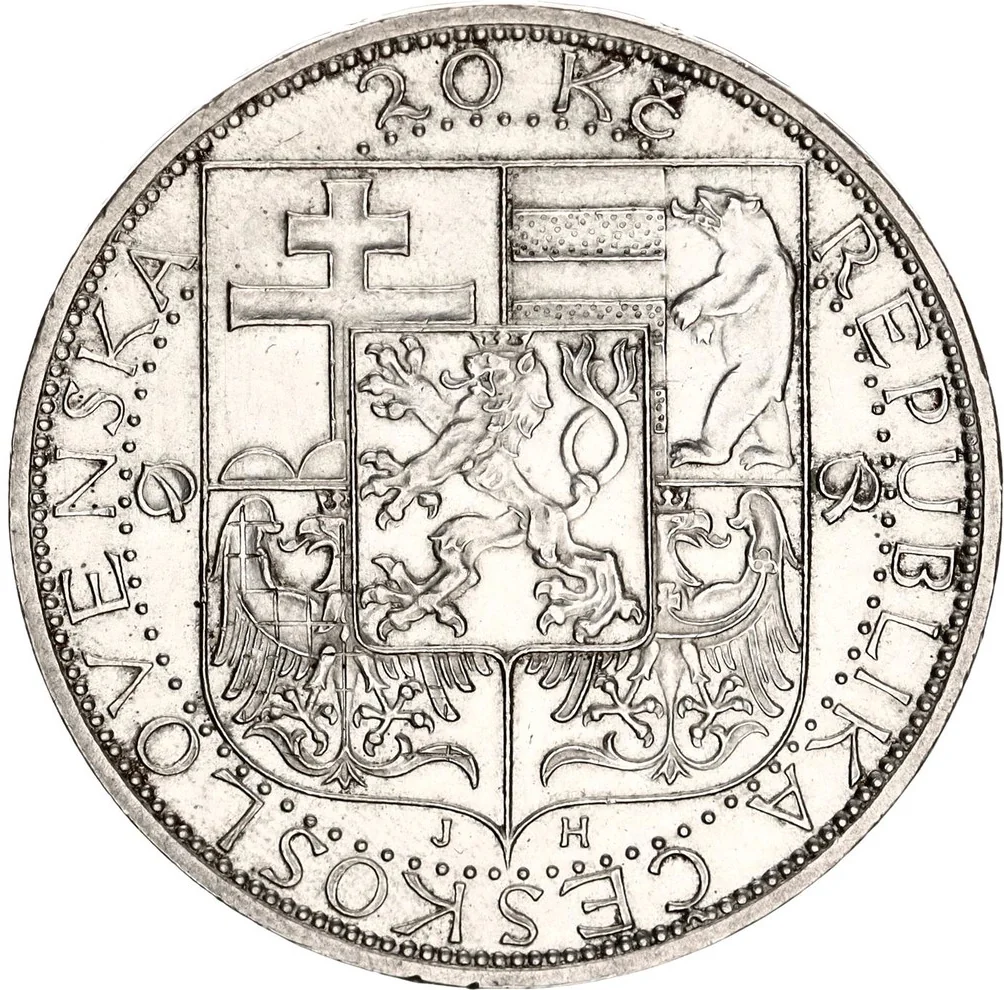
Description:
State emblem with encircling lettering.
Inscription:
REPUBLIKA ČESKOSLOVENSKÁ 20 Kč
J H
J H
Translation:
REPUBLIC OF CZECHOSLOVAKIA 20 Kč
J H
J H
Script: Latin
Engraver: Jaroslav Horejc
Reverse
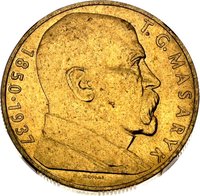
Description:
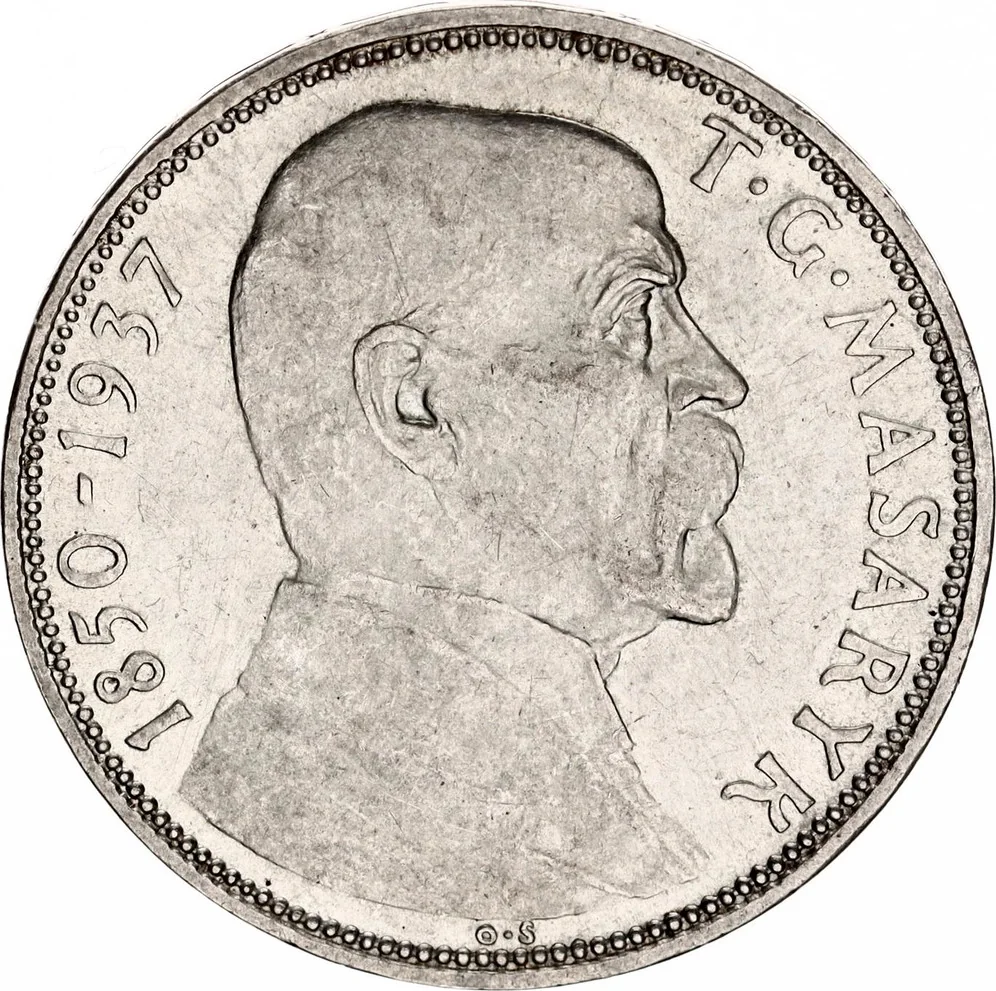
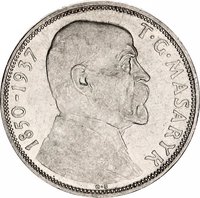
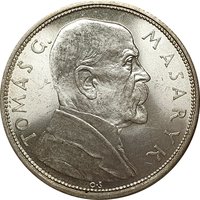
President Masaryk bust (right)
Inscription:
T٠G٠MASARYK
1850-1937
O·Š
1850-1937
O·Š
Translation:
T. G. Masaryk
1850-1937
Founder of the State
1850-1937
Founder of the State
Script: Latin
Language: Czech
Engraver: Otakar Španiel
Edge
Plain with crosses and waves
Legend:
~x~
Mints
| Name | Mark |
|---|---|
| Kremnica | — |
Mintings
| Year | Mint Mark | Mintage | Quality | Collection |
|---|---|---|---|---|
| 1937 | — | 1,000,000 |
Historical background
In 1937, the currency situation in Czechoslovakia was one of relative stability and strength, especially when compared to the turbulent economies of many of its European neighbours. The Czechoslovak koruna (Kč), established upon the country's founding in 1919, was a symbol of the First Republic's economic resilience and prudent fiscal management. Backed by substantial gold and foreign exchange reserves managed by the National Bank of Czechoslovakia, the koruna was a fully convertible "hard currency" with a fixed exchange rate under the gold standard. This discipline fostered significant foreign investment, particularly from France and Britain, and made Czechoslovakia a leading industrial exporter in Central Europe.
However, this stability existed under growing political and economic shadows. The Great Depression had hit the country's export-oriented industries hard, particularly in the predominantly German-speaking Sudetenland, fuelling ethnic tensions exploited by Nazi Germany. While the central bank successfully defended the koruna's parity, it came at the cost of deflationary pressure and higher unemployment in certain regions. Furthermore, the government's substantial military spending from 1936 onward to counter the rising German threat began to strain public finances, though not yet critically impacting the currency's external value.
Ultimately, the soundness of the koruna in 1937 was a testament to Prague's strong institutions, but it was increasingly vulnerable to external political forces beyond its control. The currency's fate was inextricably linked to the republic's territorial integrity. The Munich Agreement of September 1938 and the subsequent dismemberment of the state would shatter the economic foundations, leading to the separation of the Slovak and Bohemian-Moravian currencies and the end of the resilient koruna as it had existed in 1937.
However, this stability existed under growing political and economic shadows. The Great Depression had hit the country's export-oriented industries hard, particularly in the predominantly German-speaking Sudetenland, fuelling ethnic tensions exploited by Nazi Germany. While the central bank successfully defended the koruna's parity, it came at the cost of deflationary pressure and higher unemployment in certain regions. Furthermore, the government's substantial military spending from 1936 onward to counter the rising German threat began to strain public finances, though not yet critically impacting the currency's external value.
Ultimately, the soundness of the koruna in 1937 was a testament to Prague's strong institutions, but it was increasingly vulnerable to external political forces beyond its control. The currency's fate was inextricably linked to the republic's territorial integrity. The Munich Agreement of September 1938 and the subsequent dismemberment of the state would shatter the economic foundations, leading to the separation of the Slovak and Bohemian-Moravian currencies and the end of the resilient koruna as it had existed in 1937.
🌱 Common