

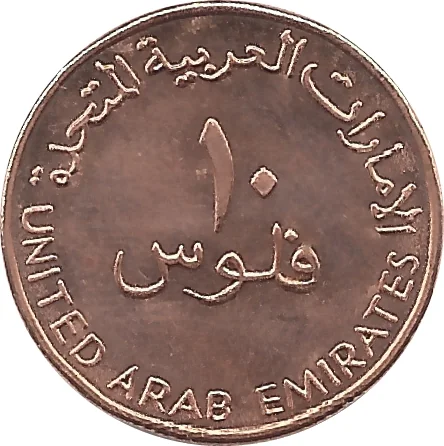
10 Fils – United Arab Emirates
United Arab Emirates
Context
Years: 2017–2018
Issuer: United Arab Emirates 
Ruler: Khalifa bin Zayed Al Nahyan
Currency:
(since 1973)
Material
References
Numista: #125915
Value
Exchange value: 0.10 AED
Obverse
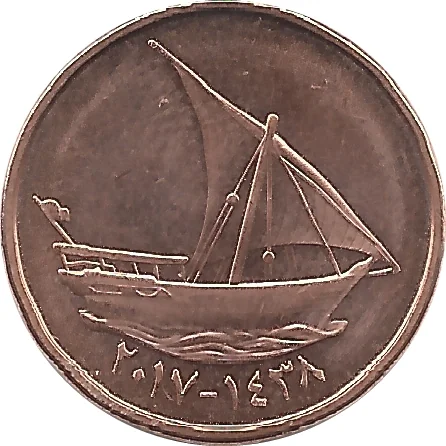
Reverse
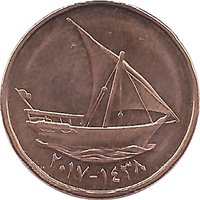
Description:
Dhow, dates follow
Inscription:
١٤٣٨-٢٠١٧
Translation:
1438-2017
Script: Arabic
Language: Arabic
Engraver: Geoffrey Colley
Edge
Plain
Categories
| Transportation> Watercraft |
Mintings
| Year | Mint Mark | Mintage | Quality | Collection |
|---|---|---|---|---|
| 2017 | — | — | ||
| 2018 | — | — |
Historical background
In 2017, the currency situation in the United Arab Emirates was characterized by stability and predictability, underpinned by the UAE Dirham's (AED) long-standing peg to the US Dollar. This fixed exchange rate regime, established in 1997, set the value at approximately AED 3.6725 per USD. This policy provided a crucial anchor for the economy, fostering confidence among international investors and businesses by eliminating foreign exchange risk for trade and investment flows denominated in dollars. It also provided stability for a population where expatriates comprise the majority, facilitating remittances.
The year saw the dirham's peg indirectly influenced by US Federal Reserve monetary policy. As the Fed continued its path of interest rate hikes begun in 2015, the UAE Central Bank, in lockstep, raised its key interest rates to maintain the currency peg's credibility. This alignment was necessary to prevent capital outflows but also increased borrowing costs within the domestic economy. While the strong dollar-linked dirham benefited importers and kept inflation relatively low, it posed a mild challenge to export competitiveness and tourism from regions with weaker currencies against the dollar.
Furthermore, 2017 was a year of strategic foresight regarding currency infrastructure. While the peg itself was never in doubt, the UAE, alongside Saudi Arabia, was actively laying the groundwork for a potential unified digital currency for cross-border banking transactions between Gulf Cooperation Council (GCC) countries. This exploration, alongside the ongoing development of Dubai as a global fintech hub, indicated a forward-looking approach to financial systems, even as the traditional fiat currency regime remained firmly and successfully fixed to the US dollar.
The year saw the dirham's peg indirectly influenced by US Federal Reserve monetary policy. As the Fed continued its path of interest rate hikes begun in 2015, the UAE Central Bank, in lockstep, raised its key interest rates to maintain the currency peg's credibility. This alignment was necessary to prevent capital outflows but also increased borrowing costs within the domestic economy. While the strong dollar-linked dirham benefited importers and kept inflation relatively low, it posed a mild challenge to export competitiveness and tourism from regions with weaker currencies against the dollar.
Furthermore, 2017 was a year of strategic foresight regarding currency infrastructure. While the peg itself was never in doubt, the UAE, alongside Saudi Arabia, was actively laying the groundwork for a potential unified digital currency for cross-border banking transactions between Gulf Cooperation Council (GCC) countries. This exploration, alongside the ongoing development of Dubai as a global fintech hub, indicated a forward-looking approach to financial systems, even as the traditional fiat currency regime remained firmly and successfully fixed to the US dollar.
🌱 Fairly Common