


200 Euro – France
Non-circulating coins
Commemoration: G20 Summit in Cannes, France, November 3-4, 2011.
France
Obverse
Description:
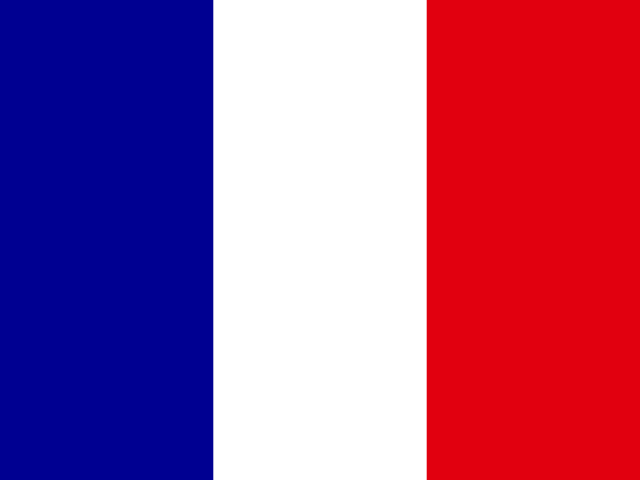
Barefoot, the Sower walks toward the sun on the right, its light filling the room and illuminating the Eiffel Tower (G20 symbol) amid flying stars. To her left, the text reads "G20 FRANCE 2011".
Inscription:
G20 FRANCE 2011
RF
RF
Translation:
G20 FRANCE 2011
RF
RF
Script: Latin
Engraver: Joaquin Jimenez
Reverse
Description:
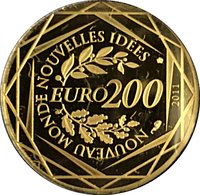
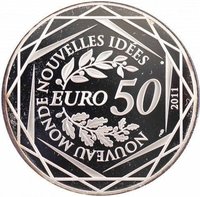
"200 EURO" flanked by oak and laurel branches (evoking the euro's initials). The G20 motto "NEW WORLD NEW IDEAS" and year 2011 are encircled by lines forming a hexagon.
Inscription:
NOUVEAU MONDE NOUVELLES IDÉES
EURO 200
2011
EURO 200
2011
Translation:
New World New Ideas
Euro 200
2011
Euro 200
2011
Script: Latin
Language: French
Engraver: Joaquin Jimenez
Edge
Mints
| Name | Mark |
|---|---|
| Monnaie de Paris | — |
Mintings
| Year | Mint Mark | Mintage | Quality | Collection |
|---|---|---|---|---|
| 2011 | — | 100 |
Historical background
In 2011, France was a core member of the Eurozone, having adopted the euro as its physical currency nearly a decade earlier in 2002. The country was therefore fully integrated into the monetary policy framework of the European Central Bank (ECB), which set interest rates for the entire bloc. Domestically, the primary economic concerns were not about a national currency but about sovereign debt, sluggish growth, and rising unemployment, which placed pressure on the government of President Nicolas Sarkozy to implement austerity measures while trying to stimulate the economy.
The broader Eurozone context, however, defined France's currency situation. The year was dominated by the escalating sovereign debt crisis, with Greece, Ireland, and Portugal requiring international bailouts. Intense market speculation swirled around the survival of the euro itself, and France found itself under scrutiny due to its large banking sector's exposure to debt from peripheral European nations and its own rising public debt levels. A significant moment came in late 2011 when credit rating agencies warned of a potential downgrade of France's prized AAA credit rating, threatening its status as a core pillar of the monetary union and increasing its borrowing costs.
Consequently, France's monetary position was one of constrained sovereignty. While the euro provided stability against currency speculation targeting France directly, it also meant Paris had no independent lever to devalue its currency to boost competitiveness. French policy was thus focused on European-level crisis management, advocating for stronger EU financial firewalls and greater fiscal coordination, while domestically attempting to reduce its budget deficit to meet Eurozone rules and defend its credit rating amidst a worsening economic outlook.
The broader Eurozone context, however, defined France's currency situation. The year was dominated by the escalating sovereign debt crisis, with Greece, Ireland, and Portugal requiring international bailouts. Intense market speculation swirled around the survival of the euro itself, and France found itself under scrutiny due to its large banking sector's exposure to debt from peripheral European nations and its own rising public debt levels. A significant moment came in late 2011 when credit rating agencies warned of a potential downgrade of France's prized AAA credit rating, threatening its status as a core pillar of the monetary union and increasing its borrowing costs.
Consequently, France's monetary position was one of constrained sovereignty. While the euro provided stability against currency speculation targeting France directly, it also meant Paris had no independent lever to devalue its currency to boost competitiveness. French policy was thus focused on European-level crisis management, advocating for stronger EU financial firewalls and greater fiscal coordination, while domestically attempting to reduce its budget deficit to meet Eurozone rules and defend its credit rating amidst a worsening economic outlook.

✨ Legendary