

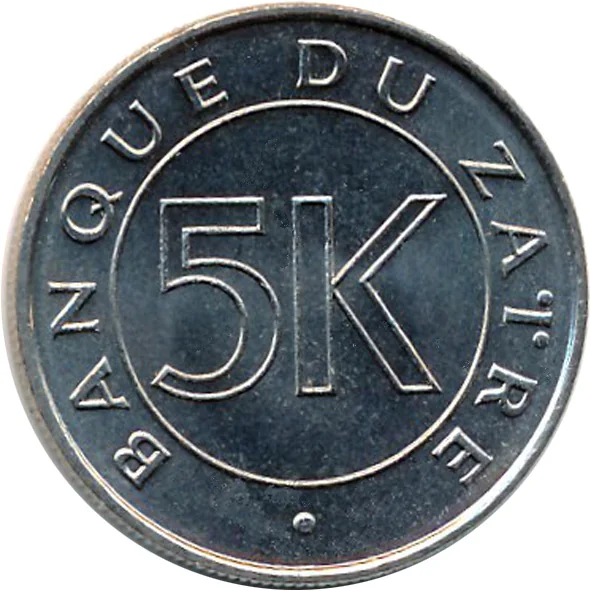
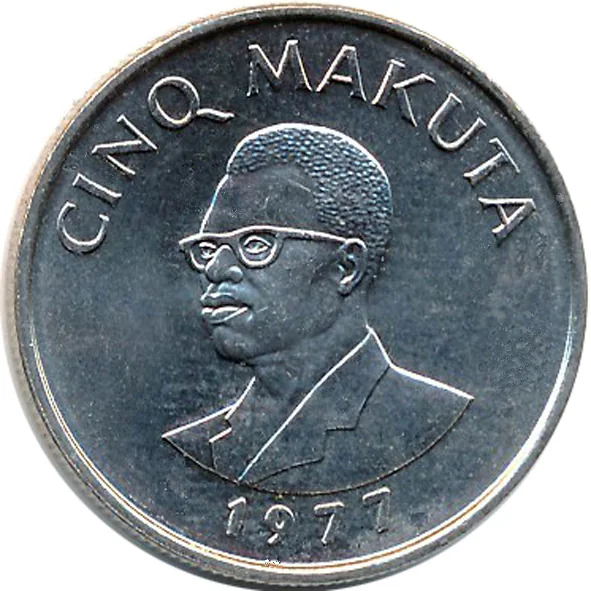
5 makuta – Zaire
Add to wishlist
Democratic Republic of the Congo
Context
Year: 1977
Country: Democratic Republic of the Congo
Issuer: Zaire
Issuing organization: Bank of Zaire
Period:
(1971—1997)
Currency:
(1967—1993)
Demonetized: Yes
Total mintage: 8,000,000
Material
Diameter: 25 mm
Weight: 6.5 g
Shape: Round
Composition: Copper-nickel
Technique: Milled
Alignment: Coin alignment
flip
References
KM: #
Numista: #12539
Value
Exchange value: 0.05 ZRZ
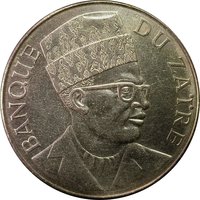
Obverse
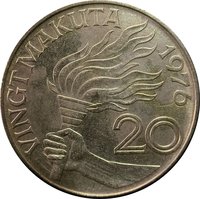
Reverse
Edge
Reeded
Mints
| Name | Mark |
|---|---|
| Munich | — |
Mintings
| Year | Mint Mark | Mintage | Quality | Collection |
|---|---|---|---|---|
| 1977 | — | 8,000,000 |
Historical background
By 1977, the currency situation in Zaire (now the Democratic Republic of the Congo) was a critical symptom of the nation's profound economic and political decay under President Mobutu Sese Seko. The official currency, the zaire, was in a state of hyperinflationary collapse, having lost both its domestic purchasing power and all international confidence. This crisis was driven by decades of extreme mismanagement, including the wholesale nationalization of foreign-owned businesses (Zairianization), rampant corruption that diverted state resources, and massive printing of money to cover fiscal deficits, all while the country's mineral-rich productive capacity crumbled.
The practical consequences were severe for the population. A thriving black market for foreign currency, especially US dollars, operated openly in major cities, with exchange rates vastly different from the meaningless official rate set by the Banque du Zaïre. Salaries paid in rapidly depreciating zaires became worthless within days, forcing citizens to engage in barter or spend hours in queues for basic goods. The government's attempts at reform, including a redenomination in 1967 and periodic price controls, were superficial and failed to address the root causes of state plunder and industrial decline.
This monetary chaos unfolded against a backdrop of regional conflict, most notably the Shaba I invasion in March 1977, which further destabilized the copper-rich region vital to the economy. The crisis forced Mobutu to seek international bailouts, particularly from the International Monetary Fund (IMF), which demanded austerity and currency devaluation in exchange for loans. However, these measures provided only temporary relief, as the underlying kleptocratic system remained intact, ensuring that the zaire's downward spiral would continue throughout the 1980s and culminate in the country's complete economic breakdown.
The practical consequences were severe for the population. A thriving black market for foreign currency, especially US dollars, operated openly in major cities, with exchange rates vastly different from the meaningless official rate set by the Banque du Zaïre. Salaries paid in rapidly depreciating zaires became worthless within days, forcing citizens to engage in barter or spend hours in queues for basic goods. The government's attempts at reform, including a redenomination in 1967 and periodic price controls, were superficial and failed to address the root causes of state plunder and industrial decline.
This monetary chaos unfolded against a backdrop of regional conflict, most notably the Shaba I invasion in March 1977, which further destabilized the copper-rich region vital to the economy. The crisis forced Mobutu to seek international bailouts, particularly from the International Monetary Fund (IMF), which demanded austerity and currency devaluation in exchange for loans. However, these measures provided only temporary relief, as the underlying kleptocratic system remained intact, ensuring that the zaire's downward spiral would continue throughout the 1980s and culminate in the country's complete economic breakdown.
🌱 Common