

1 Tögrög (Karl Marx) – Mongolia
Circulating commemorative coins
Commemoration: 170th Anniversary of Karl Marx
Mongolia
Context
Material
Diameter: 32 mm
Weight: 14.9 g
Shape: Round
Composition: Aluminium bronze
Magnetic: No
Technique: Milled
Alignment: Medal alignment
flip
References
KM: #Click to copy to clipboard52
Numista: #12533
Value
Exchange value: 1 MNT
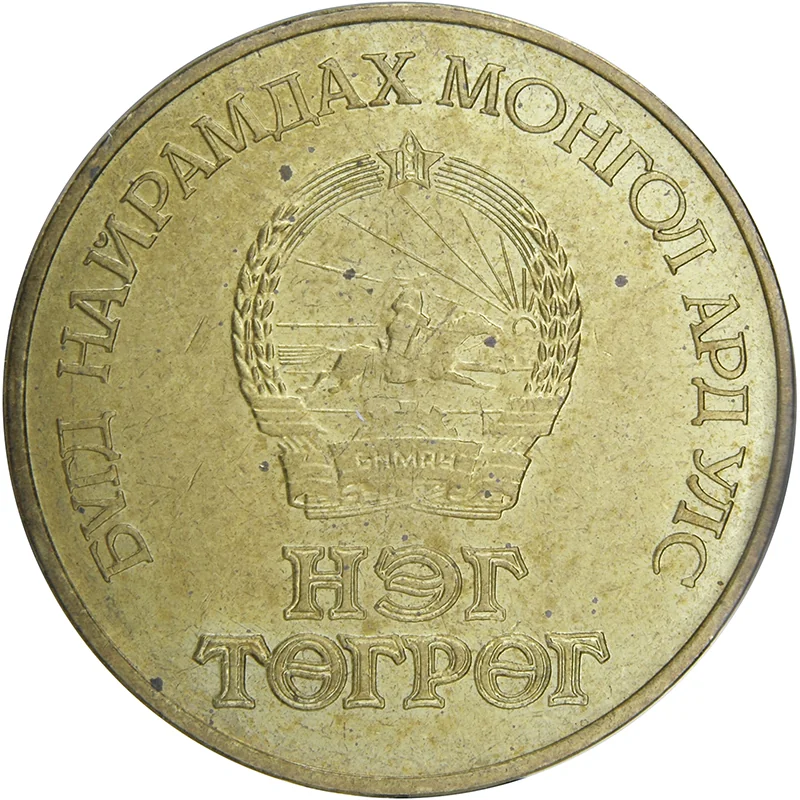
Obverse
Description:
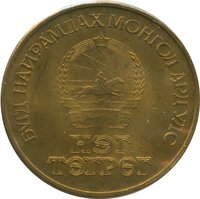
People's Republic of Mongolia emblem (1960–1992).
Inscription:
БҮГД НАЙРАМДАХ МОНГОЛ АРД УЛС
НЭГ
ТӨГРӨГ
НЭГ
ТӨГРӨГ
Translation:
PEOPLE'S REPUBLIC OF MONGOLIA
ONE
TÖGRÖG
ONE
TÖGRÖG
Language: Mongolian
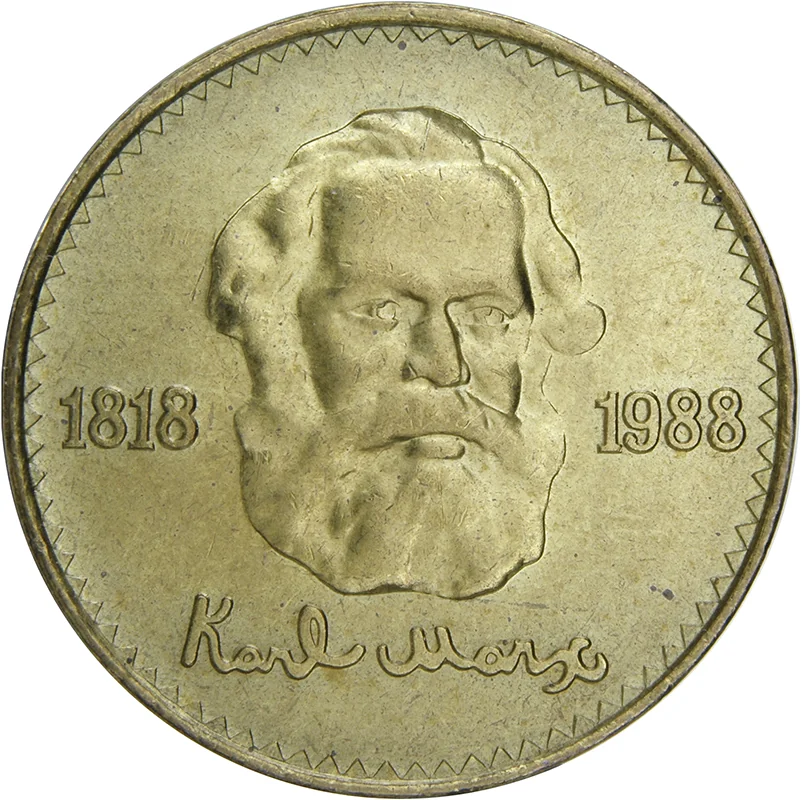
Reverse
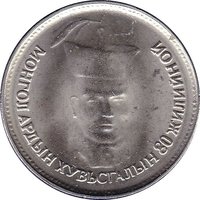
Description:
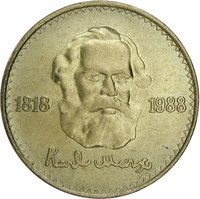
Portrait of Karl Marx.
Inscription:
1818 1988
Karl Marx
Karl Marx
Edge
Smooth with inscription
Mintings
| Year | Mint Mark | Mintage | Quality | Collection |
|---|---|---|---|---|
| 1988 | — | — |
Historical background
In 1988, Mongolia's currency situation was fundamentally defined by its status as a satellite state of the Soviet Union within the Council for Mutual Economic Assistance (COMECON). The national currency, the tögrög (MNT), was a non-convertible administrative instrument with an official exchange rate set artificially high by the state, bearing little relation to its actual economic value. Internally, prices for essential goods and services were heavily subsidized and controlled, while externally, the tögrög's value was pegged to the Soviet ruble at a fixed rate of 1.3 tögrög to 1 ruble. This system facilitated planned trade, with the vast majority of Mongolia's commerce—over 90%—conductively with the USSR and other communist bloc countries, using transferable rubles for accounting rather than hard currency.
However, this stability was superficial and masked growing economic strains. The Mongolian economy was almost entirely dependent on Soviet subsidies, which by the late 1980s were estimated to comprise up to one-third of the state budget. The rigid command economy suffered from inefficiencies, declining productivity, and a growing mismatch between supply and consumer demand. While there was no open inflation due to price controls, latent inflationary pressures manifested as chronic shortages of goods, a burgeoning black market, and a widening gap between the official exchange rate and the currency's real purchasing power. The tögrög in practice existed in a dual system: the artificial official rate for state planning and a far weaker implicit market rate for illicit transactions.
The year 1988 fell within the early period of Mikhail Gorbachev's reforms in the USSR, which had profound implications for Mongolia. As the Soviet Union began to reduce its foreign aid and push for economic restructuring (perestroika), the foundations of Mongolia's monetary system started to erode. Mongolian leadership, under Jambyn Batmönkh, cautiously initiated its own version of reform (ögsölt öörchlölt), but the currency regime remained unchanged. Consequently, 1988 represents the final phase of a stagnant but stable planned monetary system, immediately preceding the severe economic shock and hyperinflation that would follow the abrupt withdrawal of Soviet support in the early 1990s, forcing a painful transition to a market-based currency.
However, this stability was superficial and masked growing economic strains. The Mongolian economy was almost entirely dependent on Soviet subsidies, which by the late 1980s were estimated to comprise up to one-third of the state budget. The rigid command economy suffered from inefficiencies, declining productivity, and a growing mismatch between supply and consumer demand. While there was no open inflation due to price controls, latent inflationary pressures manifested as chronic shortages of goods, a burgeoning black market, and a widening gap between the official exchange rate and the currency's real purchasing power. The tögrög in practice existed in a dual system: the artificial official rate for state planning and a far weaker implicit market rate for illicit transactions.
The year 1988 fell within the early period of Mikhail Gorbachev's reforms in the USSR, which had profound implications for Mongolia. As the Soviet Union began to reduce its foreign aid and push for economic restructuring (perestroika), the foundations of Mongolia's monetary system started to erode. Mongolian leadership, under Jambyn Batmönkh, cautiously initiated its own version of reform (ögsölt öörchlölt), but the currency regime remained unchanged. Consequently, 1988 represents the final phase of a stagnant but stable planned monetary system, immediately preceding the severe economic shock and hyperinflation that would follow the abrupt withdrawal of Soviet support in the early 1990s, forcing a painful transition to a market-based currency.
🌟 Uncommon