

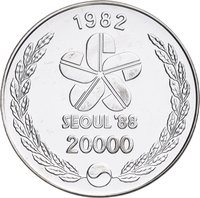
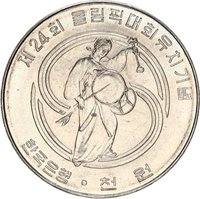
20000 Won – South Korea
Non-circulating coins
Commemoration: 1988 Olympic Games
South Korea
Context
Material
References
KM: #Click to copy to clipboard30
Numista: #125192
Value
Exchange value: 20000 KRW = $14.03
Bullion value: $58.84
Inflation-adjusted value: 91076.00 KRW
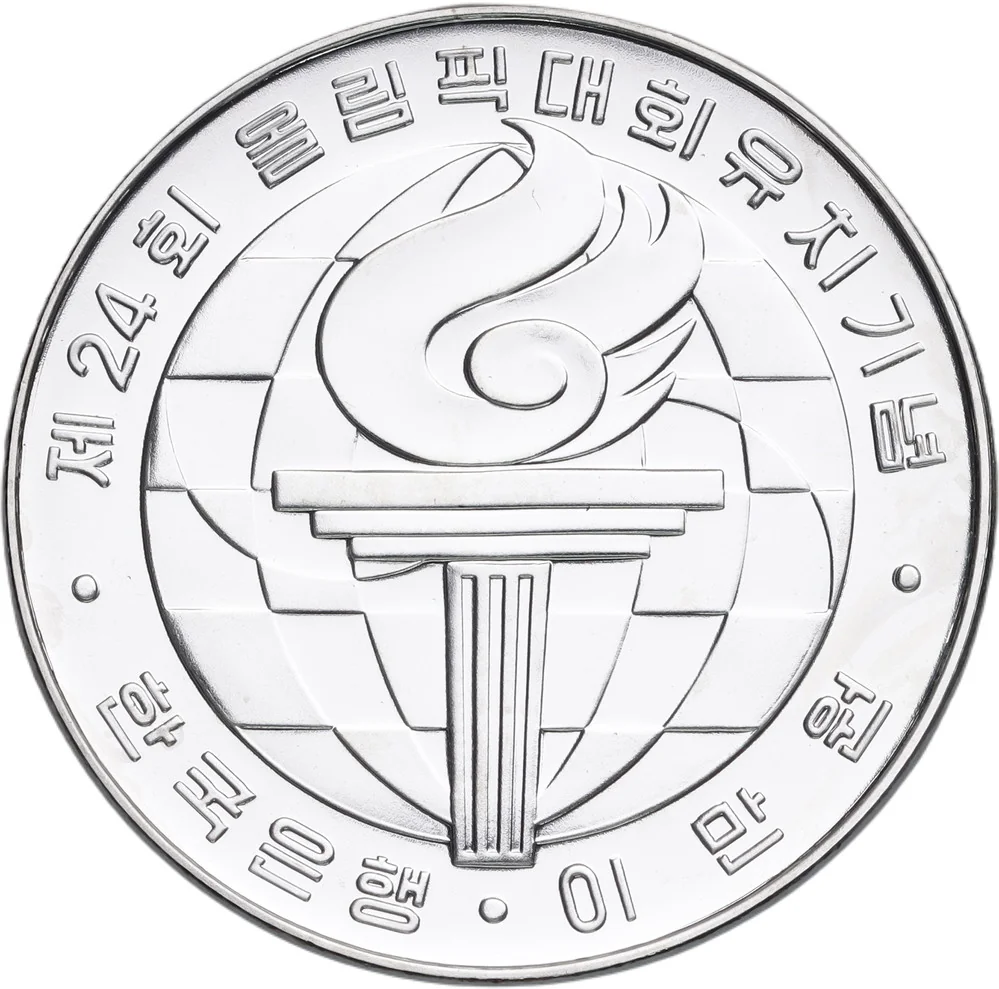
Obverse
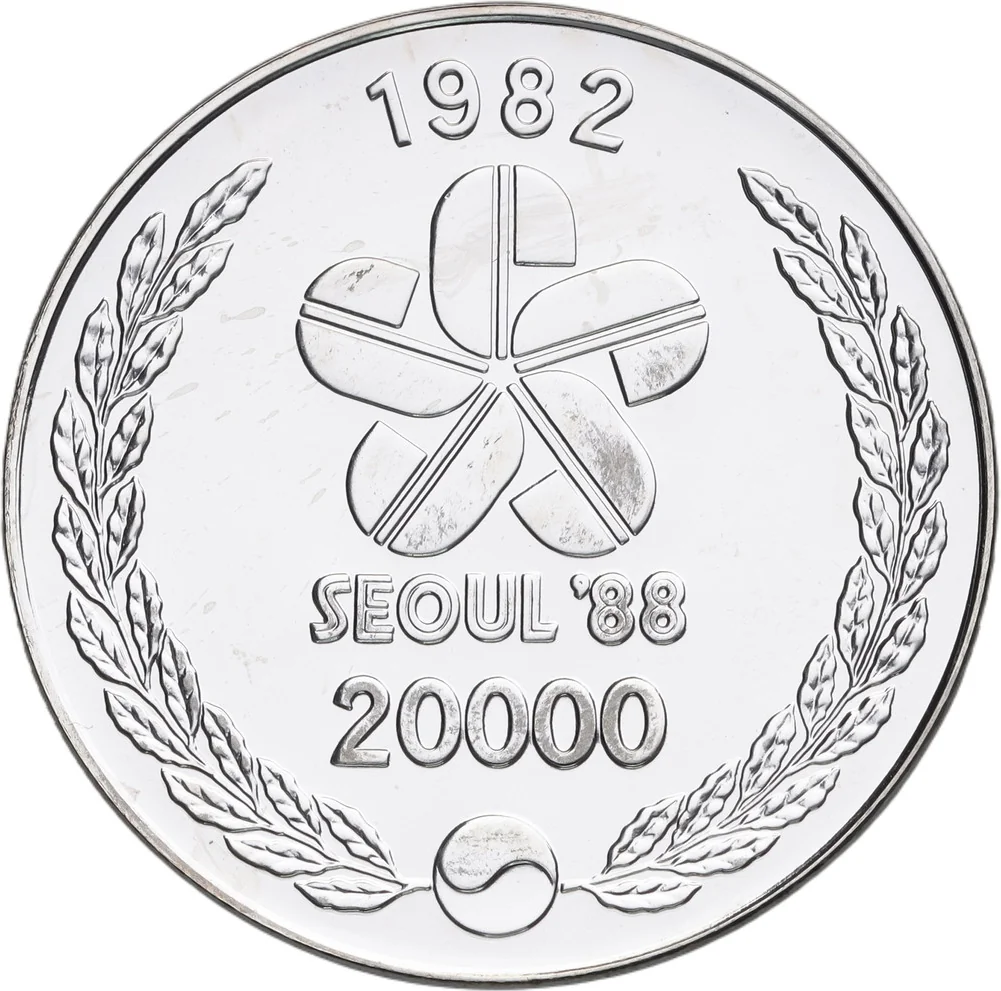
Reverse
Edge
Reeded
Categories
| Sport> Summer Olympic Games |
Mints
| Name | Mark |
|---|---|
| Korea Minting and Security Printing Corporation | — |
Mintings
| Year | Mint Mark | Mintage | Quality | Collection |
|---|---|---|---|---|
| 1982 | — | 180,000 | ||
| 1982 | — | 10,000 | Proof |
Historical background
In 1982, South Korea's currency situation was characterized by a tightly controlled and managed exchange rate regime under the guidance of President Chun Doo-hwan's authoritarian government. The Korean won (KRW) was not freely convertible, and its value was pegged to a basket of currencies, heavily weighted toward the U.S. dollar. This fixed exchange rate system was a cornerstone of the state-led, export-oriented economic development model, providing stability for the chaebols (large family-owned conglomerates) by ensuring predictable exchange costs for their imports of raw materials and for pricing their exports.
However, this stability came at a cost and masked underlying pressures. The won was widely considered overvalued to keep import prices low and curb inflation, but this made Korean exports less competitive internationally. Furthermore, the regime maintained strict capital controls to prevent money from flowing out of the country and to direct domestic savings toward industrial policy goals. A complex dual-rate system existed, with a preferential official rate for authorized transactions and a more realistic, depreciated "free market" rate for others, leading to distortions and a thriving black market for foreign currency.
The year 1982 itself saw a significant but controlled policy adjustment. In January, as part of broader economic liberalization measures encouraged by the United States, the government implemented a substantial devaluation of the won by approximately 7% against the dollar and simplified the dual-rate system. This move aimed to boost export competitiveness amid a global recession and rising protectionism. While still far from a free float, this adjustment reflected the government's recognition of external imbalances and marked a cautious, incremental step toward the financial liberalization that would accelerate in the late 1980s.
However, this stability came at a cost and masked underlying pressures. The won was widely considered overvalued to keep import prices low and curb inflation, but this made Korean exports less competitive internationally. Furthermore, the regime maintained strict capital controls to prevent money from flowing out of the country and to direct domestic savings toward industrial policy goals. A complex dual-rate system existed, with a preferential official rate for authorized transactions and a more realistic, depreciated "free market" rate for others, leading to distortions and a thriving black market for foreign currency.
The year 1982 itself saw a significant but controlled policy adjustment. In January, as part of broader economic liberalization measures encouraged by the United States, the government implemented a substantial devaluation of the won by approximately 7% against the dollar and simplified the dual-rate system. This move aimed to boost export competitiveness amid a global recession and rising protectionism. While still far from a free float, this adjustment reflected the government's recognition of external imbalances and marked a cautious, incremental step toward the financial liberalization that would accelerate in the late 1980s.
💎 Very Rare