

5 centimos – Spain
Add to wishlist
Spain
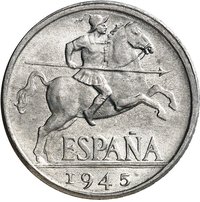
Obverse
Description:
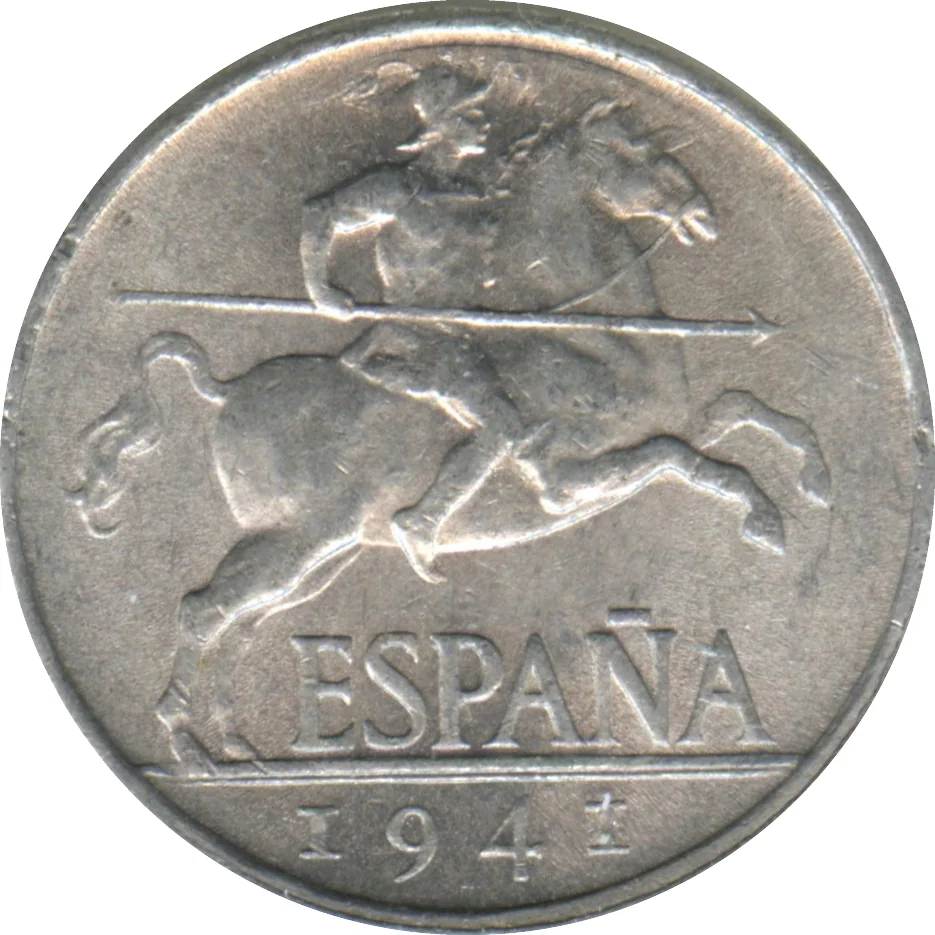
Spear-wielding Iberian horseman.
Inscription:
ESPAÑA 1941
Translation:
Spain 1941
Script: Latin
Language: Spanish
Engraver: Carlos Mingo López
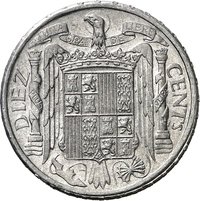
Reverse
Description:
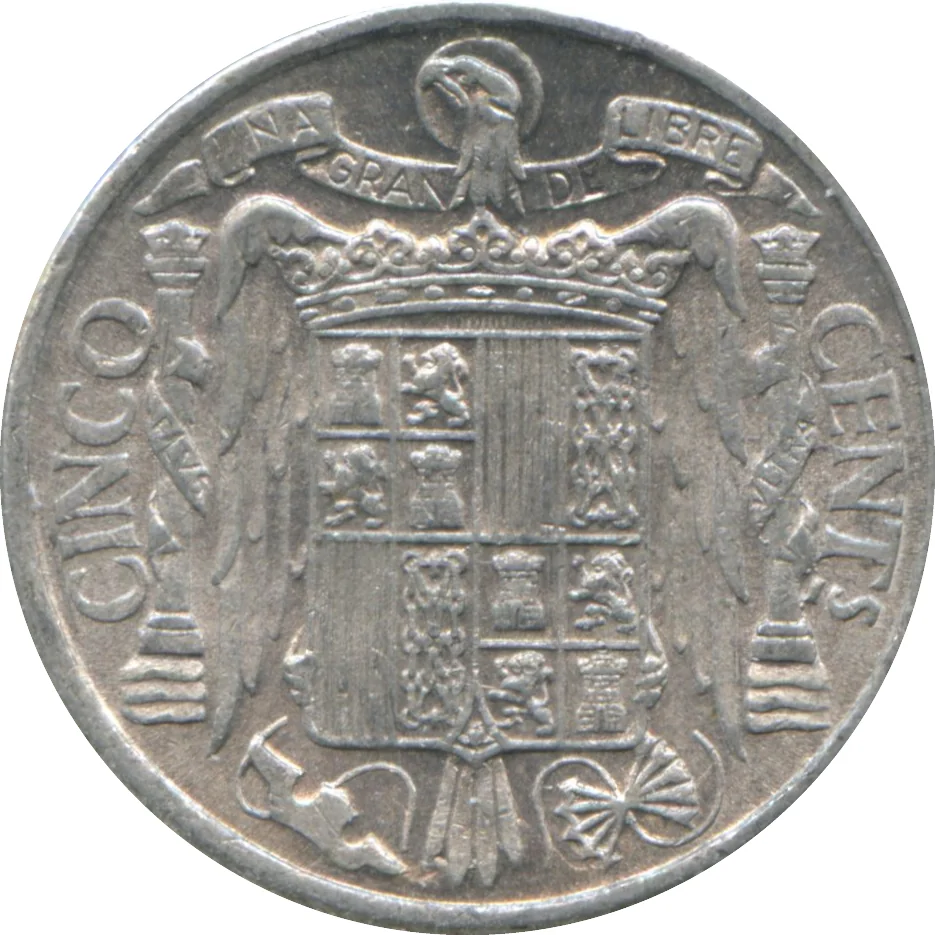
Spanish coat of arms.
Inscription:
CINCO CENTS
UNA GRANDE LIBRE
PLUS ULTRA
UNA GRANDE LIBRE
PLUS ULTRA
Translation:
Five Cents
One Great Free
Further Beyond
One Great Free
Further Beyond
Script: Latin
Engraver: Carlos Mingo López
Edge
Festooned
Categories
| Animal> Horse |
| Symbols> Coat of Arms |
| Object> Cold weapons |
Mints
| Name | Mark |
|---|---|
| Royal Mint of Madrid | — |
Mintings
| Year | Mint Mark | Mintage | Quality | Collection |
|---|---|---|---|---|
| 1940 | — | 175,000,000 | ||
| 1941 | — | 202,107,000 | ||
| 1945 | — | 221,500,000 | ||
| 1953 | — | 31,573,000 |
Historical background
In 1940, Spain was a devastated nation emerging from the catastrophic Spanish Civil War (1936-1939). The victorious Nationalist regime under General Francisco Franco inherited an economy in ruins, with industrial and agricultural production shattered, infrastructure destroyed, and the country isolated internationally due to its fascist-aligned government. The monetary system was fractured, with the pre-war peseta devalued and multiple competing currencies still in circulation, including Republican pesetas, which the new regime was desperate to invalidate. This economic collapse created a context of severe scarcity, rampant inflation, and a sprawling black market that would define the early years of the Francoist autarky.
The Franco regime responded by imposing a policy of economic autarky (self-sufficiency), seeking to control all aspects of the economy, including currency. In 1939, the peseta nacional was established as the sole legal tender, and a complex system of exchange controls was enforced. The official exchange rate was fixed at an artificially strong level, but this bore little relation to reality. A severe shortage of foreign currency and gold reserves, coupled with low exports and international ostracism, meant the peseta's real value plummeted. Consequently, a vast and essential black market for currency (the "estraperlo") flourished, where pesetas traded for foreign currencies at a fraction of their official rate, facilitating the import of vital goods otherwise unavailable.
Thus, the currency situation in 1940 was one of stark duality and instability. The government maintained a rigid official exchange rate for propaganda purposes and control, while the population and many businesses depended on the illegal parallel market for practical survival. This dysfunctional system exacerbated poverty, hindered reconstruction, and entrenched corruption. It would take over a decade, and a shift away from strict autarky following the 1953 Pact of Madrid with the United States, for Spain's currency and economy to begin a slow path toward stabilization and integration into the Western financial system.
The Franco regime responded by imposing a policy of economic autarky (self-sufficiency), seeking to control all aspects of the economy, including currency. In 1939, the peseta nacional was established as the sole legal tender, and a complex system of exchange controls was enforced. The official exchange rate was fixed at an artificially strong level, but this bore little relation to reality. A severe shortage of foreign currency and gold reserves, coupled with low exports and international ostracism, meant the peseta's real value plummeted. Consequently, a vast and essential black market for currency (the "estraperlo") flourished, where pesetas traded for foreign currencies at a fraction of their official rate, facilitating the import of vital goods otherwise unavailable.
Thus, the currency situation in 1940 was one of stark duality and instability. The government maintained a rigid official exchange rate for propaganda purposes and control, while the population and many businesses depended on the illegal parallel market for practical survival. This dysfunctional system exacerbated poverty, hindered reconstruction, and entrenched corruption. It would take over a decade, and a shift away from strict autarky following the 1953 Pact of Madrid with the United States, for Spain's currency and economy to begin a slow path toward stabilization and integration into the Western financial system.
🌱 Very Common