

4 escudos – Spain
Add to wishlist
Spain
Context
Material
Diameter: 26 mm
Weight: 13 g
Gold Weight:: 11.92 g
Thickness: 1 mm
Shape: Irregular round
Composition: 91.7% Gold
Magnetic: No
Technique: Hammered
References
KM: #
Numista: #555192
Value
Bullion value: $1830.15
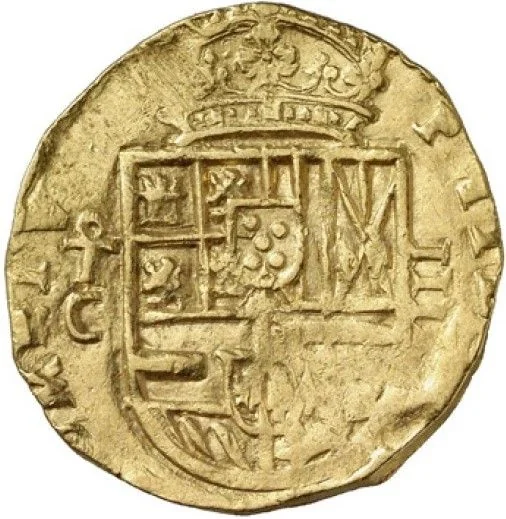
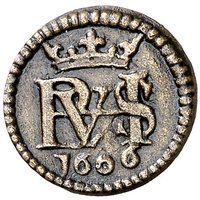
Obverse
Description:
Spanish coat of arms with Portuguese arms.
Inscription:
PHILIPPVS III D G OMNIVM
To C IIII
To C IIII
Script: Latin
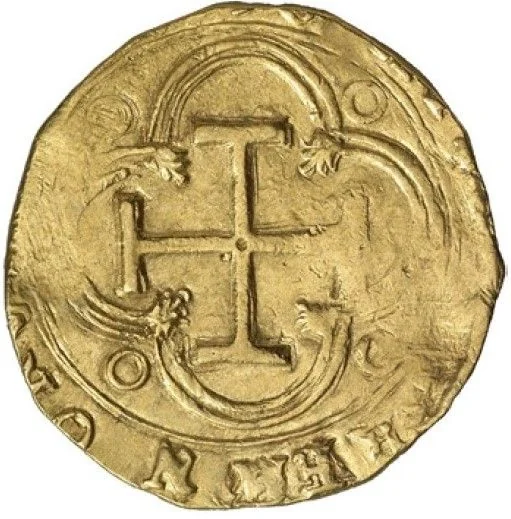
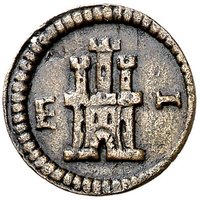
Reverse
Edge
Categories
| Symbols> Coat of Arms |
| Symbol> Cross |
Mints
| Name | Mark |
|---|---|
| Royal Mint of Seville | S |
| Toledo | (T) |
Mintings
| Year | Mint Mark | Mintage | Quality | Collection |
|---|---|---|---|---|
| — | SB | — | ||
| — | TC | — |
Historical background
In 1599, Spain was in the throes of a severe monetary crisis, a direct consequence of the Crown of Castile's relentless spending on its vast European and global empire. King Philip III had inherited from his father, Philip II, a state burdened by colossal debt from decades of warfare against England, the Dutch rebels, and the Ottoman Empire. To finance these conflicts, the crown had repeatedly resorted to borrowing from foreign bankers and, most destructively, to the debasement of its silver currency. The primary unit, the real, had been steadily reduced in silver content, leading to a loss of confidence in the coinage and rampant inflation, a phenomenon Spaniards termed the "price revolution."
The situation reached a critical point in 1599 with the decision to issue massive quantities of a new, heavily debased coin: the vellón. This currency was made from an alloy of copper with only a tiny amount of silver (vellón rico) or, soon after, pure copper (vellón pobre). The public, recognizing the intrinsic worthlessness of these coins, hoarded the older, purer silver reales, following Gresham's Law that "bad money drives out good." This led to a disastrous bifurcation of the economy: everyday small transactions were forced into depreciating copper, while large-scale trade and international finance demanded scarce silver, causing economic dislocation and social unrest.
The immediate consequences were severe inflation, a collapse in royal credit, and a deep distrust of the monarchy's financial management. While the crisis peaked in 1599, it set the tone for the entire 17th century, often called Spain's "Iron Century." The crown's short-term fix of flooding the economy with copper vellón, rather than addressing fundamental fiscal reforms, locked Spain into a cycle of currency manipulation, debt defaults, and economic decline that eroded the foundations of its once-dominant global position.
The situation reached a critical point in 1599 with the decision to issue massive quantities of a new, heavily debased coin: the vellón. This currency was made from an alloy of copper with only a tiny amount of silver (vellón rico) or, soon after, pure copper (vellón pobre). The public, recognizing the intrinsic worthlessness of these coins, hoarded the older, purer silver reales, following Gresham's Law that "bad money drives out good." This led to a disastrous bifurcation of the economy: everyday small transactions were forced into depreciating copper, while large-scale trade and international finance demanded scarce silver, causing economic dislocation and social unrest.
The immediate consequences were severe inflation, a collapse in royal credit, and a deep distrust of the monarchy's financial management. While the crisis peaked in 1599, it set the tone for the entire 17th century, often called Spain's "Iron Century." The crown's short-term fix of flooding the economy with copper vellón, rather than addressing fundamental fiscal reforms, locked Spain into a cycle of currency manipulation, debt defaults, and economic decline that eroded the foundations of its once-dominant global position.
✨ Legendary