



10 pesos – Philippines
Add to wishlist
Circulating commemorative coins
Commemoration: ASEAN Philippines 2026
Philippines
Context
Year: 2026
Issuer: Philippines
Issuing organization: Central Bank of the Philippines
Period:
(since 1946)
Currency:
(since 1967)
Material


References
Numista: #554996
Value
Exchange value: 10 PHP
Obverse
Description:
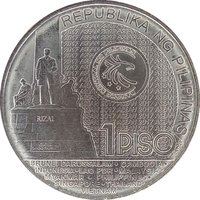
Left: Bust of Mabini facing right. Right: Year, denomination, and mint mark over microtext country name.
Inscription:
REPUBLIKA NG PILIPINAS
10 PISO
APOLINARIO MABINI
10 PISO
APOLINARIO MABINI
Script: Latin
Reverse
Description:
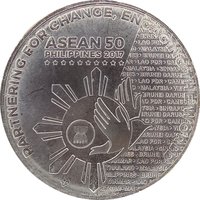
ASEAN 2026 logo left, QR code right, BSP logo bottom.
Inscription:
ASEAN PHILIPPINES 2026
BANGKO SENTRAL NG PILIPINAS
BANGKO SENTRAL NG PILIPINAS
Script: Latin
Edge
Milled with text.
Legend:
Bangko Sentral ng Pilipinas.
Categories
| Person> Politician |
| Plants> Flower |
Mints
| Name | Mark |
|---|---|
| BSP Security Plant Complex | (PI) |
Mintings
| Year | Mint Mark | Mintage | Quality | Collection |
|---|---|---|---|---|
| 2026 | PI | — |
Historical background
As of 2026, the Philippine peso (PHP) operates within a managed float regime under the Bangko Sentral ng Pilipinas (BSP), continuing its trajectory from the early 2020s. The currency's value is primarily influenced by a combination of domestic economic performance, overseas Filipino worker (OFW) remittances, business process outsourcing (BPO) receipts, and the broader dynamics of the US dollar. Following the global economic adjustments post-pandemic, the BSP has maintained a vigilant stance, utilizing its monetary policy tools and foreign exchange reserves to mitigate excessive volatility and maintain macroeconomic stability. The key focus remains on managing inflationary pressures while supporting growth, with the peso's fluctuations reflecting the ongoing balance between these priorities.
The external sector presents a mixed picture. Sustained strong inflows from remittances and the resilient services export sector provide fundamental support for the currency. However, these are counterbalanced by a persistent trade deficit, driven by the nation's need to import energy, capital goods, and food. Furthermore, the monetary policy divergence between the BSP and the US Federal Reserve continues to be a significant short-term driver of peso movement. Higher interest rates in the United States can lead to capital outflows and peso depreciation, a challenge the BSP must navigate carefully to avoid destabilizing the foreign exchange market while also protecting domestic growth.
Looking ahead, the peso's stability in 2026 is closely tied to the government's success in attracting foreign direct investment (FDI) into high-value sectors like manufacturing and renewable energy, which could improve the structural trade balance. Digitalization efforts in finance and a potential sovereign green bond issuance also offer avenues for strengthening the currency's profile. Ultimately, the BSP's credibility and its ability to anchor inflation expectations are seen as the bedrock for maintaining investor confidence and ensuring the peso remains a stable store of value amidst global financial uncertainties.
The external sector presents a mixed picture. Sustained strong inflows from remittances and the resilient services export sector provide fundamental support for the currency. However, these are counterbalanced by a persistent trade deficit, driven by the nation's need to import energy, capital goods, and food. Furthermore, the monetary policy divergence between the BSP and the US Federal Reserve continues to be a significant short-term driver of peso movement. Higher interest rates in the United States can lead to capital outflows and peso depreciation, a challenge the BSP must navigate carefully to avoid destabilizing the foreign exchange market while also protecting domestic growth.
Looking ahead, the peso's stability in 2026 is closely tied to the government's success in attracting foreign direct investment (FDI) into high-value sectors like manufacturing and renewable energy, which could improve the structural trade balance. Digitalization efforts in finance and a potential sovereign green bond issuance also offer avenues for strengthening the currency's profile. Ultimately, the BSP's credibility and its ability to anchor inflation expectations are seen as the bedrock for maintaining investor confidence and ensuring the peso remains a stable store of value amidst global financial uncertainties.
✨ Legendary