

2 Pyas – Myanmar
Myanmar
Context
Year: 1838
Buddhist (Chulasakarat) Year: 1199
Issuer: Myanmar 
Currency:
(1852—1889)
Demonetized: Yes
Material
Diameter: 24.87 mm
Weight: 6.25 g
Shape: Irregular round
Composition: Copper
Magnetic: No
Technique: Milled
Alignment: Medal alignment
flip
References
KM: #Click to copy to clipboard1.1
Numista: #550511
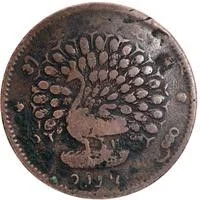
Obverse
Description:
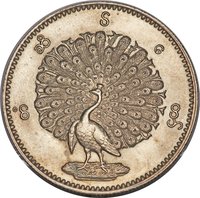
Peacock dancing left
Script: Burmese
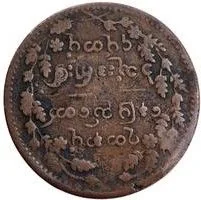
Reverse
Description:
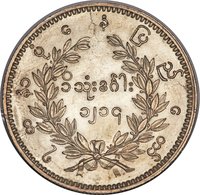
Burmese legend in four lines within a wreath, divided.
Script: Burmese
Edge
Plain
Mints
| Name | Mark |
|---|---|
| Kolkata / Calcutta / Murshidabad | — |
Mintings
| Year | Mint Mark | Mintage | Quality | Collection |
|---|---|---|---|---|
| 1838 | — | — |
Historical background
In 1838, the currency situation in the Kingdom of Burma (Myanmar) was characterized by a traditional bimetallic system under the absolute rule of King Bagyidaw of the Konbaung Dynasty. The state treasury, or Hluttaw, maintained strict royal monopolies over the issuance of coinage. The primary units were the silver kyat (also known as the tical) and the gold mu, with their values fixed by royal decree in a specific ratio. Smaller transactions were facilitated by copper and lead *pe coins, and in rural areas, barter remained a common practice alongside the use of bullet-shaped silver lumps known as ganza. This system was largely insular, designed to serve the domestic economy and affirm royal authority rather than facilitate international trade.
However, this period was one of severe economic strain and monetary instability. The kingdom was still reeling from the financial and territorial devastation of the First Anglo-Burmese War (1824–1826), which concluded with the Treaty of Yandabo. The war indemnity of one million pounds sterling imposed by the British East India Company had drained the royal treasury of vast quantities of silver bullion. This massive outflow of specie led to a severe shortage of silver coinage, causing debasement of the currency, inflation, and significant hardship for the population. The state’s attempts to replenish its coffers through increased taxation and forced contributions further exacerbated economic distress.
Consequently, the currency landscape was fragmented and unreliable. While the royal mint in the capital issued coins, their value and purity were increasingly suspect. The scarcity of official coinage spurred the circulation of older, worn coins and private tokens, leading to a loss of public confidence. Furthermore, along the coastal regions and borders, foreign silver coins—particularly Indian Rupees and Spanish Dollars—began to circulate more prominently as a more stable alternative, subtly undermining the royal monopoly. Thus, in 1838, Myanmar’s currency was not only a symbol of a weakened kingdom but also a practical reflection of an economy struggling under the weight of war debt and transition.
However, this period was one of severe economic strain and monetary instability. The kingdom was still reeling from the financial and territorial devastation of the First Anglo-Burmese War (1824–1826), which concluded with the Treaty of Yandabo. The war indemnity of one million pounds sterling imposed by the British East India Company had drained the royal treasury of vast quantities of silver bullion. This massive outflow of specie led to a severe shortage of silver coinage, causing debasement of the currency, inflation, and significant hardship for the population. The state’s attempts to replenish its coffers through increased taxation and forced contributions further exacerbated economic distress.
Consequently, the currency landscape was fragmented and unreliable. While the royal mint in the capital issued coins, their value and purity were increasingly suspect. The scarcity of official coinage spurred the circulation of older, worn coins and private tokens, leading to a loss of public confidence. Furthermore, along the coastal regions and borders, foreign silver coins—particularly Indian Rupees and Spanish Dollars—began to circulate more prominently as a more stable alternative, subtly undermining the royal monopoly. Thus, in 1838, Myanmar’s currency was not only a symbol of a weakened kingdom but also a practical reflection of an economy struggling under the weight of war debt and transition.
✨ Legendary