

50 Schilling – Austria
Non-circulating coins
Commemoration: International Garden Exhibition
Austria

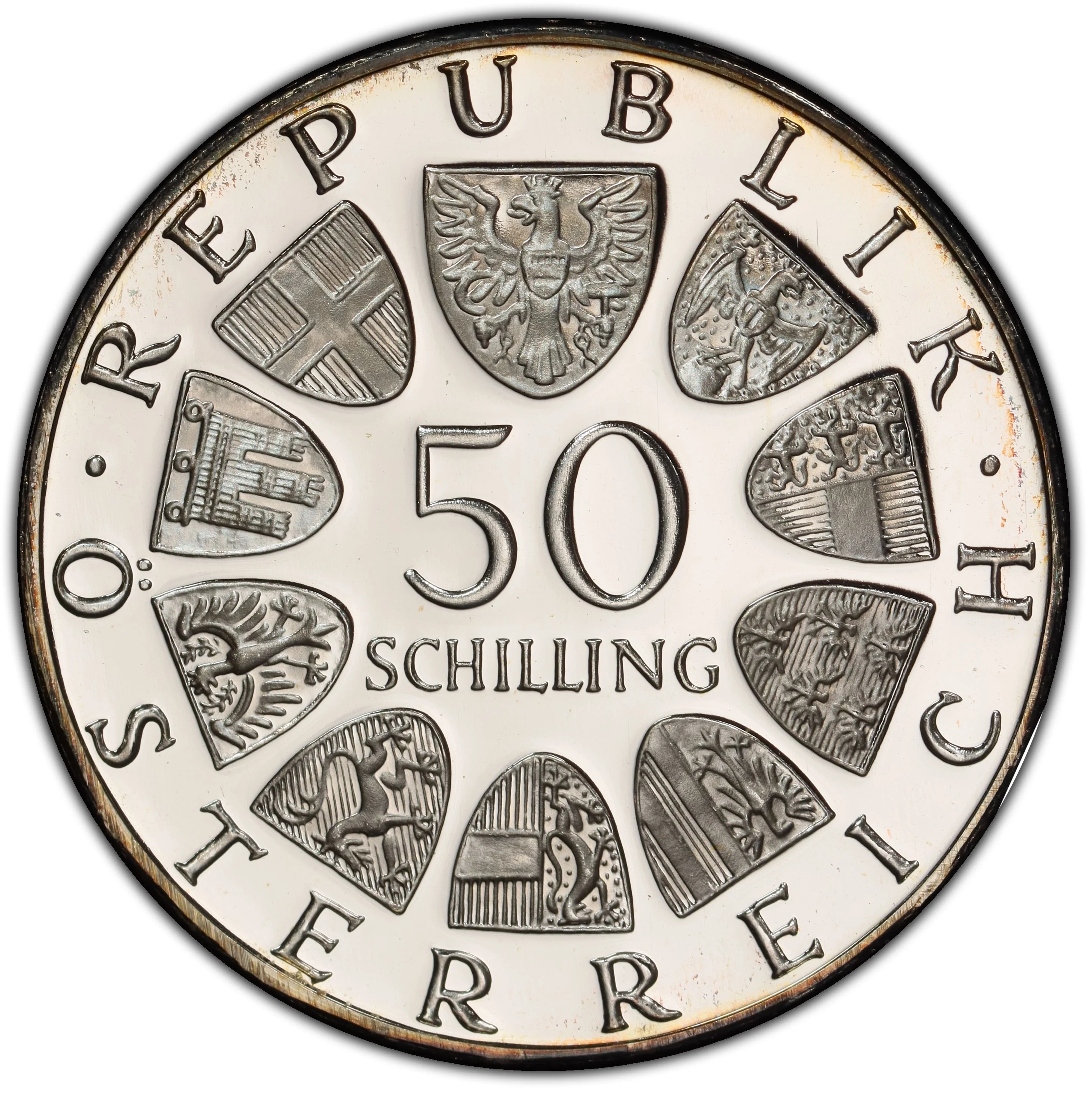
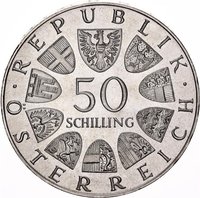
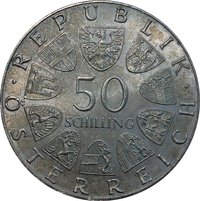
Obverse
Description:
Shield-ringed value
Inscription:
· REPUBLIK ·
50
SCHILLING
ÖSTERREICH
50
SCHILLING
ÖSTERREICH
Translation:
REPUBLIC
50
SCHILLING
AUSTRIA
50
SCHILLING
AUSTRIA
Script: Latin
Language: German
Engraver: Edwin Grienauer
Reverse
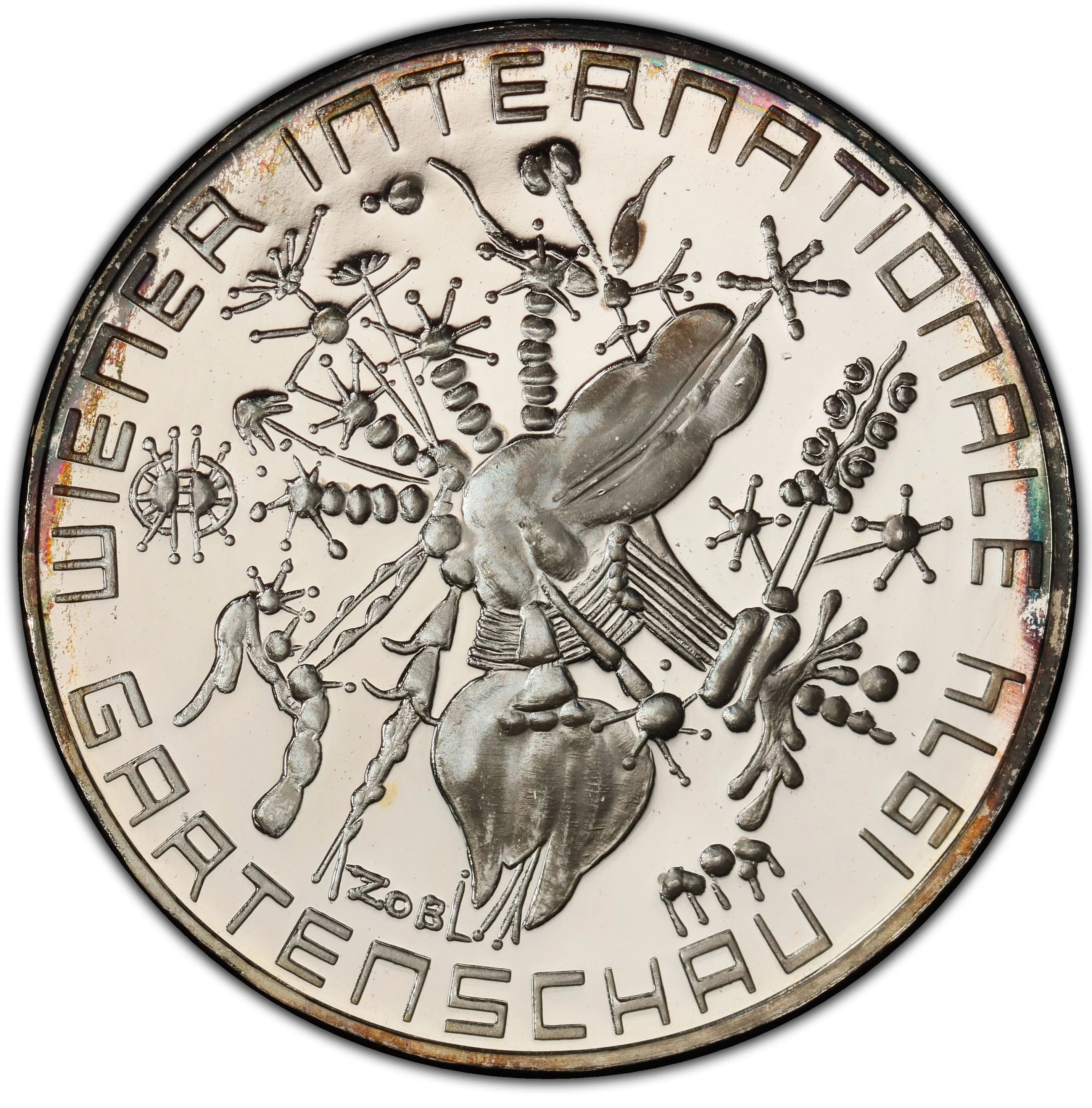
Description:
International Flower Show
Date below
Date below
Inscription:
WIENER INTERNATIONALE
ZOBL
GARTENSCHAU 1974
ZOBL
GARTENSCHAU 1974
Script: Latin
Engraver: Helmut Zobl
Edge
Lettering:FUENFZIG SCHILLING - * -
Legend:
FUENFZIG SCHILLING - * -
Translation:
FIFTY SCHILLING - * -
Language: German
Mints
| Name | Mark |
|---|---|
| Münze Österreich | — |
Mintings
| Year | Mint Mark | Mintage | Quality | Collection |
|---|---|---|---|---|
| 1974 | — | 2,279,000 | ||
| 1974 | — | 221,000 | Proof |
Historical background
In 1974, Austria's currency situation was defined by its participation in the "European currency snake," a multilateral agreement aimed at reducing exchange rate fluctuations between European Community members and associated states like Austria. This system, formally known as the European Exchange Rate Agreement, required member currencies to maintain their values within a narrow band (a "tunnel") against each other, while collectively floating against the U.S. dollar. For Austria, a small, open economy with deep trade ties to Western Europe, the primary objective was to maintain stability against its key trading partner, the Deutsche Mark (DM), thereby anchoring its own economic credibility and controlling inflation.
Domestically, the Austrian Schilling was managed with a strong emphasis on stability, a legacy of the hyperinflation traumas of the 1920s. The Austrian National Bank (OeNB) pursued a hartwährungspolitik (hard currency policy), informally shadowing the DM even before formally joining the snake in 1971. This policy was largely successful; inflation in Austria, while rising due to the global oil crisis, remained significantly lower than in many peer nations. However, the fixed exchange rate regime limited the OeNB's ability to use independent monetary policy to combat the stagflationary pressures of the time, as interest rates had to be aligned to support the currency peg.
The year 1974 was a challenging test for this arrangement. The collapse of the Bretton Woods system in 1971-73 and the first oil price shock of 1973 created immense volatility in global markets and divergent economic pressures across Europe. Maintaining the required parity within the snake demanded significant foreign exchange interventions and strict fiscal discipline. While Austria successfully kept the Schilling stable within the mechanism throughout 1974, the inherent strains of the system were becoming clear, foreshadowing the eventual difficulties that would lead to periodic realignments and, ultimately, the snake's evolution into the European Monetary System (EMS) later in the decade.
Domestically, the Austrian Schilling was managed with a strong emphasis on stability, a legacy of the hyperinflation traumas of the 1920s. The Austrian National Bank (OeNB) pursued a hartwährungspolitik (hard currency policy), informally shadowing the DM even before formally joining the snake in 1971. This policy was largely successful; inflation in Austria, while rising due to the global oil crisis, remained significantly lower than in many peer nations. However, the fixed exchange rate regime limited the OeNB's ability to use independent monetary policy to combat the stagflationary pressures of the time, as interest rates had to be aligned to support the currency peg.
The year 1974 was a challenging test for this arrangement. The collapse of the Bretton Woods system in 1971-73 and the first oil price shock of 1973 created immense volatility in global markets and divergent economic pressures across Europe. Maintaining the required parity within the snake demanded significant foreign exchange interventions and strict fiscal discipline. While Austria successfully kept the Schilling stable within the mechanism throughout 1974, the inherent strains of the system were becoming clear, foreshadowing the eventual difficulties that would lead to periodic realignments and, ultimately, the snake's evolution into the European Monetary System (EMS) later in the decade.
🌱 Common