

100 centavos – Timor-Leste
Add to wishlist
Circulating commemorative coins
Commemoration: Boaventura de Manufahi
Timor-Leste
Context
Years: 2012–2017
Issuer: Timor-Leste
Period:
(since 2002)
Currency:
(since 2003)
Total mintage: 55,793,000
Material

References
KM: #
Numista: #40654
Obverse
Description:
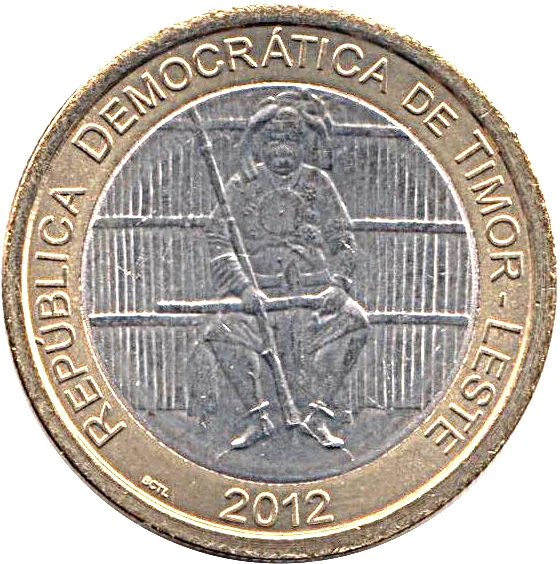
Boaventura de Manufahi seated. Date.
Inscription:
REPUBLICA DEMOCRATICA DE TIMOR-LESTE 2012
BCTL
BCTL
Script: Latin
Engraver: Baiba Šime
Reverse
Description:
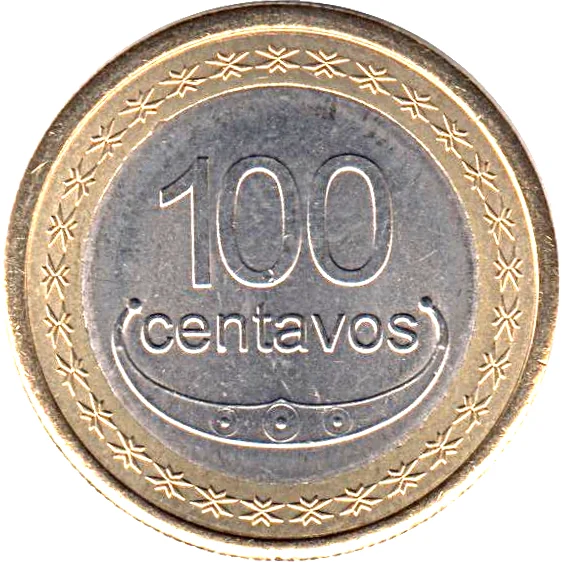
Kaibauk (crescent ornament) with Tais-patterned border.
Inscription:
100
centavos
centavos
Script: Latin
Engraver: Baiba Šime
Edge
Reeded
Mints
| Name | Mark |
|---|---|
| Royal Australian Mint | — |
| Imprensa Nacional - Casa da Moeda | BCTL |
Mintings
Historical background
In 2012, Timor-Leste's currency situation was defined by its continued use of the United States Dollar (USD) as its official legal tender, a framework established upon independence in 2000. This dollarization provided immediate macroeconomic stability, curbing hyperinflation and establishing a credible medium of exchange. However, by 2012, significant drawbacks were evident. The economy lacked independent monetary policy tools, rendering the Central Bank of Timor-Leste powerless to influence interest rates or manage money supply to stimulate growth. Furthermore, the nation did not benefit from seigniorage (profit from issuing currency), and its fiscal revenue in USD was highly vulnerable to fluctuations in global oil prices, upon which the state budget overwhelmingly depended.
The year 2012 was a pivotal one as it marked the official establishment of the Central Bank of Timor-Leste (Banco Central de Timor-Leste, BCTL) by law in September, succeeding the former Banking and Payments Authority. This institutional step was widely seen as a foundational move toward a potential future introduction of a national currency. Public and political debate on this issue was active, with discussions weighing the symbolic importance of a sovereign currency against the risks of abandoning the stability of the USD. Proponents argued a national currency could empower economic sovereignty, while critics warned of potential instability, high transition costs, and the challenge of building public trust in a new monetary institution.
Economically, the country's Petroleum Fund, a sovereign wealth fund established to manage oil and gas revenues, continued to grow and was denominated in USD, further entrenching the dollar's dominance. The government's heavy reliance on drawing from this fund to finance its state budgets meant that fiscal policy was the primary, and often blunt, instrument for managing the economy. Consequently, in 2012, the currency situation remained stable but passive, with the new Central Bank beginning its long-term work of developing financial infrastructure and capacity, while the broader question of eventual de-dollarization loomed as a complex strategic decision for the future.
The year 2012 was a pivotal one as it marked the official establishment of the Central Bank of Timor-Leste (Banco Central de Timor-Leste, BCTL) by law in September, succeeding the former Banking and Payments Authority. This institutional step was widely seen as a foundational move toward a potential future introduction of a national currency. Public and political debate on this issue was active, with discussions weighing the symbolic importance of a sovereign currency against the risks of abandoning the stability of the USD. Proponents argued a national currency could empower economic sovereignty, while critics warned of potential instability, high transition costs, and the challenge of building public trust in a new monetary institution.
Economically, the country's Petroleum Fund, a sovereign wealth fund established to manage oil and gas revenues, continued to grow and was denominated in USD, further entrenching the dollar's dominance. The government's heavy reliance on drawing from this fund to finance its state budgets meant that fiscal policy was the primary, and often blunt, instrument for managing the economy. Consequently, in 2012, the currency situation remained stable but passive, with the new Central Bank beginning its long-term work of developing financial infrastructure and capacity, while the broader question of eventual de-dollarization loomed as a complex strategic decision for the future.
🌱 Common