

¼ Dollar – United States
Non-circulating coins
Commemoration: United States Mint's "America the Beautiful" Quarters® Program
United States
Context
Year: 2016
Issuer: United States 
Period:
(since 1776)
Currency:
(since 1785)
Subdivision: ¼ Dollar = 25 Cents
Total mintage: 479,657
Material
References
KM: #Click to copy to clipboard639a
Numista: #101189
Value
Exchange value: ¼ USD = $0.25
Bullion value: $16.10
Inflation-adjusted value: 0.34 USD
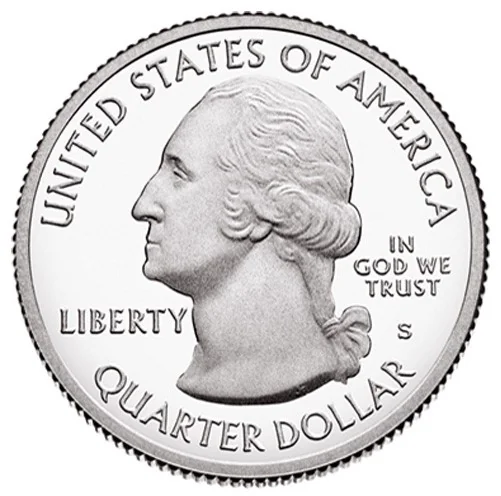
Obverse
Description:
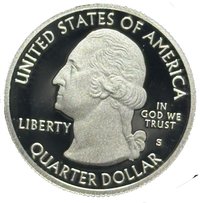
George Washington in left profile.
Inscription:
UNITED STATES OF AMERICA
IN
GOD WE
TRUST
LIBERTY
S
QUARTER DOLLAR
IN
GOD WE
TRUST
LIBERTY
S
QUARTER DOLLAR
Script: Latin
Engraver: William Cousins
Designer: John Flanagan
Reverse
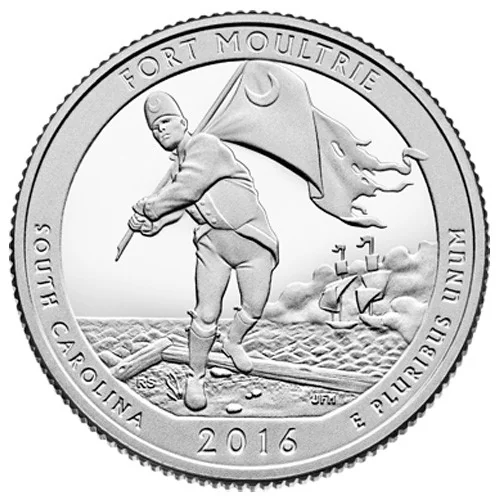
Description:
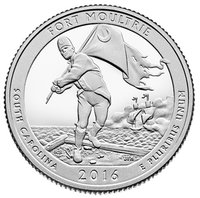
Sergeant William Jasper replaces the flag under British naval fire.
Inscription:
FORT MOULTRIE
RS JFM
SOUTH CAROLINA 2016 E PLURIBUS UNUM
RS JFM
SOUTH CAROLINA 2016 E PLURIBUS UNUM
Script: Latin
Engraver: Joseph Menna
Designer: Richard Scott
Edge
Reeded
Categories
| Geography> Park |
| Symbol> Flag |
| Geography> Sea |
| Transportation> Watercraft |
| History> War |
Mints
| Name | Mark |
|---|---|
| United States Mint of San Francisco | S |
Mintings
| Year | Mint Mark | Mintage | Quality | Collection |
|---|---|---|---|---|
| 2016 | S | 479,657 | Proof |
Historical background
In 2016, the United States currency situation was characterized by a period of relative strength and stability for the U.S. dollar, underpinned by a diverging monetary policy path from other major economies. The Federal Reserve, having ended its quantitative easing program in 2014, was in a tightening cycle, raising the federal funds rate in December 2015 for the first time in nearly a decade and signaling further gradual hikes. This contrasted sharply with the European Central Bank and the Bank of Japan, which were still employing aggressive stimulus measures, making dollar-denominated assets more attractive and pushing the dollar's value higher on foreign exchange markets.
Domestically, the economy was in a sustained, though modest, expansion with low unemployment and contained inflation, which gave the Fed confidence to continue normalizing policy. However, this strong dollar presented a significant headwind for large U.S. multinational corporations, as it made American exports more expensive and reduced the value of overseas earnings when converted back to dollars. This dynamic contributed to an earnings recession in the S&P 500 for much of 2015 and into early 2016, creating a tension between the Fed's domestic objectives and the global financial environment.
The year was also dominated by significant political uncertainty, which introduced volatility into currency markets. The unexpected outcome of the Brexit referendum in June 2016 caused a sharp, temporary flight to the safety of the U.S. dollar and Treasury bonds. Furthermore, the contentious U.S. presidential election campaign, culminating in Donald Trump's victory in November, created waves of volatility. Markets initially reacted with a "risk-off" sell-off, but the dollar quickly rallied on anticipation of pro-growth policies, tax cuts, and infrastructure spending, ending the year near 14-year highs on a trade-weighted basis as investors priced in faster growth and higher interest rates.
Domestically, the economy was in a sustained, though modest, expansion with low unemployment and contained inflation, which gave the Fed confidence to continue normalizing policy. However, this strong dollar presented a significant headwind for large U.S. multinational corporations, as it made American exports more expensive and reduced the value of overseas earnings when converted back to dollars. This dynamic contributed to an earnings recession in the S&P 500 for much of 2015 and into early 2016, creating a tension between the Fed's domestic objectives and the global financial environment.
The year was also dominated by significant political uncertainty, which introduced volatility into currency markets. The unexpected outcome of the Brexit referendum in June 2016 caused a sharp, temporary flight to the safety of the U.S. dollar and Treasury bonds. Furthermore, the contentious U.S. presidential election campaign, culminating in Donald Trump's victory in November, created waves of volatility. Markets initially reacted with a "risk-off" sell-off, but the dollar quickly rallied on anticipation of pro-growth policies, tax cuts, and infrastructure spending, ending the year near 14-year highs on a trade-weighted basis as investors priced in faster growth and higher interest rates.
🌟 Limited