

1 Cent – Trinidad and Tobago
Trinidad and Tobago
Context
Years: 1966–1973
Issuer: Trinidad and Tobago 
Ruler: Elizabeth II
Currency:
(since 1964)
Demonetization: 3 July 2018
Total mintage: 75,908,104
Material
References
KM: #Click to copy to clipboard1
Numista: #969
Value
Exchange value: 0.01 TTD
Obverse
Description:
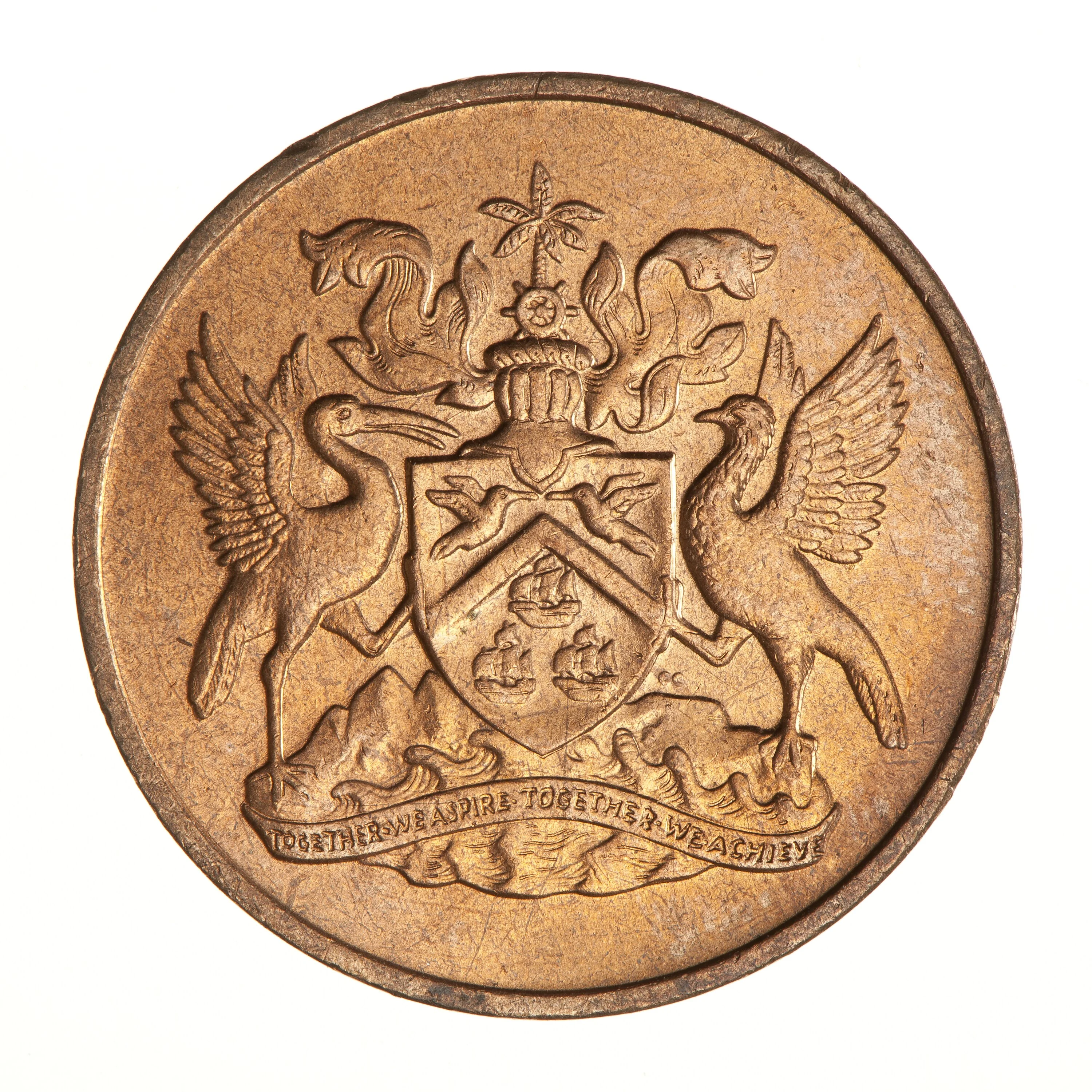
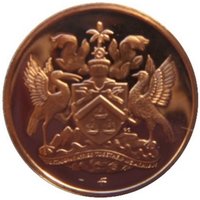
Trinidad and Tobago's coat of arms.
Inscription:
GC
TOGETHER WE ASPIRE - TOGETHER WE ACHIEVE
TOGETHER WE ASPIRE - TOGETHER WE ACHIEVE
Script: Latin
Designer: Geoffrey Colley
Reverse
Description:
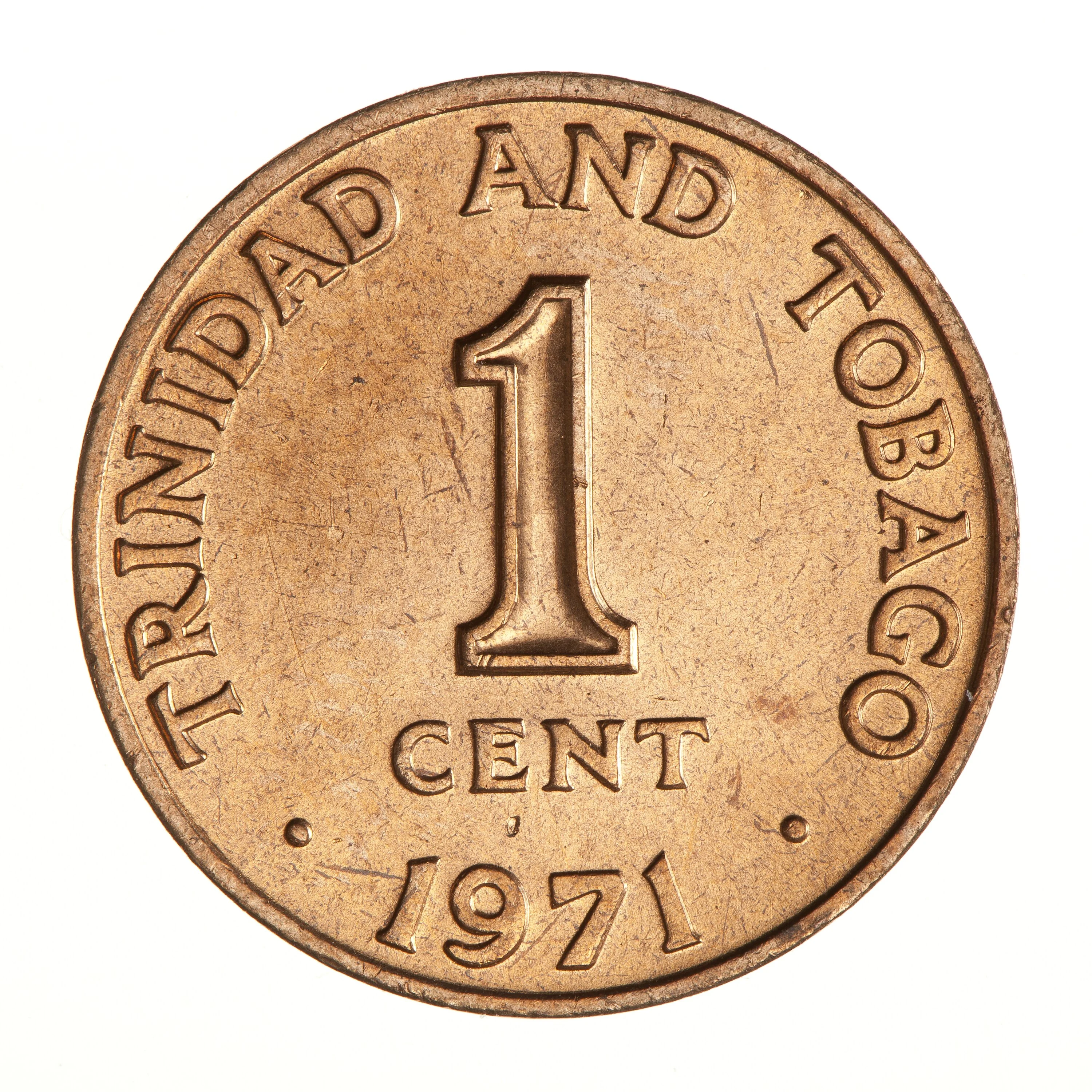
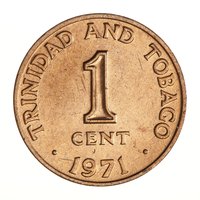
Lettering surrounds denomination, date below.
Inscription:
TRINIDAD AND TOBAGO
1
CENT
· 1972 ·
1
CENT
· 1972 ·
Script: Latin
Edge
Plain
Categories
| Symbols> Coat of Arms |
Mints
| Name | Mark |
|---|---|
| Royal Mint (Tower Hill) | — |
| Royal Mint | — |
| Franklin Mint | FM |
Mintings
Historical background
In 1966, Trinidad and Tobago's currency situation was defined by its recent transition to a fully independent national currency. Just two years prior, in 1964, the country had introduced the Trinidad and Tobago dollar (TTD), replacing the long-standing British West Indies dollar (BWI$) at par. This move was a key step in asserting monetary sovereignty following the nation's political independence from the United Kingdom in 1962. The new currency was initially managed by the Trinidad and Tobago Board of Commissioners of Currency, which issued notes and coins bearing national symbols, a point of significant pride.
The currency operated on a fixed exchange rate regime, pegged to sterling at a rate of TT$4.80 to £1. This peg was a legacy of the colonial monetary system and reflected the region's strong economic and trade ties with the United Kingdom. The stability of this peg was considered crucial for maintaining investor confidence and facilitating international trade, particularly for the country's dominant export, petroleum. Consequently, the Central Bank of Trinidad and Tobago, established in 1964, had as one of its primary mandates the defense of this fixed parity.
Economically, the context was one of robust growth fueled by the oil and emerging petrochemical sectors, which provided the foreign exchange reserves necessary to comfortably support the currency peg. There was little pressure on the Trinidad and Tobago dollar in 1966; inflation was moderate, and the balance of payments was strong. The currency situation was therefore characterized by stability and confidence, underpinned by hydrocarbon revenues and a conservative monetary framework inherited from the colonial period but now under nascent national control.
The currency operated on a fixed exchange rate regime, pegged to sterling at a rate of TT$4.80 to £1. This peg was a legacy of the colonial monetary system and reflected the region's strong economic and trade ties with the United Kingdom. The stability of this peg was considered crucial for maintaining investor confidence and facilitating international trade, particularly for the country's dominant export, petroleum. Consequently, the Central Bank of Trinidad and Tobago, established in 1964, had as one of its primary mandates the defense of this fixed parity.
Economically, the context was one of robust growth fueled by the oil and emerging petrochemical sectors, which provided the foreign exchange reserves necessary to comfortably support the currency peg. There was little pressure on the Trinidad and Tobago dollar in 1966; inflation was moderate, and the balance of payments was strong. The currency situation was therefore characterized by stability and confidence, underpinned by hydrocarbon revenues and a conservative monetary framework inherited from the colonial period but now under nascent national control.
🌱 Very Common