

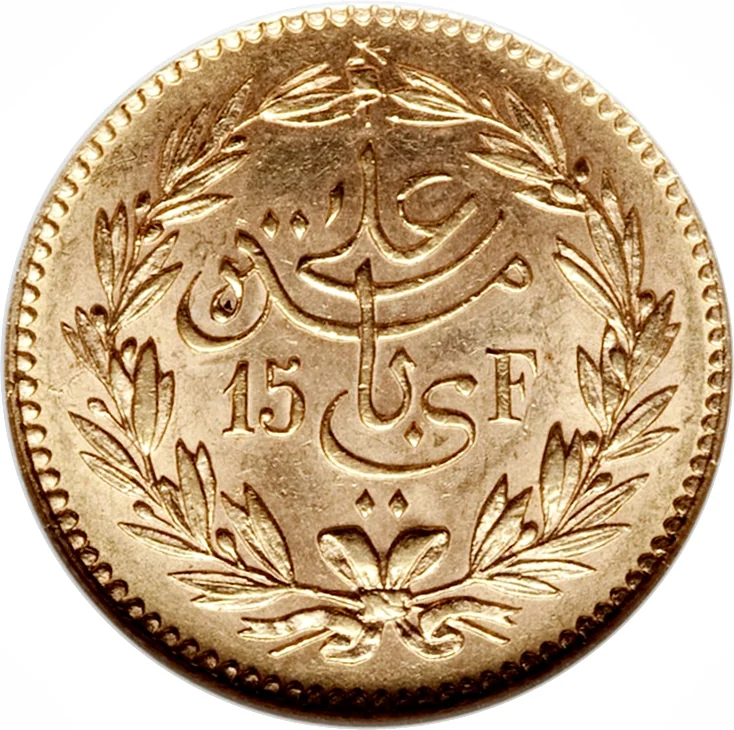
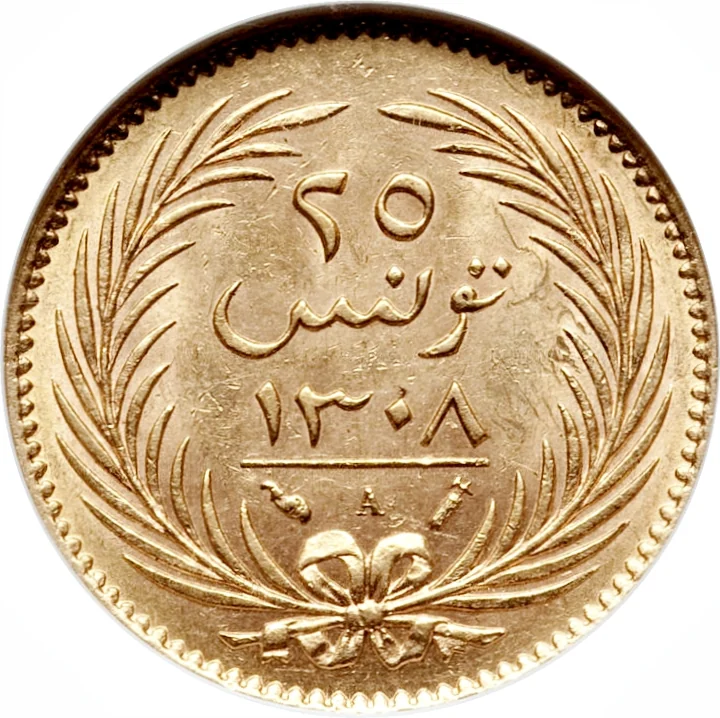

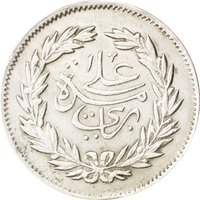
Obverse
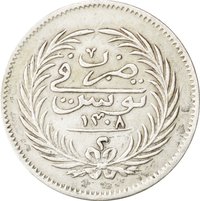
Reverse
Edge
Reeded
Mintings
| Year | Mint Mark | Mintage | Quality | Collection |
|---|---|---|---|---|
| 1890 | — | 52,000 | ||
| 1891 | — | 120,000 | ||
| 1891 | — | — | Proof |
Historical background
In 1890, Tunisia existed under a complex monetary system, a direct reflection of its political status as a French protectorate established just nine years earlier in 1881. While France now controlled Tunisia's foreign policy and finances, the pre-colonial Ottoman and European monetary influences remained deeply embedded in daily commerce. The official currency was the Tunisian rial, a large silver coin subdivided into 16 kharub, each of 13 fals (copper coins). However, this system existed alongside a plethora of circulating foreign coins, creating a chaotic exchange environment.
The most significant foreign currency was the French franc, which gained increasing dominance due to French administrative control and investment. Alongside it, the Spanish peso, the Italian lira, the British sovereign, and various Ottoman and Algerian coins all circulated with fluctuating and locally negotiated values. This multiplicity caused significant confusion for trade and taxation, hindering economic stability. The French administration, seeking to modernize the economy and tighten its fiscal control, recognized the urgent need for monetary unification and reform.
Consequently, the year 1890 fell within a pivotal transitional period. French authorities were actively planning a major currency overhaul, which would culminate in the 1891 decree. This reform formally pegged the Tunisian rial to the French franc at a fixed rate (1 rial = 5 francs) and aimed to gradually phase out the multitude of foreign coins, replacing them with a new, franc-based subsidiary coinage. Thus, the monetary situation in 1890 was one of lingering Ottoman-era complexity under growing pressure from the French protectorate to impose a standardized, colonial-franc system to facilitate economic exploitation and administrative integration.
The most significant foreign currency was the French franc, which gained increasing dominance due to French administrative control and investment. Alongside it, the Spanish peso, the Italian lira, the British sovereign, and various Ottoman and Algerian coins all circulated with fluctuating and locally negotiated values. This multiplicity caused significant confusion for trade and taxation, hindering economic stability. The French administration, seeking to modernize the economy and tighten its fiscal control, recognized the urgent need for monetary unification and reform.
Consequently, the year 1890 fell within a pivotal transitional period. French authorities were actively planning a major currency overhaul, which would culminate in the 1891 decree. This reform formally pegged the Tunisian rial to the French franc at a fixed rate (1 rial = 5 francs) and aimed to gradually phase out the multitude of foreign coins, replacing them with a new, franc-based subsidiary coinage. Thus, the monetary situation in 1890 was one of lingering Ottoman-era complexity under growing pressure from the French protectorate to impose a standardized, colonial-franc system to facilitate economic exploitation and administrative integration.

✨ Legendary