

½ crown – England
Add to wishlist
United Kingdom
Context
Years: 1696–1697
Country: United Kingdom
Issuer: England
Ruler: William III
Currency:
(1158—1970)
Demonetized: Yes
Material
References
KM: #
Numista: #55821
Value
Bullion value: $33.88
Obverse
Description:
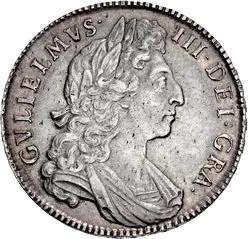
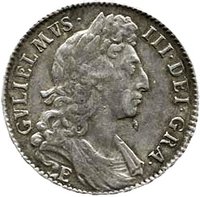
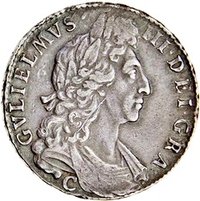
First laureate, draped bust of William III right, legend surrounding.
Inscription:
GVLIELMVS· III·DEI·GRA
Script: Latin
Reverse
Description:
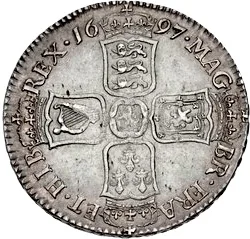
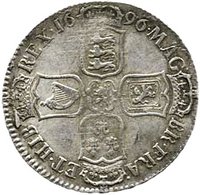
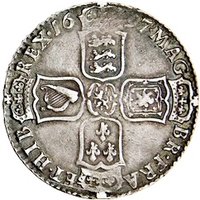
Crowned cruciform shields flank central lion, date above, legend around. Large shields, simple harp.
Inscription:
MAG BR·FRA ET·HIB REX·1697·
Script: Latin
Edge
Regnal year in Latin
Legend:
NONO
Mintings
| Year | Mint Mark | Mintage | Quality | Collection |
|---|---|---|---|---|
| 1696 | — | — | ||
| 1697 | — | — |
Historical background
In 1696, England was in the midst of a severe monetary crisis, primarily driven by the poor state of its silver coinage. For decades, coins had been clipped and filed by the public, reducing their silver content and intrinsic value below their face value. This led to Gresham’s Law in action: "bad money drives out good," as people hoarded full-weight coins and used only the degraded ones for trade. The situation crippled commerce, undermined government finances, and created widespread economic uncertainty, as the very medium of exchange was neither trusted nor uniform.
The government, under King William III and the Chancellor of the Exchequer, Charles Montagu, responded with a radical solution: the Great Recoinage of 1696. This was an immense logistical undertaking, masterminded by the scientist Isaac Newton, who would later become Warden of the Royal Mint. The plan was to recall all the old, damaged silver coins and replace them with new, milled-edge coins that were difficult to clip. The process was financed by a controversial new window tax and a loan from the newly founded Bank of England, established just two years prior in 1694.
The recoinage itself proved deeply disruptive in the short term. The Mint could not produce the new coins fast enough, creating a severe shortage of currency that contracted the economy and caused hardship. However, by successfully restoring a sound and trustworthy silver currency, it laid a critical foundation for financial stability. The crisis also had a lasting unintended consequence: it accelerated the shift toward gold as the de facto standard. With silver scarce, the gold guinea, whose value was fixed by the recoinage, became increasingly dominant in large transactions, setting England on a path that would ultimately lead to the formal Gold Standard in the next century.
The government, under King William III and the Chancellor of the Exchequer, Charles Montagu, responded with a radical solution: the Great Recoinage of 1696. This was an immense logistical undertaking, masterminded by the scientist Isaac Newton, who would later become Warden of the Royal Mint. The plan was to recall all the old, damaged silver coins and replace them with new, milled-edge coins that were difficult to clip. The process was financed by a controversial new window tax and a loan from the newly founded Bank of England, established just two years prior in 1694.
The recoinage itself proved deeply disruptive in the short term. The Mint could not produce the new coins fast enough, creating a severe shortage of currency that contracted the economy and caused hardship. However, by successfully restoring a sound and trustworthy silver currency, it laid a critical foundation for financial stability. The crisis also had a lasting unintended consequence: it accelerated the shift toward gold as the de facto standard. With silver scarce, the gold guinea, whose value was fixed by the recoinage, became increasingly dominant in large transactions, setting England on a path that would ultimately lead to the formal Gold Standard in the next century.
💎 Very Rare