

½ real – Spain
Add to wishlist
Spain
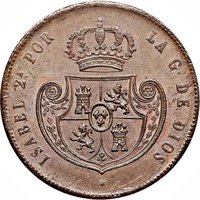
Obverse
Description:
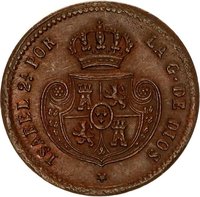
Royal arms of Spain.
Inscription:
ISABEL 2A. POR LA G· DE DIOS
Script: Latin
Engraver: Remigio Vega
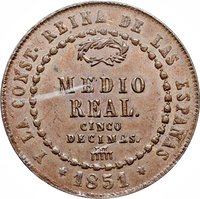
Reverse
Description:
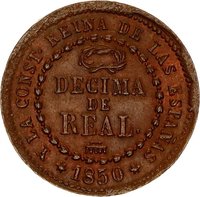
Five-line inscription within dotted circle, surrounded by lettering.
Inscription:
Y LA CONST· REINA DE LAS ESPAÑAS
MEDIO REAL.
CINCO DECIMAS.
· D · G ·
🟌 1848 🟌
MEDIO REAL.
CINCO DECIMAS.
· D · G ·
🟌 1848 🟌
Script: Latin
Engraver: Remigio Vega
Edge
Categories
| Symbols> Coat of Arms |
Mints
| Name | Mark |
|---|---|
| Royal Mint of Madrid | DG |
| Royal Mint of Madrid | (M) |
Mintings
| Year | Mint Mark | Mintage | Quality | Collection |
|---|---|---|---|---|
| 1848 | DG | — | ||
| 1848 | M | — |
Historical background
In 1848, Spain's currency system was a complex and unstable patchwork, reflecting the nation's broader political and economic turmoil in the mid-19th century. The country operated on a bimetallic standard in theory, but in practice, it suffered from a severe shortage of precious metal coinage. Decades of war, colonial losses, and fiscal mismanagement had drained the treasury, leading to the widespread circulation of debased coinage, token money, and a plethora of paper vales (promissory notes) issued by both the state and private banks. This created a climate of monetary confusion, where the face value of a coin often exceeded its intrinsic metal value, and public trust in the medium of exchange was low.
The political instability of the period, marked by the European Revolutions of 1848 which sparked unrest in Spain, exacerbated these monetary problems. Successive governments, desperate for revenue, resorted to inflationary measures. The most significant response was the establishment of the Bank of Spain (Banco de España) in 1856, a project already in gestation by 1848, which aimed to consolidate note-issuing privileges and impose order. However, in the immediate term, the state continued to rely on forced loans from existing banks and the issuance of more debt, further undermining confidence.
Consequently, the Spanish economy in 1848 was hampered by a lack of a uniform, trusted currency, which stifled commerce and investment. Different regions often relied on varying mixes of old royal coinage, French francs (from trade), and unreliable paper. This fragmentation mirrored the country's struggle to modernize its economy and centralize its state. The currency situation of 1848 thus set the stage for the major financial reforms of the 1850s, which would seek to create a unified, gold-backed national currency system to support Spain's industrial and capitalist development.
The political instability of the period, marked by the European Revolutions of 1848 which sparked unrest in Spain, exacerbated these monetary problems. Successive governments, desperate for revenue, resorted to inflationary measures. The most significant response was the establishment of the Bank of Spain (Banco de España) in 1856, a project already in gestation by 1848, which aimed to consolidate note-issuing privileges and impose order. However, in the immediate term, the state continued to rely on forced loans from existing banks and the issuance of more debt, further undermining confidence.
Consequently, the Spanish economy in 1848 was hampered by a lack of a uniform, trusted currency, which stifled commerce and investment. Different regions often relied on varying mixes of old royal coinage, French francs (from trade), and unreliable paper. This fragmentation mirrored the country's struggle to modernize its economy and centralize its state. The currency situation of 1848 thus set the stage for the major financial reforms of the 1850s, which would seek to create a unified, gold-backed national currency system to support Spain's industrial and capitalist development.
💎 Very Rare