

5 Doppie – Castiglione Delle Stiviere
Italy
Context

Material
Diameter: 40 mm
Weight: 35 g
Gold weight: 34.51 g
Shape: Irregular round
Composition: 98.6% Gold
Magnetic: No
Technique: Hammered
Alignment: Medal alignment

flip
References
KM: #Click to copy to clipboard12
Numista: #537001
Value
Bullion value: $5763.63
Obverse
Description:
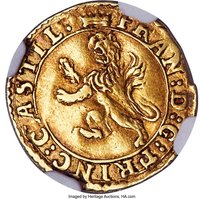
Half-length armored figure right, date beneath.
Inscription:
FRANCISCVS D G PRINCEPS CASTILIONI
GASP
1614
GASP
1614
Script: Latin
Reverse
Description:
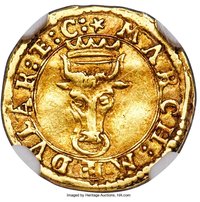
Quartered shield with central escutcheon, encircled by the Order of the Golden Fleece.
Inscription:
MARCHIO MEDVLARVM ET C
Script: Latin
Edge
Mints
| Name | Mark |
|---|---|
| Castiglione delle Stiviere | — |
Mintings
| Year | Mint Mark | Mintage | Quality | Collection |
|---|---|---|---|---|
| 1614 | — | — |
Historical background
In 1614, Castiglione delle Stiviere, a small but significant town in the Duchy of Mantua, operated within a complex and fragmented monetary landscape typical of the Italian peninsula. The official currency was the Mantuan scudo, issued under the authority of Duke Ferdinando Gonzaga. However, the practical reality for merchants and townsfolk was one of monetary plurality. Due to the town's location and trade links, a variety of coins circulated freely alongside the local issue, most notably the powerful Venetian ducat and the Spanish real, reflecting the broader political and economic influences of the Spanish Habsburgs and the Venetian Republic in Lombardy.
This circulation of multiple foreign and domestic coins created chronic challenges. The value of coins was not strictly by face but by their precious metal content (gold or silver), which led to frequent episodes of clipping, counterfeiting, and the deliberate export of full-weight coins, leaving a degraded currency pool behind. Local authorities and the ducal mint in Mantua struggled to enforce official exchange rates (cridae) against the market's constant fluctuations. For Castiglione's economy, based on agriculture, wool, and its famed lace production, this instability introduced uncertainty into every transaction, complicating trade and taxation.
The situation was further strained by the broader fiscal pressures on the Gonzaga court. Duke Ferdinando faced immense debts from lavish patronage and military expenditures, leading to periodic debasements of the Mantuan currency—reducing its silver or gold content to create more coinage from the same metal reserve. While such measures provided short-term relief for the ducal treasury, they eroded public trust, drove up prices, and incentivized hoarding of older, purer coins. Thus, in 1614, a resident of Castiglione delle Stiviere navigated a daily economy defined by a jumble of coins of varying reliability, all subject to the distant and often desperate financial policies of their sovereign.
This circulation of multiple foreign and domestic coins created chronic challenges. The value of coins was not strictly by face but by their precious metal content (gold or silver), which led to frequent episodes of clipping, counterfeiting, and the deliberate export of full-weight coins, leaving a degraded currency pool behind. Local authorities and the ducal mint in Mantua struggled to enforce official exchange rates (cridae) against the market's constant fluctuations. For Castiglione's economy, based on agriculture, wool, and its famed lace production, this instability introduced uncertainty into every transaction, complicating trade and taxation.
The situation was further strained by the broader fiscal pressures on the Gonzaga court. Duke Ferdinando faced immense debts from lavish patronage and military expenditures, leading to periodic debasements of the Mantuan currency—reducing its silver or gold content to create more coinage from the same metal reserve. While such measures provided short-term relief for the ducal treasury, they eroded public trust, drove up prices, and incentivized hoarding of older, purer coins. Thus, in 1614, a resident of Castiglione delle Stiviere navigated a daily economy defined by a jumble of coins of varying reliability, all subject to the distant and often desperate financial policies of their sovereign.
✨ Legendary