

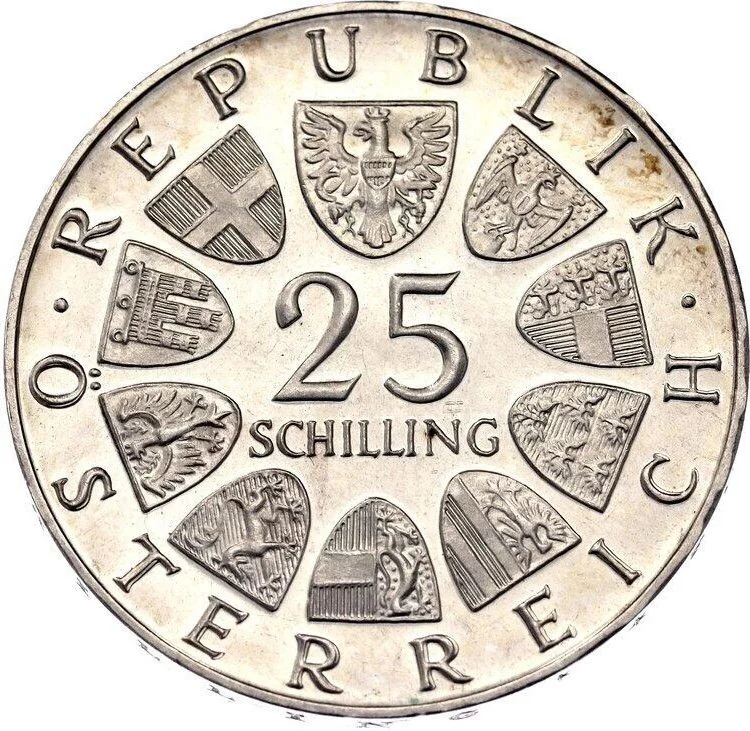
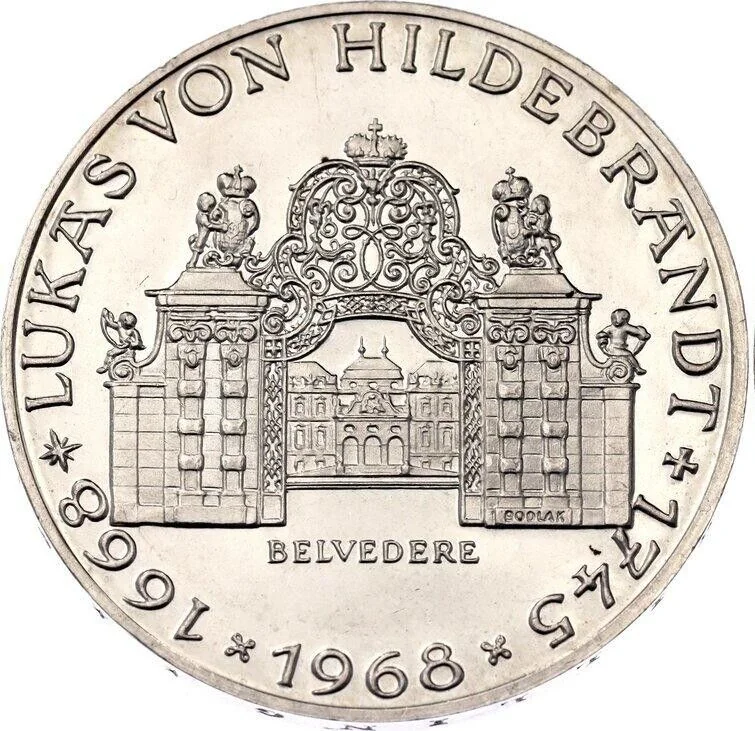
25 Schilling (Lukas von Hildebrandt) – Austria
Non-circulating coins
Commemoration: 300th Anniversary of birth of Lukas von Hildebrandt
Austria

Obverse
Reverse
Description:
Belvedere Castle entrance
Inscription:
1668 LUKAS VON HILDEBRANDT 1745
BELVEDERE
1968
BELVEDERE
1968
Script: Latin
Engraver: Kurt Bodlak
Edge
Smooth with value
Legend:
FUENFUNDZWANZIG SCHILLING **
Translation:
Twenty-Five Schilling
Language: German
Categories
| Building> Castle or fortification |
| Event> Birth anniversary |
Mints
| Name | Mark |
|---|---|
| Münze Österreich | — |
Mintings
| Year | Mint Mark | Mintage | Quality | Collection |
|---|---|---|---|---|
| 1968 | — | 1,258,000 | ||
| 1968 | — | 42,000 | Proof |
Historical background
In 1968, Austria operated under a stable and successful hard currency policy, a cornerstone of its post-war economic identity. The Austrian schilling, reintroduced in 1945, was firmly pegged to the US dollar at a fixed rate of 26 schillings to 1 dollar, a parity established in 1953. This commitment to a strong, convertible currency, managed by the respected Oesterreichische Nationalbank (OeNB), was a deliberate political and economic choice. It fostered low inflation, attracted foreign investment, and symbolized the country's economic recovery and integration into the Western bloc, contrasting sharply with the controlled currencies of Eastern Europe.
This stability, however, existed within a tense international monetary environment. The Bretton Woods system of fixed exchange rates was under growing strain due to US balance-of-payments deficits and inflationary pressures. While not at the epicenter of the crises that would eventually unravel the system, Austria was keenly aware of the vulnerabilities. The schilling's dollar peg meant that international turbulence, particularly speculation against the dollar or the Deutsche Mark (a key reference currency for Austria's trade), required vigilant management by the OeNB to maintain the agreed parity and domestic price stability.
Domestically, 1968 was a year of robust economic growth and near-full employment, which validated the hard currency policy in the public eye. There were no major currency reforms or devaluations that year; the story was one of continuity and confidence. The social partnership, Austria's unique system of consensus between government, business, and labor unions, strongly supported this policy, accepting that wage moderation was necessary to maintain the schilling's strength and Austria's export competitiveness. Thus, the currency situation in 1968 was characterized by a successful, defensive adherence to a fixed parity, providing a bedrock of stability while the foundations of the global monetary order began to shake.
This stability, however, existed within a tense international monetary environment. The Bretton Woods system of fixed exchange rates was under growing strain due to US balance-of-payments deficits and inflationary pressures. While not at the epicenter of the crises that would eventually unravel the system, Austria was keenly aware of the vulnerabilities. The schilling's dollar peg meant that international turbulence, particularly speculation against the dollar or the Deutsche Mark (a key reference currency for Austria's trade), required vigilant management by the OeNB to maintain the agreed parity and domestic price stability.
Domestically, 1968 was a year of robust economic growth and near-full employment, which validated the hard currency policy in the public eye. There were no major currency reforms or devaluations that year; the story was one of continuity and confidence. The social partnership, Austria's unique system of consensus between government, business, and labor unions, strongly supported this policy, accepting that wage moderation was necessary to maintain the schilling's strength and Austria's export competitiveness. Thus, the currency situation in 1968 was characterized by a successful, defensive adherence to a fixed parity, providing a bedrock of stability while the foundations of the global monetary order began to shake.
🌱 Common