

2 Rand – South Africa
Non-circulating coins
Commemoration: Cradle of Mankind
South Africa
Context
Material
Diameter: 22 mm
Weight: 7.78 g
Gold weight: 7.78 g
Shape: Round
Composition: 99.99% Gold
Standard: Silver quarter ounce
Magnetic: No
Technique: Milled
Alignment: Medal alignment

flip
References
KM: #Click to copy to clipboard391
Numista: #534662
Value
Exchange value: 2 ZAR = $0.13
Bullion value: $1297.06
Inflation-adjusted value: 5.55 ZAR
Obverse
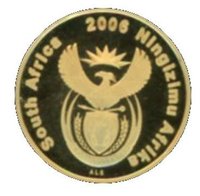
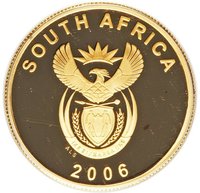
Description:
Heraldic emblem.
Inscription:
SOUTH AFRICA
2006
ALS
2006
ALS
Script: Latin
Engraver: Arthur Sutherland
Reverse
Description:
Human evolution stages: early man, ape, skull, value.
Inscription:
1/4 oz Au 999.9
Cradle of
Humankind
World Heritage Site
R2
MJS
Cradle of
Humankind
World Heritage Site
R2
MJS
Script: Latin
Edge
Reeded
Categories
| Symbols> Coat of Arms |
Mintings
| Year | Mint Mark | Mintage | Quality | Collection |
|---|---|---|---|---|
| 2006 | — | 1,000 | Proof |
Historical background
In 2006, South Africa's currency, the rand, was in a period of relative strength and stability, a significant turnaround from its extreme volatility earlier in the decade. This followed a dramatic depreciation in late 2001, when the rand lost over 50% of its value against major currencies, driven by a complex mix of domestic and international factors including emerging market crises, domestic political concerns, and capital outflows. The recovery was underpinned by a sustained commodity boom, with high global prices for South Africa's key exports like gold, platinum, and other minerals driving strong current account surpluses and attracting foreign investment.
The macroeconomic policy framework, established in the post-apartheid era, provided a crucial anchor. The South African Reserve Bank (SARB), operating under a formal inflation-targeting regime adopted in 2000, maintained a tight monetary policy with high interest rates to curb inflation, which bolstered investor confidence. Concurrently, the government's commitment to fiscal discipline, demonstrated through consistent budget surpluses and reduced public debt, earned positive reviews from international credit rating agencies and markets. This "virtuous cycle" of high commodity prices, prudent policy, and capital inflows saw the rand trade in a range of approximately R6 to R7.50 against the US dollar for much of the year, a marked appreciation from its historic low near R13.90 in 2001.
However, this strength presented its own set of challenges. The robust rand began to hurt the manufacturing and export sectors outside of commodities, making South African goods more expensive internationally and raising concerns about "Dutch disease" and long-term de-industrialization. Policymakers faced the difficult task of balancing the benefits of a strong currency—such as lower imported inflation and cheaper capital goods—against the need to protect jobs in vulnerable industries. Thus, while 2006 represented a year of currency stability and economic confidence, it also laid the groundwork for ongoing debates about exchange rate management and the structure of the South African economy.
The macroeconomic policy framework, established in the post-apartheid era, provided a crucial anchor. The South African Reserve Bank (SARB), operating under a formal inflation-targeting regime adopted in 2000, maintained a tight monetary policy with high interest rates to curb inflation, which bolstered investor confidence. Concurrently, the government's commitment to fiscal discipline, demonstrated through consistent budget surpluses and reduced public debt, earned positive reviews from international credit rating agencies and markets. This "virtuous cycle" of high commodity prices, prudent policy, and capital inflows saw the rand trade in a range of approximately R6 to R7.50 against the US dollar for much of the year, a marked appreciation from its historic low near R13.90 in 2001.
However, this strength presented its own set of challenges. The robust rand began to hurt the manufacturing and export sectors outside of commodities, making South African goods more expensive internationally and raising concerns about "Dutch disease" and long-term de-industrialization. Policymakers faced the difficult task of balancing the benefits of a strong currency—such as lower imported inflation and cheaper capital goods—against the need to protect jobs in vulnerable industries. Thus, while 2006 represented a year of currency stability and economic confidence, it also laid the groundwork for ongoing debates about exchange rate management and the structure of the South African economy.
✨ Legendary