

10 Dollars (British Protectorate) – Solomon Islands
Non-circulating coins
Commemoration: 100 Years as British Protectorate
Solomon Islands
Context
Material
References
KM: #Click to copy to clipboard49
Numista: #526601
Value
Exchange value: 10 SBD
Bullion value: $76.81
Obverse
Description:
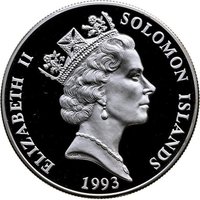
Elizabeth II facing right, encircled by text.
Inscription:
ELIZABETH II SOLOMON ISLANDS
RDM
1993
RDM
1993
Script: Latin
Designer: Raphael David Maklouf
Reverse
Description:
Queen Victoria portrait on two ships, encircled by text.
Inscription:
WESTERN PACIFIC ORDER IN COUNCIL 1893
10
DOLLARS
10
DOLLARS
Script: Latin
Edge
Reeded
Categories
| Person> Monarch |
| Transportation> Watercraft |
Mintings
| Year | Mint Mark | Mintage | Quality | Collection |
|---|---|---|---|---|
| 1993 | — | 5,000 | Proof |
Historical background
In 1993, the currency situation in Solomon Islands was defined by the exclusive use of the Solomon Islands dollar (SBD), which had been the nation's official currency since its introduction in 1977, replacing the Australian dollar. The currency was, and remains, managed by the Central Bank of Solomon Islands (CBSI). The period was one of relative stability for the SBD, but it operated within a challenging economic context. The country's economy was heavily dependent on exports of primary commodities, particularly timber, fish, and palm oil, making the currency vulnerable to fluctuations in global commodity prices and weather-related disruptions to agriculture.
The broader economic backdrop was one of recovery and cautious growth following a period of fiscal difficulty in the late 1980s. The government, under Prime Minister Solomon Mamaloni, was engaged in structural adjustment programs influenced by the International Monetary Fund and World Bank, which aimed to stabilize public finances and promote private-sector growth. These policies indirectly impacted the currency by affecting foreign exchange reserves and the balance of payments. While not in a state of crisis in 1993, the Solomon Islands dollar faced persistent pressures from a trade deficit and the demands of financing public expenditure.
Overall, the currency system in 1993 was stable but fragile, reflecting the underlying vulnerabilities of a small, open, and resource-dependent island economy. The Central Bank maintained a managed float, though the currency's value was significantly influenced by the flow of export earnings and development aid. This period preceded the severe economic and social turmoil that would engulf the country later in the decade during the ethnic tensions (1998-2003), which would profoundly destabilize the nation's economy and financial systems.
The broader economic backdrop was one of recovery and cautious growth following a period of fiscal difficulty in the late 1980s. The government, under Prime Minister Solomon Mamaloni, was engaged in structural adjustment programs influenced by the International Monetary Fund and World Bank, which aimed to stabilize public finances and promote private-sector growth. These policies indirectly impacted the currency by affecting foreign exchange reserves and the balance of payments. While not in a state of crisis in 1993, the Solomon Islands dollar faced persistent pressures from a trade deficit and the demands of financing public expenditure.
Overall, the currency system in 1993 was stable but fragile, reflecting the underlying vulnerabilities of a small, open, and resource-dependent island economy. The Central Bank maintained a managed float, though the currency's value was significantly influenced by the flow of export earnings and development aid. This period preceded the severe economic and social turmoil that would engulf the country later in the decade during the ethnic tensions (1998-2003), which would profoundly destabilize the nation's economy and financial systems.
✨ Legendary