

2 euro – Monaco
Add to wishlist
Non-circulating coins
Commemoration: Marquisate of Baux
Monaco
Obverse
Description:
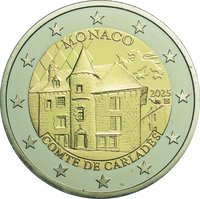
Les ruines du château des Baux, le soleil et les armoiries de Monaco.
Inscription:
MONACO
2025
MARQUISAT DES BAUX
2025
MARQUISAT DES BAUX
Script: Latin
Engraver: Joaquin Jimenez
Reverse
Edge
The sequence "2 ★ ★" repeated six times alternately upright and inverted
Legend:
2★★2★★2★★2★★2★★2★★
Categories
| Building> Castle or fortification |
| Map |
Mints
| Name | Mark |
|---|---|
| Monnaie de Paris | — |
Mintings
| Year | Mint Mark | Mintage | Quality | Collection |
|---|---|---|---|---|
| 2025 | — | 15,000 | Proof |
Historical background
In 2025, Monaco’s currency situation remains firmly anchored to the Eurozone, with the euro (EUR) as its sole official and legal tender. This arrangement is governed by a monetary agreement with the European Union, first formalized in 2002 and subsequently renewed, which grants Monaco the unique right to issue its own euro coins. These Monegasque euro coins, featuring the Prince’s seal and national symbols, are minted in limited quantities primarily for collectors and ceremonial purposes, but circulate at par value alongside other euro coins throughout the Eurozone. The principality has no independent monetary policy, effectively ceding control over interest rates and money supply to the European Central Bank (ECB).
The stability provided by the euro is considered fundamental to Monaco’s economic model, which is heavily reliant on high-end tourism, luxury commerce, and financial services. The use of the euro eliminates exchange rate risk for the vast majority of its business and clientele, who primarily come from the EU, and ensures seamless financial integration with its immediate neighbors, France and Italy. While there is no political movement to alter this arrangement, discussions in financial circles occasionally touch on the broader vulnerabilities of this dependency, particularly regarding ECB policies that may not always align perfectly with Monaco’s specific, tourism-driven economic cycles and its lack of formal representation in EU institutions.
Looking ahead, the primary currency-related focus for Monaco in 2025 is on the digital and regulatory frontier rather than any change in tender. The government and financial sector are actively adapting to new EU-wide regulations on anti-money laundering (AML) and digital finance, including the potential implications of a digital euro. As a prestigious global financial center, Monaco is enhancing its compliance frameworks to maintain its reputation and ensure its currency operations—though based on the euro—meet evolving international standards for transparency and security in an increasingly digitalized global economy.
The stability provided by the euro is considered fundamental to Monaco’s economic model, which is heavily reliant on high-end tourism, luxury commerce, and financial services. The use of the euro eliminates exchange rate risk for the vast majority of its business and clientele, who primarily come from the EU, and ensures seamless financial integration with its immediate neighbors, France and Italy. While there is no political movement to alter this arrangement, discussions in financial circles occasionally touch on the broader vulnerabilities of this dependency, particularly regarding ECB policies that may not always align perfectly with Monaco’s specific, tourism-driven economic cycles and its lack of formal representation in EU institutions.
Looking ahead, the primary currency-related focus for Monaco in 2025 is on the digital and regulatory frontier rather than any change in tender. The government and financial sector are actively adapting to new EU-wide regulations on anti-money laundering (AML) and digital finance, including the potential implications of a digital euro. As a prestigious global financial center, Monaco is enhancing its compliance frameworks to maintain its reputation and ensure its currency operations—though based on the euro—meet evolving international standards for transparency and security in an increasingly digitalized global economy.
💎 Very Rare