



Obverse
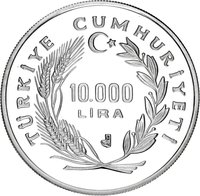
Reverse
Edge
Reeded
Mints
| Name | Mark |
|---|---|
| Mexican Mint | — |
Mintings
| Year | Mint Mark | Mintage | Quality | Collection |
|---|---|---|---|---|
| 1988 | — | 998 | Proof |
Historical background
In 1988, Turkey was in the midst of a profound economic transformation and instability under the government of Prime Minister Turgut Özal. His policies, which began in the early 1980s, aggressively promoted liberalization, export-led growth, and financial deregulation. While this spurred significant growth and modernization, it also led to chronic high inflation, large budget deficits, and a rapidly increasing foreign debt burden. The Turkish lira was under intense pressure, having undergone a dramatic devaluation; it had lost over two-thirds of its value against the US dollar since the start of the decade, with annual inflation persistently hovering around 70-75%.
The currency situation was characterized by a heavily managed float and a complex dual-exchange rate system. The Central Bank of the Republic of Turkey (CBRT) maintained an official rate for public sector transactions, while a more influential free market rate, determined in Istanbul's Banknotes Market, dictated most commercial and private sector activity. This created distortions and opportunities for arbitrage. Furthermore, high inflation made the lira an unattractive store of value, leading to widespread "dollarization" of the economy, where citizens and businesses increasingly held and transacted in foreign currencies, particularly US dollars and Deutsche Marks, to preserve savings.
The government's response in this period focused on maintaining growth and managing the symptoms rather than tackling the root causes of inflation. Interest rates were kept artificially low in real terms (below inflation), which encouraged borrowing but discouraged saving in lira and fueled further money supply growth. Consequently, 1988 represented a precarious balancing act: the economy was growing and integrating globally, but it was built on a foundation of fiscal imbalances and monetary instability that stored up severe problems for the coming decade, culminating in repeated financial crises in the 1990s and 2001.
The currency situation was characterized by a heavily managed float and a complex dual-exchange rate system. The Central Bank of the Republic of Turkey (CBRT) maintained an official rate for public sector transactions, while a more influential free market rate, determined in Istanbul's Banknotes Market, dictated most commercial and private sector activity. This created distortions and opportunities for arbitrage. Furthermore, high inflation made the lira an unattractive store of value, leading to widespread "dollarization" of the economy, where citizens and businesses increasingly held and transacted in foreign currencies, particularly US dollars and Deutsche Marks, to preserve savings.
The government's response in this period focused on maintaining growth and managing the symptoms rather than tackling the root causes of inflation. Interest rates were kept artificially low in real terms (below inflation), which encouraged borrowing but discouraged saving in lira and fueled further money supply growth. Consequently, 1988 represented a precarious balancing act: the economy was growing and integrating globally, but it was built on a foundation of fiscal imbalances and monetary instability that stored up severe problems for the coming decade, culminating in repeated financial crises in the 1990s and 2001.


✨ Legendary