Logo Title
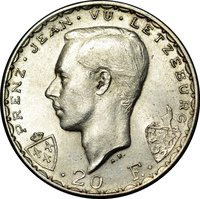
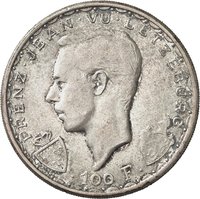
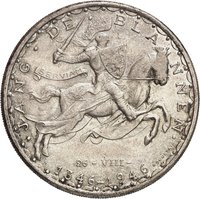
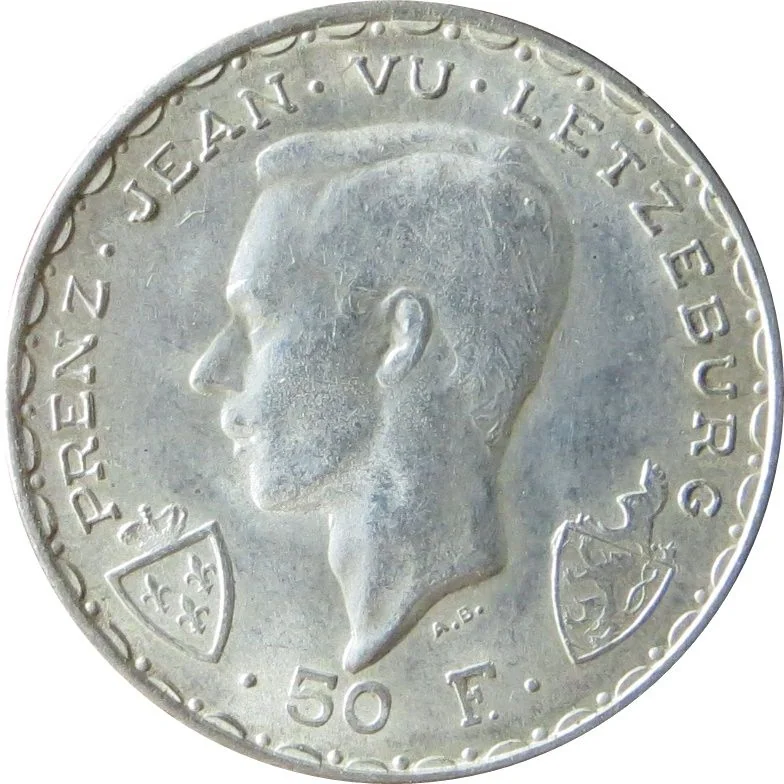
obverse
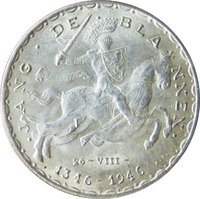
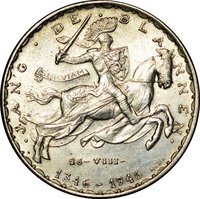
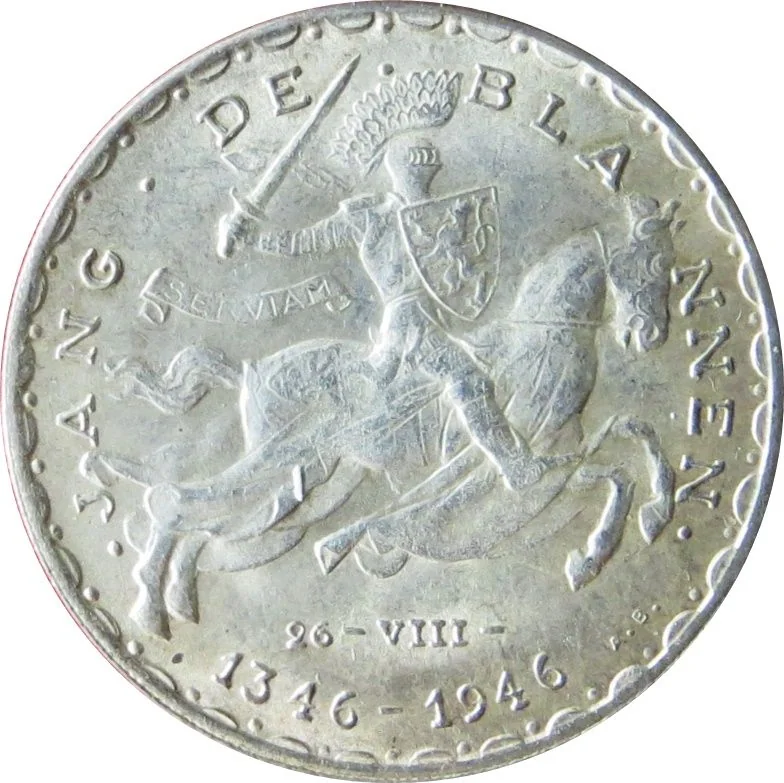
reverse
Mr. Midnight CC0

50 Francs (John the Blind's death at the battle of Crécy) – Grand Duchy of Luxembourg

Circulating commemorative coins
Commemoration: 600th Anniversary of the death of John the Blind at the battle of Crécy
Luxembourg
Context
Year: 1946
Country: Luxembourg Country flag
Ruler: Charlotte
Currency:
(1854—2001)
Demonetization: 1 July 1956
Total mintage: 100,100
Material
Diameter: 31 mm
Weight: 12.5 g
Silver weight: 10.44 g
Thickness: 1.95 mm
Shape: Round
Composition: Silver (83.5% Silver, 16.5% Copper)
Magnetic: No
Technique: Milled
Alignment: Coin alignment
Obverse
OBVERSE ↑
flip
Reverse
REVERSE ↓
References
KM: #Click to copy to clipboard48
Numista: #12411
Value
Exchange value: 50 LUF
Bullion value: $29.26

Obverse

Description:
Portrait left of Prince Jean, Hereditary Grand Duke of Luxembourg (1921–2019). Left: crowned Bourbon arms. Right: Luxembourg arms with crested helm. Engraver's initials below neck. Surrounding legend in Luxembourgish, face value between dots in exergue.
Inscription:
PRENZ•JEAN•VU•LETZEBURG

A.H.

•50 F.•
Translation:
Prince Jean of Luxembourg

50 Francs
Script: Latin
Languages: Luxembourgish, German

Reverse

Description:
Warrior (John the Blind) on horseback, wearing a crested helmet, wields a sword and a shield with Luxembourg's arms. A banner behind him bears his motto. The Luxembourg legend surrounds the scene, with the engraver's initials at 5 o'clock and the dates of his death and the coin's issue below.
Inscription:
•JANG•DE•BLANNEN•

SERVIAM

26-VIII-

1346 - 1946

A.B.
Translation:
I will serve

26 August

1346 - 1946

A.B.
Script: Latin
Languages: French, Latin

Edge

Milled

Mints

NameMark
Royal Mint of Belgium

Mintings

YearMint MarkMintageQualityCollection
1946100,000
1946100Proof

Historical background

In 1946, the Grand Duchy of Luxembourg was navigating a complex post-war monetary landscape, fundamentally shaped by the Belgian-Luxembourg Economic Union (BLEU) established in 1921. This union meant that the Luxembourg franc was pegged at par to the Belgian franc, and Belgian banknotes were legal tender within Luxembourg. However, the war had severely disrupted this system. The German occupation (1940-1944) had forcibly replaced the franc with the Reichsmark, and the subsequent liberation brought a period of monetary confusion with Allied military currency and old Belgian notes circulating alongside new issues.

The immediate post-war priority was monetary stabilization and the reassertion of sovereign control. In 1944, the Luxembourg government introduced a new national franc, but its circulation was limited and it coexisted with the still-dominant Belgian franc. By 1946, the key challenge was not a unique Luxembourg currency crisis, but rather managing inflation and economic reconstruction within the constraints of the BLEU. Luxembourg's monetary policy was largely dictated by decisions made in Brussels, as the two countries worked to harmonize their post-war recovery, including a major devaluation of the Belgian (and thus Luxembourg) franc against the US dollar in December 1945 to boost exports.

Therefore, the currency situation in Luxembourg in 1946 was one of dependent stability. The country did not face hyperinflation or a collapsed independent currency, thanks to the BLEU framework which anchored its franc to Belgium's recovering economy. The focus was on using this stable, if externally influenced, monetary base to facilitate national reconstruction, rebuild shattered infrastructure, and restore industrial production, particularly in the vital steel sector, within a broader Benelux and European recovery context.
🌟 Uncommon