

10 Litų (Republic of Lithuania) – Lithuania
Circulating commemorative coins
Commemoration: 20th anniversary of the Republic of Lithuania
Lithuania
Context

Material
References
KM: #Click to copy to clipboard84
Numista: #12410
Value
Bullion value: $38.64
Obverse
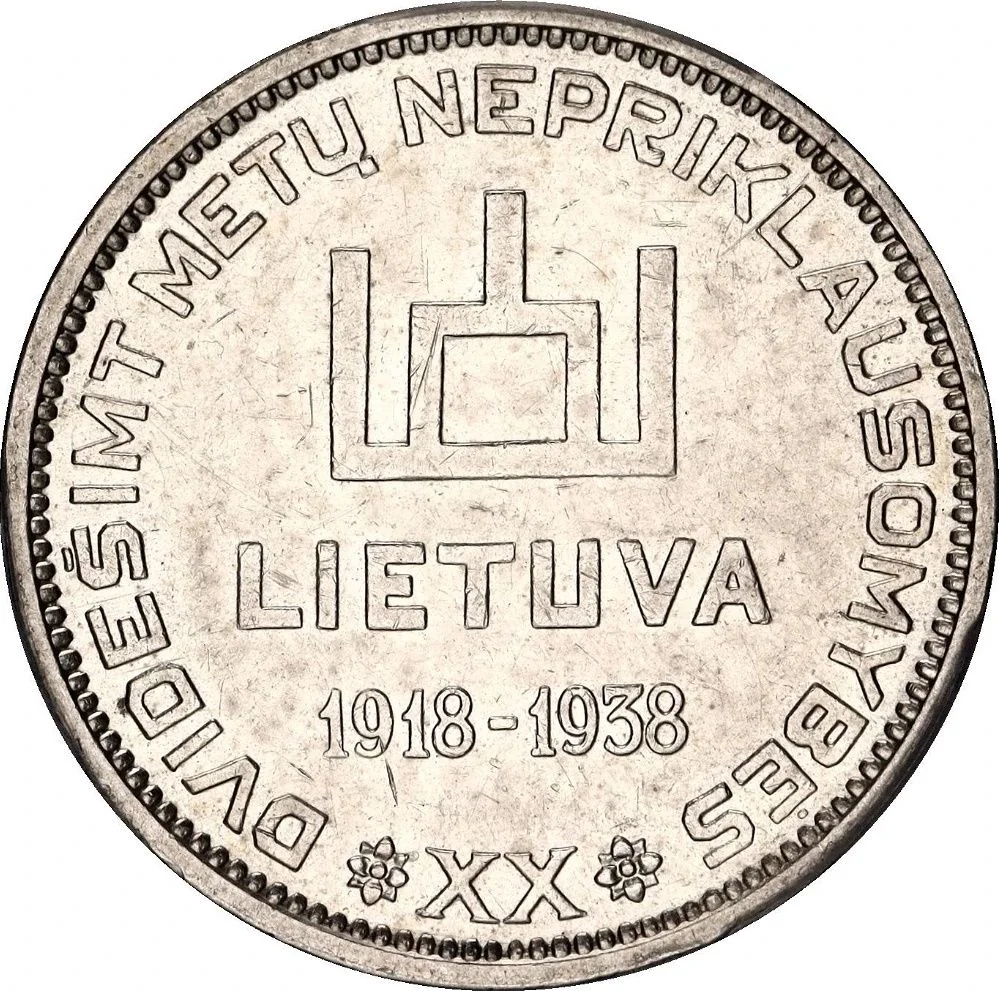
Description:
Gediminas' Columns
Inscription:
XX DVIDEŠIMT METŲ NEPRIKLAUSOMYBĖS
LIETUVA
1918-1938
LIETUVA
1918-1938
Translation:
TWENTY YEARS OF INDEPENDENCE
LITHUANIA
1918-1938
LITHUANIA
1918-1938
Script: Latin
Language: Lithuanian
Designer: Juozas Zikaras
Reverse
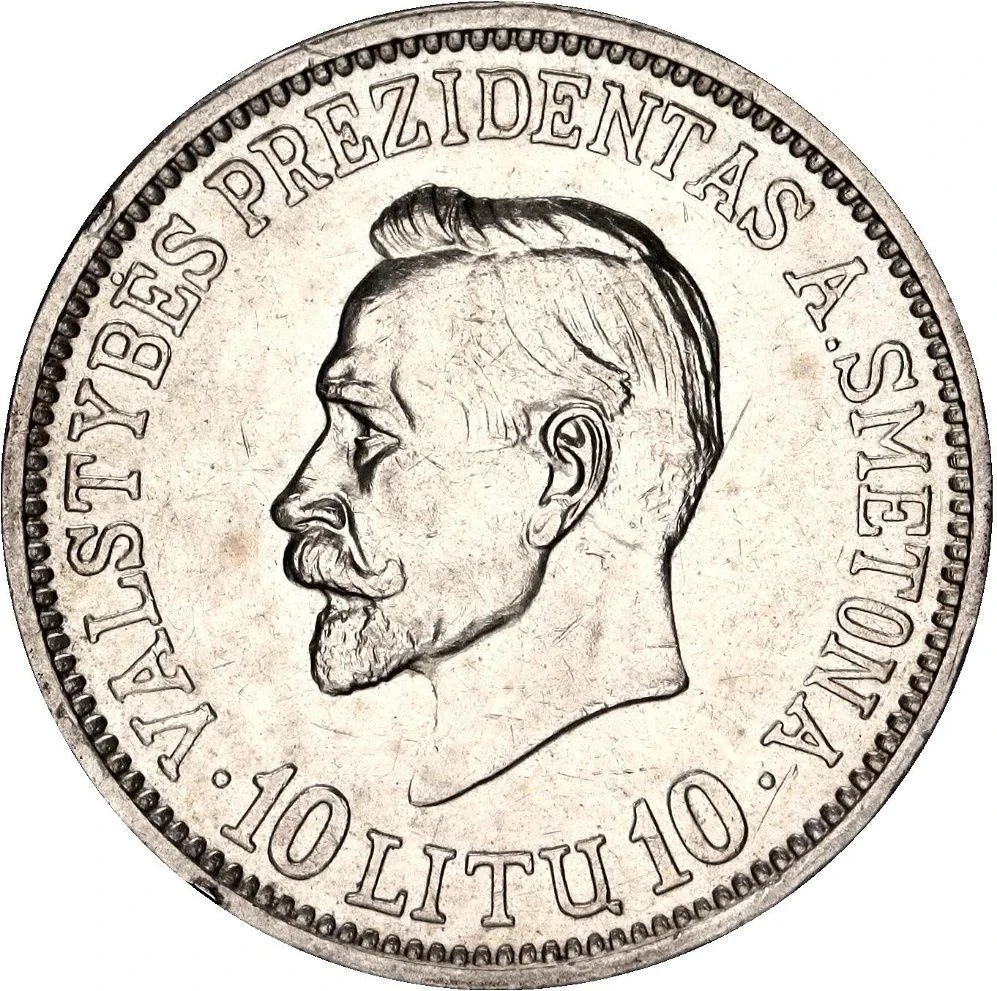
Description:
Head left (Antanas Smetona, Lithuania's first president).
Inscription:
VALSTYBĖS PREZIDENTAS A. SMETONA
10 LITŲ 10
10 LITŲ 10
Translation:
State President A. Smetona
10 Litas 10
10 Litas 10
Script: Latin
Language: Lithuanian
Edge
Smooth with inscription
Legend:
TAUTOS JĖGA VIENYBĖJE
Translation:
The strength of the nation is in unity.
Language: Lithuanian
Categories
| Event> Independence |
| Person> Politician |
Mints
| Name | Mark |
|---|---|
| Royal Mint of Belgium | — |
Mintings
| Year | Mint Mark | Mintage | Quality | Collection |
|---|---|---|---|---|
| 1938 | — | 180,000 |
Historical background
In 1938, the Republic of Lithuania operated under a stable and modern national currency, the Litas, which had been successfully reintroduced in 1922 to replace the ostmark and ostruble of the wartime occupation period. The currency's stability was a point of national pride, having been established on the gold standard in a landmark 1922 reform led by Prime Minister Ernestas Galvanauskas. Backed by a substantial gold reserve and pegged to the US dollar at a fixed rate of 10 Litas to 1 Dollar, the Litas enjoyed strong public and international confidence, facilitating steady economic growth and trade.
This monetary stability, however, existed within a tense geopolitical context. Lithuania's economy was predominantly agricultural, and its financial system, centered around the Bank of Lithuania, was acutely aware of regional pressures. The most significant shadow was cast by a long-standing trade dispute with neighboring Poland, stemming from Lithuania's refusal to recognize Poland's 1920 annexation of the Vilnius region. A Polish economic blockade throughout much of the 1920s and early 1930s had initially strained the economy, but by 1938, with the blockade eased following a Polish ultimatum, trade links were cautiously reopening, offering new prospects for the Litas's role in commerce.
Despite this outward stability, the year 1938 was one of quiet apprehension for Lithuanian financial authorities. The looming threat of Nazi Germany and the Soviet Union created underlying anxiety about the nation's long-term sovereignty and, by extension, the autonomy of its monetary policy. While the Litas remained strong and unconverted, there were unspoken concerns about the vulnerability of the national gold reserves and the currency's future in the face of potential regional conflict. Thus, the robust currency situation of 1938, while a testament to two decades of sound fiscal policy, was ultimately a calm before the storm that would see the Litas forcibly replaced by the Soviet Ruble following the Soviet occupation in 1940.
This monetary stability, however, existed within a tense geopolitical context. Lithuania's economy was predominantly agricultural, and its financial system, centered around the Bank of Lithuania, was acutely aware of regional pressures. The most significant shadow was cast by a long-standing trade dispute with neighboring Poland, stemming from Lithuania's refusal to recognize Poland's 1920 annexation of the Vilnius region. A Polish economic blockade throughout much of the 1920s and early 1930s had initially strained the economy, but by 1938, with the blockade eased following a Polish ultimatum, trade links were cautiously reopening, offering new prospects for the Litas's role in commerce.
Despite this outward stability, the year 1938 was one of quiet apprehension for Lithuanian financial authorities. The looming threat of Nazi Germany and the Soviet Union created underlying anxiety about the nation's long-term sovereignty and, by extension, the autonomy of its monetary policy. While the Litas remained strong and unconverted, there were unspoken concerns about the vulnerability of the national gold reserves and the currency's future in the face of potential regional conflict. Thus, the robust currency situation of 1938, while a testament to two decades of sound fiscal policy, was ultimately a calm before the storm that would see the Litas forcibly replaced by the Soviet Ruble following the Soviet occupation in 1940.
🌱 Fairly Common