

1 Dollar – New Zealand
Non-circulating coins
Commemoration: Royal Visit - Mount Cook
New Zealand
Context
Material
Diameter: 38.61 mm
Weight: 28.28 g
Thickness: 3 mm
Shape: Round
Composition: Copper-nickel
Technique: Milled
Alignment: Medal alignment
flip
References
KM: #Click to copy to clipboard42
Numista: #12406
Value
Exchange value: 1 NZD = $0.60
Inflation-adjusted value: 19.07 NZD
Obverse
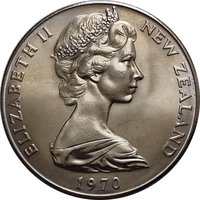
Description:
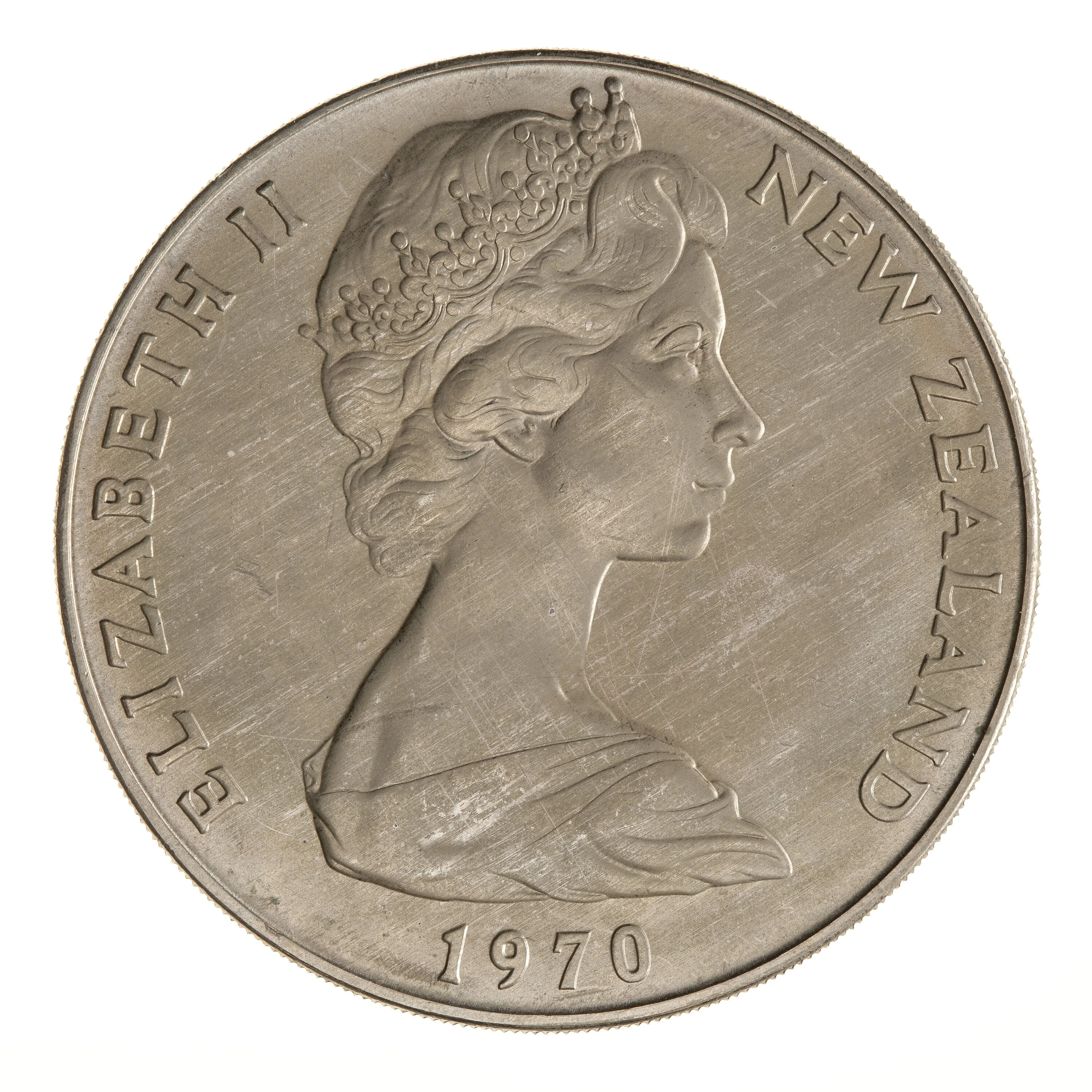
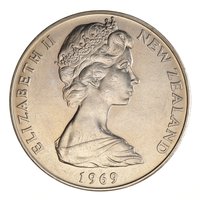
Second crowned portrait of Queen Elizabeth II, wearing the Girls of Great Britain and Ireland tiara, with legend around and date below.
Inscription:
ELIZABETH II NEW ZEALAND
1970
1970
Script: Latin
Designer: Arnold Machin
Reverse
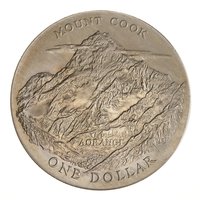
Description:
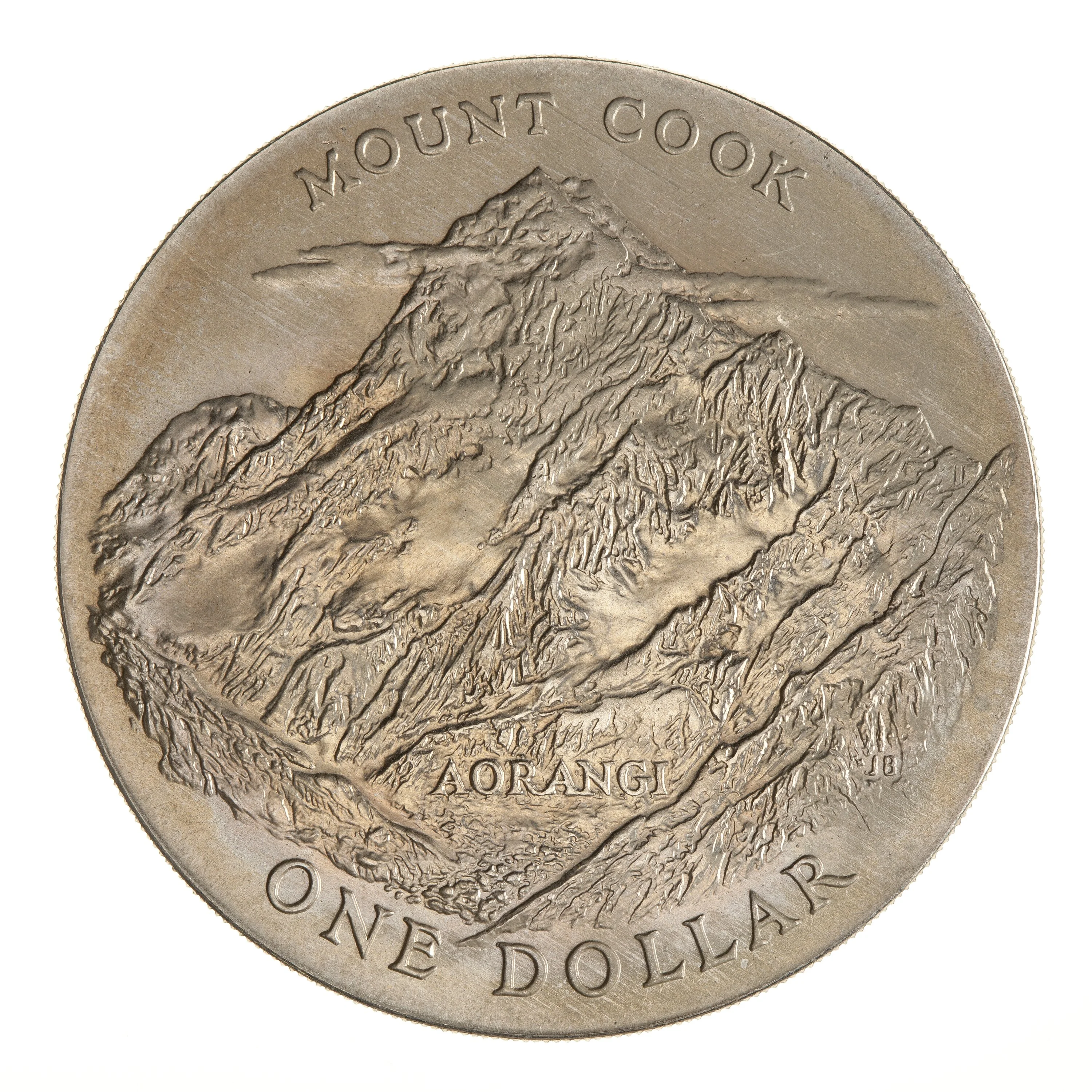
Mount Cook image, legend above, name below.
Inscription:
MOUNT COOK
AORANGI
ONE DOLLAR
AORANGI
ONE DOLLAR
Translation:
Mount Cook
Aorangi
One Dollar
Aorangi
One Dollar
Script: Latin
Designer: George James Berry
Edge
Reeded
Mints
| Name | Mark |
|---|---|
| Royal Australian Mint | — |
Mintings
| Year | Mint Mark | Mintage | Quality | Collection |
|---|---|---|---|---|
| 1970 | — | 20,000 | BU | |
| 1970 | — | 285,000 |
Historical background
In 1970, New Zealand operated under a fixed exchange rate system, a legacy of the post-war Bretton Woods agreement. The New Zealand pound (NZ£) was pegged to the British pound sterling (GBP) at parity, meaning one NZ£ equaled one GBP. This link was a cornerstone of economic policy, reflecting deep historical trade and financial ties to the United Kingdom. The system provided stability for an export-driven economy still heavily reliant on agricultural commodities, particularly wool, meat, and dairy, sold primarily to the British market.
However, this stability was increasingly strained by underlying economic pressures. The long-standing preferential access to the UK market was under threat as Britain moved towards joining the European Economic Community (EEC), casting doubt on New Zealand's primary export future. Domestically, inflationary pressures were building, and the rigid peg limited the government's ability to use independent monetary policy to address them. The fixed rate also made the currency vulnerable to speculative flows, as confidence in the sterling peg wavered internationally.
Consequently, 1970 marked a pivotal late stage in the old monetary order. While the formal link to sterling remained, decimalisation occurred in July 1967, replacing the pound with the New Zealand dollar (NZD) at a rate of two dollars to one pound. More significantly, this new dollar was pegged not to sterling alone but to the US dollar, signalling a strategic shift. The Bretton Woods system itself was crumbling, and within a few years, in 1973, New Zealand would be forced to abandon fixed rates altogether and float its currency, ending the era of which 1970 was a final, tense chapter.
However, this stability was increasingly strained by underlying economic pressures. The long-standing preferential access to the UK market was under threat as Britain moved towards joining the European Economic Community (EEC), casting doubt on New Zealand's primary export future. Domestically, inflationary pressures were building, and the rigid peg limited the government's ability to use independent monetary policy to address them. The fixed rate also made the currency vulnerable to speculative flows, as confidence in the sterling peg wavered internationally.
Consequently, 1970 marked a pivotal late stage in the old monetary order. While the formal link to sterling remained, decimalisation occurred in July 1967, replacing the pound with the New Zealand dollar (NZD) at a rate of two dollars to one pound. More significantly, this new dollar was pegged not to sterling alone but to the US dollar, signalling a strategic shift. The Bretton Woods system itself was crumbling, and within a few years, in 1973, New Zealand would be forced to abandon fixed rates altogether and float its currency, ending the era of which 1970 was a final, tense chapter.
🌱 Common