

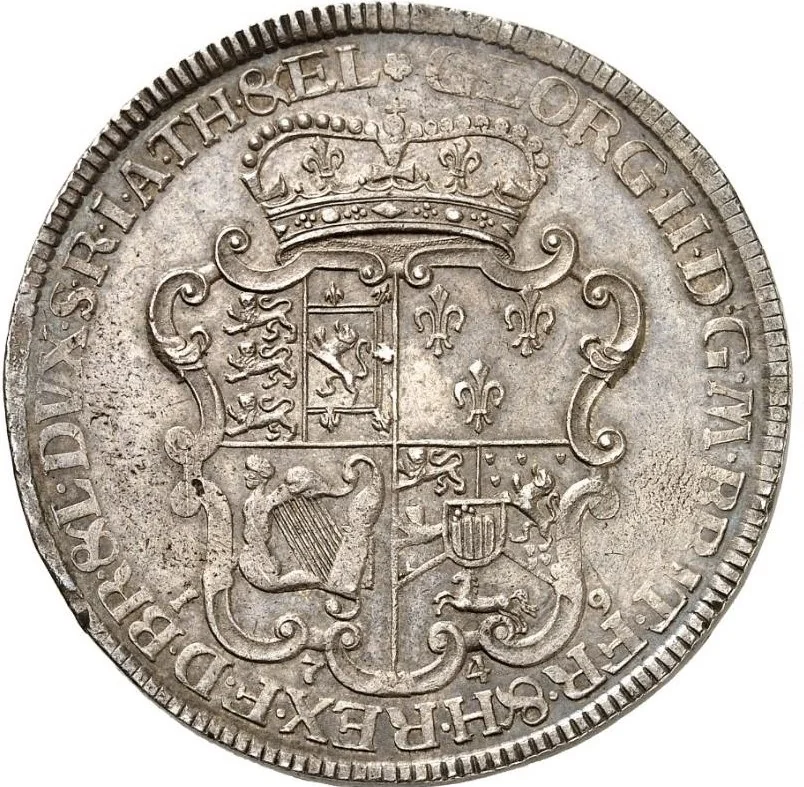

Obverse
Description:
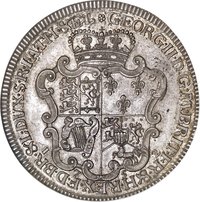
Quartered arms on an ornate shield.
Inscription:
GEORG • II • D • G • M • BRIT • FR • & H • REX • F • D • BR • & L • DVX • S • R • I • A • TH • EL • *
1749
1749
Script: Latin
Reverse
Description:
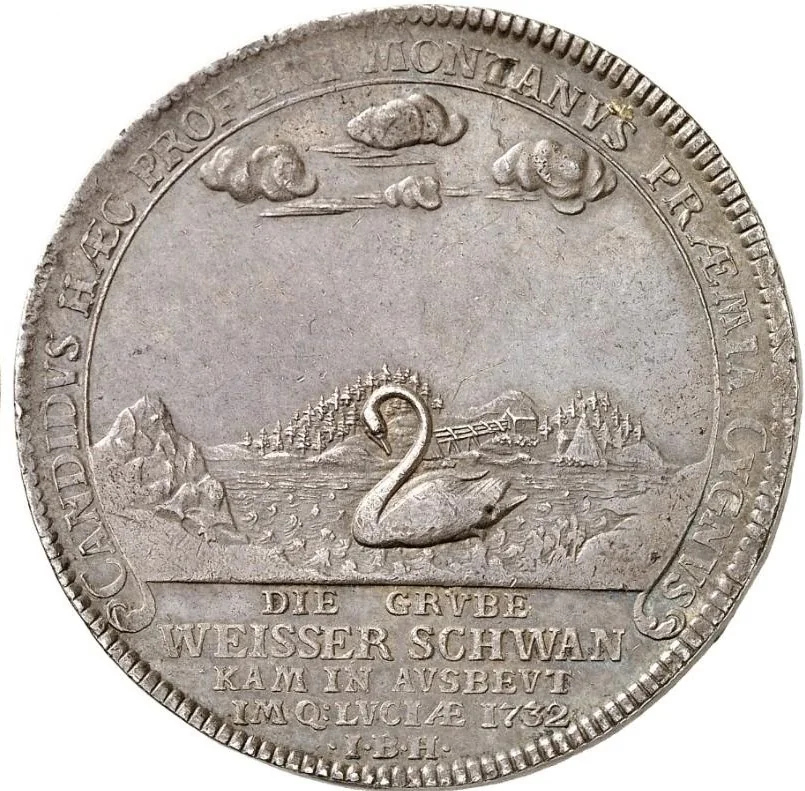
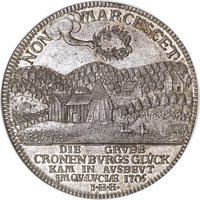
Swan glides on a lake between hills under clouds.
Inscription:
CANDIDVS HAEC PROFERT MONTANVS PRAEMIA CYGNVS,
DIE GRVBE
WEISSER SCHWAN
KAM IN AVSBEVT
IM Q: LVCIAE 1732
I.B.H.
DIE GRVBE
WEISSER SCHWAN
KAM IN AVSBEVT
IM Q: LVCIAE 1732
I.B.H.
Script: Latin
Edge
Mints
| Name | Mark |
|---|---|
| Zellerfeld | — |
Mintings
| Year | Mint Mark | Mintage | Quality | Collection |
|---|---|---|---|---|
| 1744 | — | — | ||
| 1745 | — | — | ||
| 1748 | — | — | ||
| 1749 | — | — | ||
| 1750 | — | — | ||
| 1752 | — | — | ||
| 1756 | — | — |
Historical background
In 1744, the currency situation in the Electorate of Brunswick-Lüneburg (commonly referred to as Hanover after its capital) was complex and strained, a legacy of its fragmented political past. The territory, now under the personal rule of the British King George II, operated within a mosaic of monetary systems. While the official unit of account was the Reichsthaler, divided into 24 Gute Groschen or 36 Mariengroschen, the actual circulating coinage was a confusing mix. Older coins from the various former subdivisions (like Calenberg, Grubenhagen, and Lüneburg), neighbouring German states, and foreign currencies (especially English coin due to the personal union) all circulated simultaneously, leading to chronic problems with valuation and exchange.
This monetary fragmentation was exacerbated by the financial demands of the War of the Austrian Succession (1740-1748), in which Hanover was actively involved as a British ally. The need to fund military campaigns placed severe pressure on state finances, increasing the temptation towards currency debasement. While a formal, significant devaluation was avoided in 1744, the state likely struggled to maintain the specie value of its coinage against the flood of lower-quality coins in regional circulation. This created a climate of uncertainty for commerce, where the intrinsic silver content of a coin often mattered more than its face value.
Consequently, the year 1744 represents a point of persistent monetary challenge rather than dramatic reform. The Hanoverian administration had to navigate the competing needs of funding its military commitments, maintaining some semblance of monetary stability for its economy, and managing the inconvenient reality of a heterogeneous coinage. This situation would eventually contribute to later 18th-century efforts at standardization, but in the mid-1740s, the currency system remained a patchwork, strained by the costs of war and the complexities of its political unions.
This monetary fragmentation was exacerbated by the financial demands of the War of the Austrian Succession (1740-1748), in which Hanover was actively involved as a British ally. The need to fund military campaigns placed severe pressure on state finances, increasing the temptation towards currency debasement. While a formal, significant devaluation was avoided in 1744, the state likely struggled to maintain the specie value of its coinage against the flood of lower-quality coins in regional circulation. This created a climate of uncertainty for commerce, where the intrinsic silver content of a coin often mattered more than its face value.
Consequently, the year 1744 represents a point of persistent monetary challenge rather than dramatic reform. The Hanoverian administration had to navigate the competing needs of funding its military commitments, maintaining some semblance of monetary stability for its economy, and managing the inconvenient reality of a heterogeneous coinage. This situation would eventually contribute to later 18th-century efforts at standardization, but in the mid-1740s, the currency system remained a patchwork, strained by the costs of war and the complexities of its political unions.
✨ Legendary