

5 marks (Nazi rule at Potsdam Garrison Church) – Germany
Add to wishlist
Circulating commemorative coins
Commemoration: 1st Anniversary of Nazi Rule - Potsdam Garrison Church
Germany
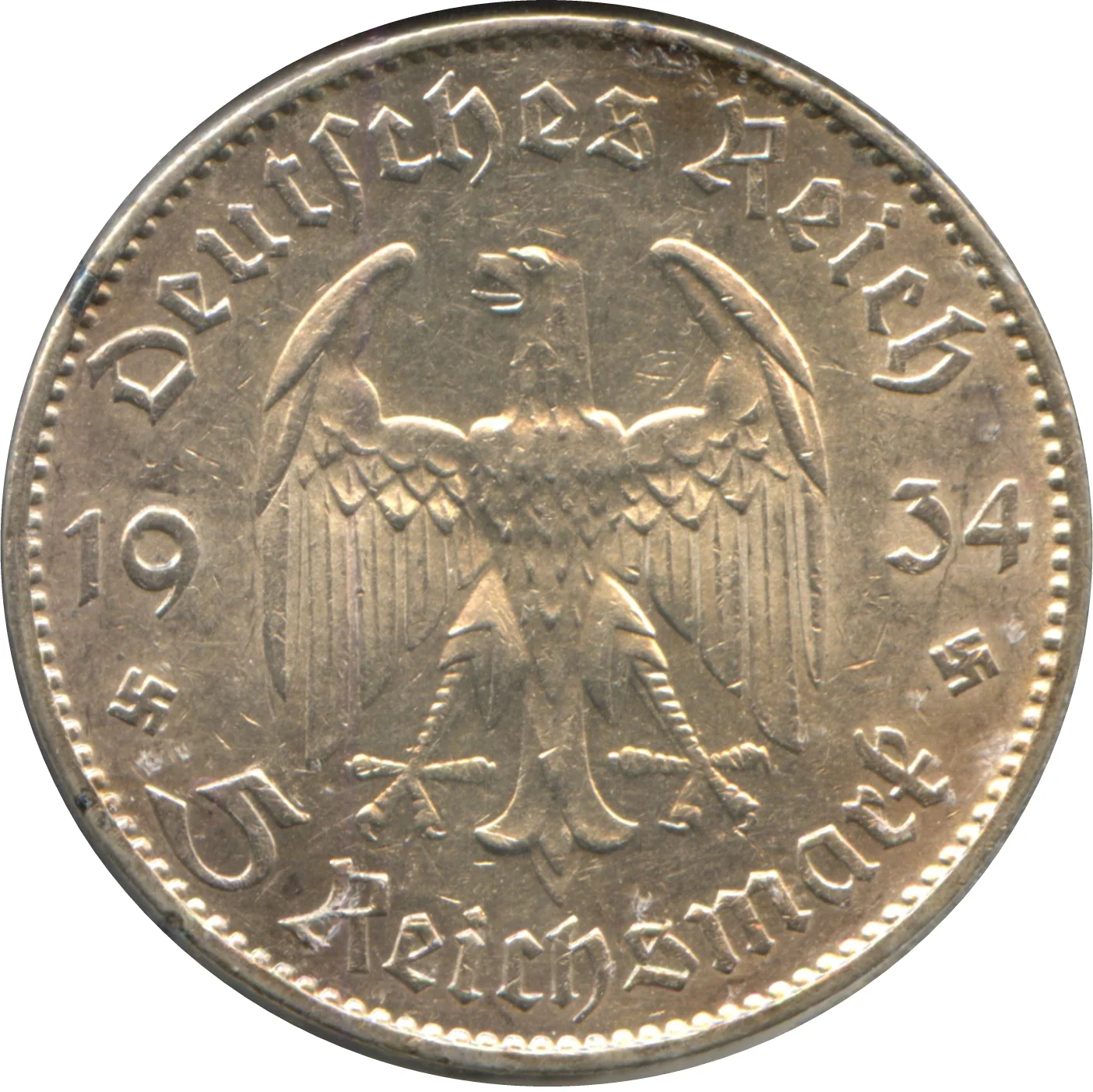
Obverse
Description:
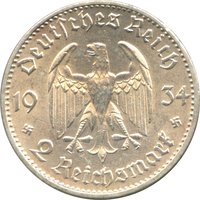
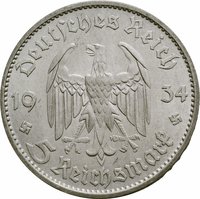
German eagle dividing date and value below.
Inscription:
Deutsches Reich
19 34
5 Reichsmark
19 34
5 Reichsmark
Translation:
German Reich
19 34
5 Reichsmarks
19 34
5 Reichsmarks
Language: German
Reverse
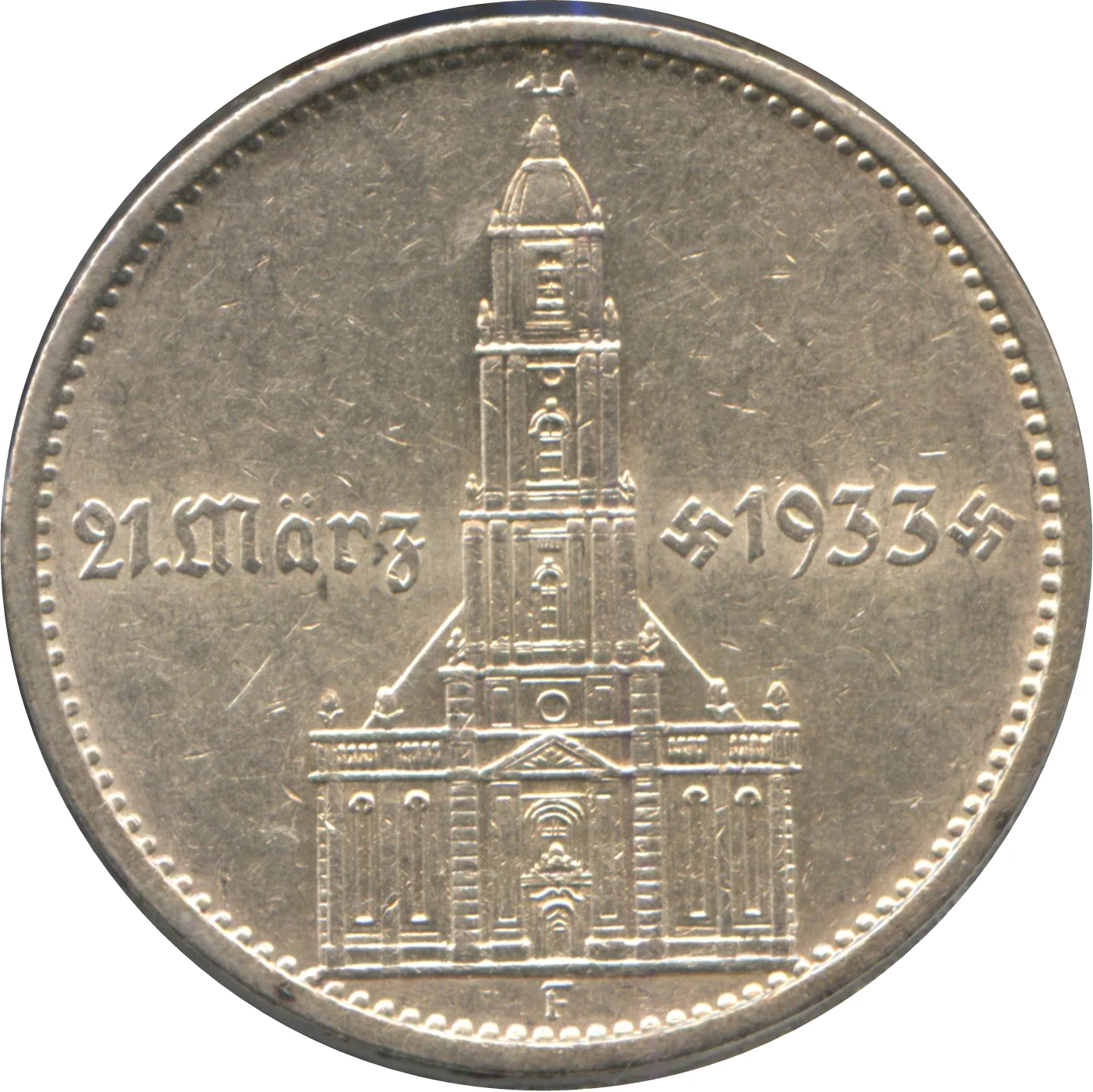
Description:
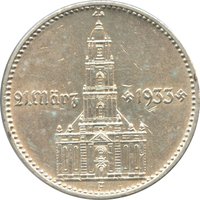
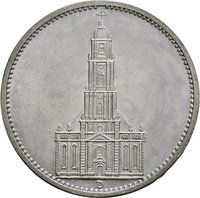
Potsdam Garrison Church: a divisive date.
Inscription:
21. März 1933
F
F
Translation:
21 March 1933
Language: German
Edge
Lettered
Legend:
Gemeinnutz geht vor Eigennutz
Translation:
Common utility precedes self-interest.
Language: German
Categories
| Animal> Bird |
| Building> Religious building |
Mints
| Name | Mark |
|---|---|
| Berlin | A |
| Munich | D |
| Muldenhütten | E |
| Staatliche Münze Baden-Württemberg | F |
| Staatliche Münze Baden-Württemberg | G |
| Hamburgische Münze | J |
Mintings
Historical background
By 1934, Germany's currency situation was one of strict control and precarious stability, a direct legacy of the hyperinflation that had destroyed the Reichsmark a decade earlier. The traumatic memory of 1923 made the preservation of the currency's value a paramount political concern for the Nazi regime, which had come to power in 1933. To prevent capital flight and maintain external confidence, the government upheld the "Reichsmark" as a nominally stable unit, but it was heavily managed through a complex system of exchange controls and multiple, non-convertible special currencies for foreign trade, established under the "New Plan" of Hjalmar Schacht.
Internally, the regime prioritized full employment and massive rearmament, financing these projects not through taxation or sound monetary policy, but through the creation of secret debt instruments. The most famous of these were the "Mefo bills," promissory notes issued by a dummy company to pay armaments contractors, which the Reichsbank discounted. This allowed the government to create money in disguise, injecting vast sums into the economy while keeping the official national debt and money supply figures artificially low. The system was inherently inflationary, but price and wage controls, along with the suppression of independent unions, prevented open inflation from appearing in consumer markets.
Consequently, the apparent stability of the Reichsmark in 1934 was a carefully constructed illusion. The currency was shielded from international market forces by strict controls, while domestically, purchasing power was maintained through authoritarian economic management. The true cost of rearmament was being deferred, building up immense hidden inflationary pressures within a closed economic system. The currency's stability was therefore entirely dependent on continued state control and the success of the regime's expansionist policies, setting a dangerous financial foundation for the years to come.
Internally, the regime prioritized full employment and massive rearmament, financing these projects not through taxation or sound monetary policy, but through the creation of secret debt instruments. The most famous of these were the "Mefo bills," promissory notes issued by a dummy company to pay armaments contractors, which the Reichsbank discounted. This allowed the government to create money in disguise, injecting vast sums into the economy while keeping the official national debt and money supply figures artificially low. The system was inherently inflationary, but price and wage controls, along with the suppression of independent unions, prevented open inflation from appearing in consumer markets.
Consequently, the apparent stability of the Reichsmark in 1934 was a carefully constructed illusion. The currency was shielded from international market forces by strict controls, while domestically, purchasing power was maintained through authoritarian economic management. The true cost of rearmament was being deferred, building up immense hidden inflationary pressures within a closed economic system. The currency's stability was therefore entirely dependent on continued state control and the success of the regime's expansionist policies, setting a dangerous financial foundation for the years to come.
🌱 Common