Logo Title
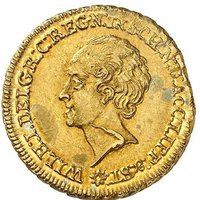
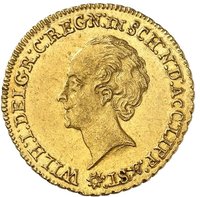
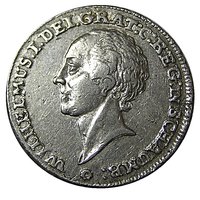
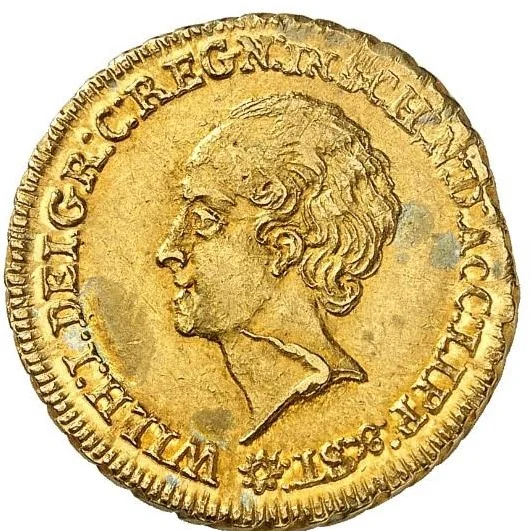
obverse
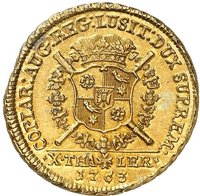
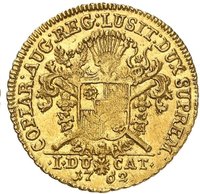
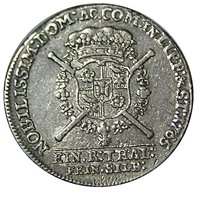
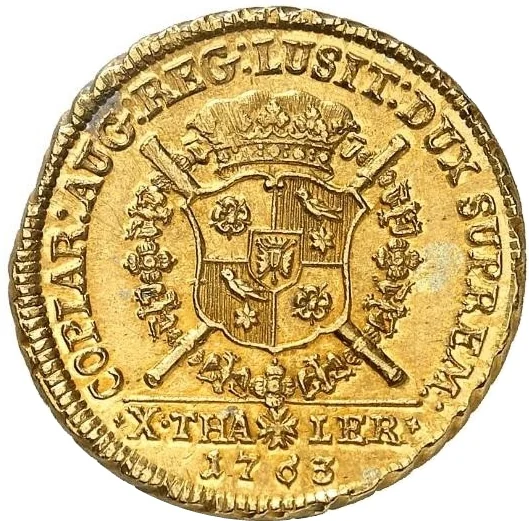
reverse
Fritz Rudolf Künker GmbH & Co. KG, Osnabrück and Lübke & Wiedemann KG, Leonberg

10 Thalers – County of Schaumburg-Lippe

Germany
Context
Year: 1763
Country: Germany Country flag
Currency:
(1643—1806)
Demonetized: Yes
Material
Weight: 13.28 g
Gold weight: 11.95 g
Shape: Round
Composition: 90% Gold
Magnetic: No
Alignment: Medal alignment
Obverse
OBVERSE ↑
flip
Reverse
REVERSE ↑
References
KM: #Click to copy to clipboard19
Numista: #265080
Value
Bullion value: $1997.72

Obverse

Description:
Go left.
Inscription:
WILH: I • DEI • GR: C: REGN: IN SCH: N: D: ACC LIPP & IS
Script: Latin

Reverse

Description:
Shield quartered with central shield, encircled by a chain, upon a cross. Inscription and date below.
Inscription:
COPIAR: AUG: REG: LUSIT: DUX SUPREM.

X. THA - LER 1763
Script: Latin

Edge

Slanted

Mintings

YearMint MarkMintageQualityCollection
1763

Historical background

In 1763, the County of Schaumburg-Lippe, a small German territory within the Holy Roman Empire, faced a complex monetary landscape typical of the fragmented German states of the era. Its currency system was not autonomous but was deeply integrated into the wider regional economic sphere, particularly that of the neighboring Electorate of Hanover. The primary circulating specie was the Reichsthaler, a standard silver coin of the Empire, but daily transactions were more commonly conducted in a confusing array of smaller divisional coins, such as Gute Groschen and Mariengroschen, whose values and silver content were subject to local ordinance and fluctuation.

This year was pivotal due to the aftermath of the Seven Years' War (1756-1763). The conflict had placed immense fiscal strain on the county, leading Count Wilhelm von Schaumburg-Lippe to heavily mortgage his lands. To meet wartime obligations and service debt, the principality, like many others, had likely resorted to the debasement of its subsidiary coinage—reducing the precious metal content to create more coins from the same amount of silver. This practice, while providing short-term revenue, eroded public trust in the currency and contributed to inflationary pressures, complicating post-war economic recovery.

Furthermore, the monetary chaos of the period was exacerbated by the circulation of numerous foreign coins, especially from Hanover and Brunswick, as well as low-quality Kippermünzen (debased coinage) from other struggling territories. In response to this empire-wide crisis, 1763 saw the proposal for a convention at Leipzig to standardize the Reichsthaler across the Empire. For Schaumburg-Lippe, the year thus represented a moment of financial vulnerability, caught between the pressing need for post-war stabilization and the slow-moving efforts towards imperial monetary reform that would only achieve partial success in the decades to follow.
Legendary