

25 Markkaa (Turku) – Finland
Non-circulating coins
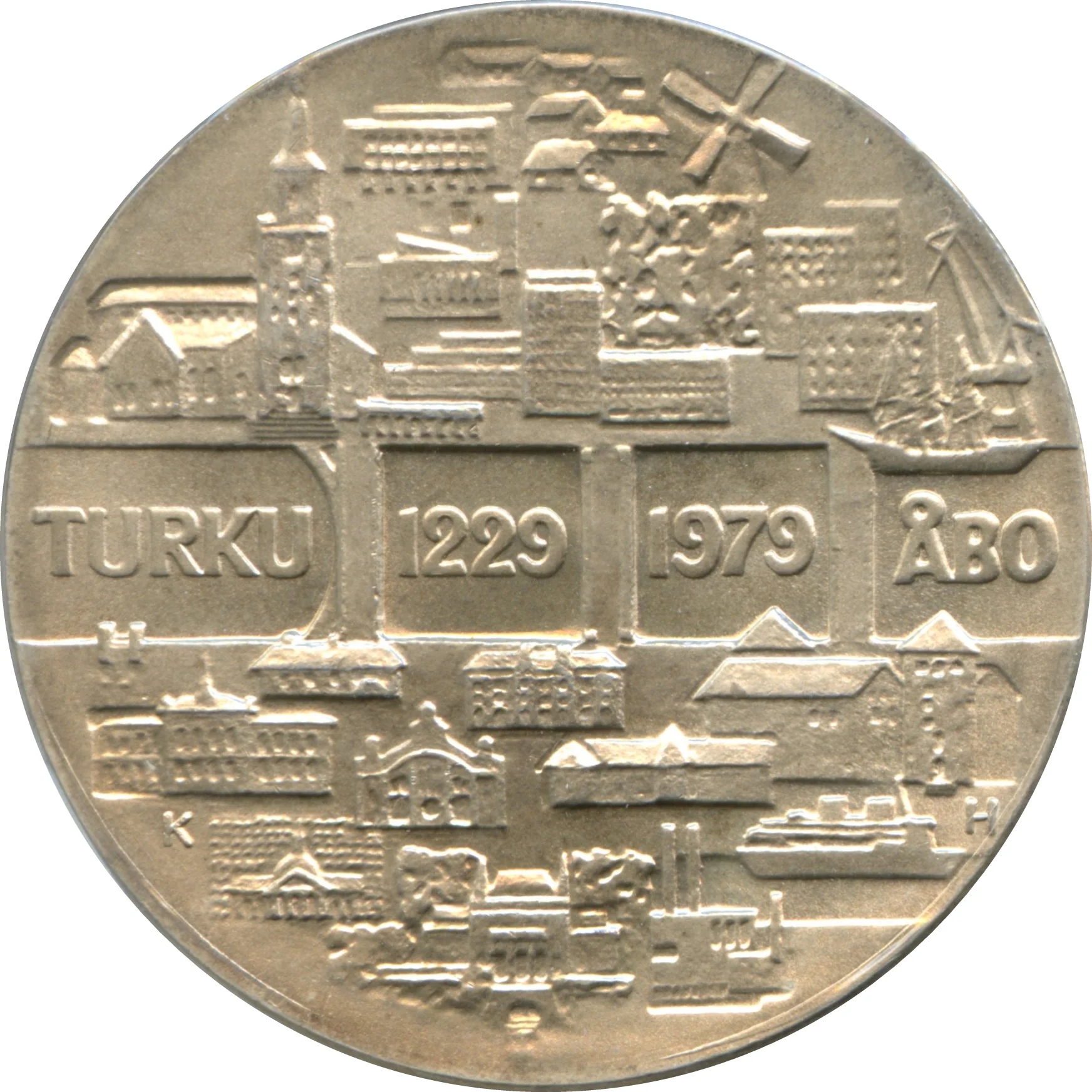
Commemoration: 750th Anniversary of Turku
Finland

Obverse
Description:
Turku city scene with dates.
Inscription:
TURKU 1229 1979 ÅBO
Translation:
Turku 1229 1979 Åbo
Script: Latin
Engraver: Heikki Häiväoja
Reverse
Description:
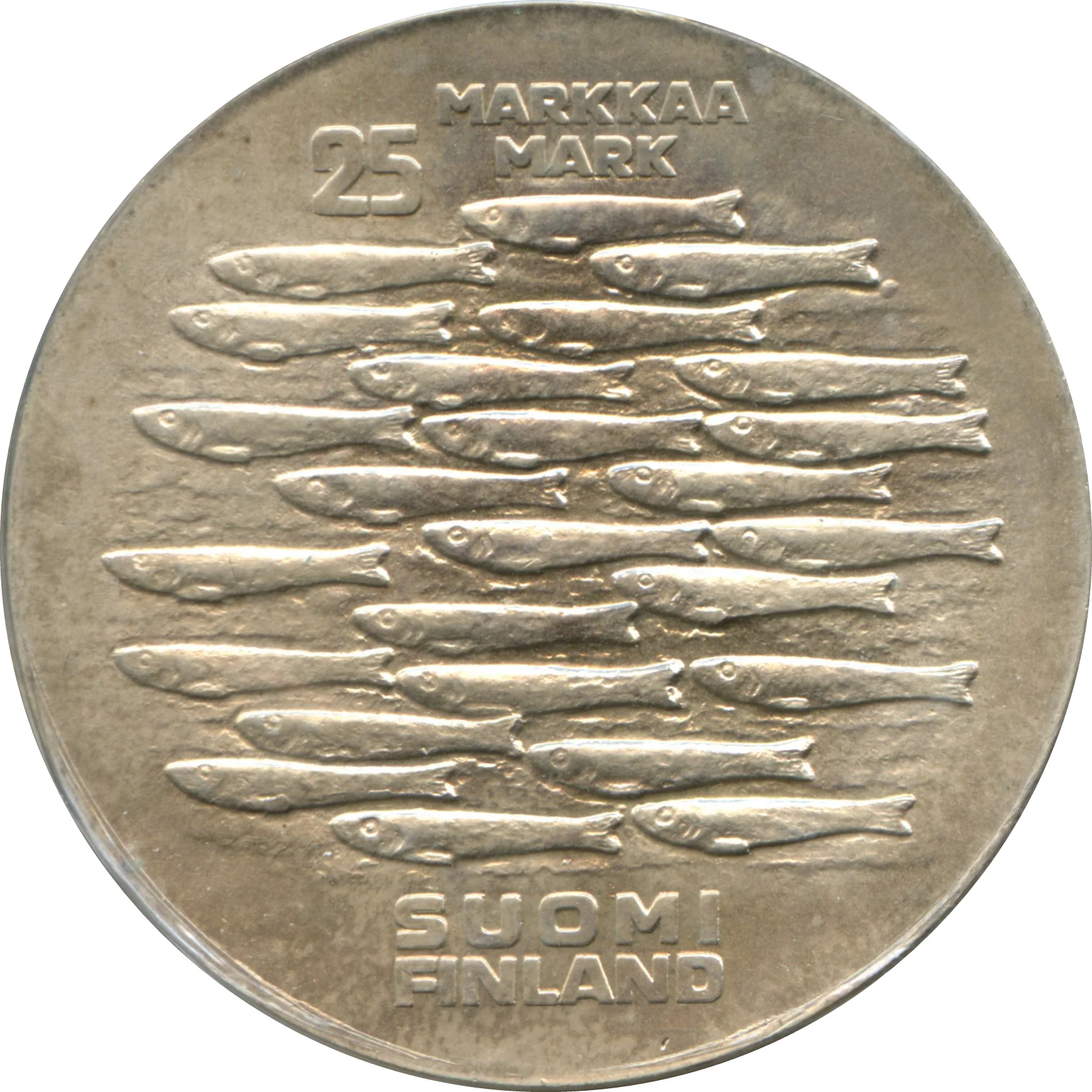
School of fish, species name.
Inscription:
25 MARKKA
MARK
SUOMI
FINLAND
MARK
SUOMI
FINLAND
Script: Latin
Engraver: Heikki Häiväoja
Edge
Plain
Mints
| Name | Mark |
|---|---|
| Mint of Finland | — |
Mintings
| Year | Mint Mark | Mintage | Quality | Collection |
|---|---|---|---|---|
| 1979 | H | 300,000 |
Historical background
In 1979, Finland's currency situation was defined by its managed exchange rate regime and the lingering challenges of the 1970s oil crises. The Finnish markka (FIM) was pegged to a trade-weighted currency basket, primarily reflecting the values of its major trading partners' currencies, including the Deutsche Mark, US Dollar, and Swedish Krona. This system, established in 1977, aimed to stabilize the external value of the markka and control inflation, which had been a persistent issue following the oil price shocks. The Bank of Finland actively intervened in foreign exchange markets to maintain the peg, making monetary policy largely subservient to the exchange rate target.
Domestically, the economy was under strain. Finland had experienced several devaluations earlier in the decade (most notably in 1977 and 1978) to restore competitiveness, but high inflation continued to erode these gains. This created a cycle known as the "devaluation-inflation spiral," where devaluations made imports more expensive, fueling domestic inflation, which in turn hurt export competitiveness again. In 1979, the second major oil crisis triggered by the Iranian Revolution further pressured the economy, raising import costs and worsening the trade balance, thereby testing the sustainability of the existing peg.
Consequently, 1979 was a year of mounting pressure that set the stage for significant changes in the following decade. While the currency basket peg held formally, the underlying economic imbalances were growing. The challenges of this period ultimately contributed to a policy shift in the early 1980s, leading to financial deregulation and a series of devaluations, most notably in 1982, as Finland struggled to reconcile fixed exchange rates with independent economic policy in a volatile global environment.
Domestically, the economy was under strain. Finland had experienced several devaluations earlier in the decade (most notably in 1977 and 1978) to restore competitiveness, but high inflation continued to erode these gains. This created a cycle known as the "devaluation-inflation spiral," where devaluations made imports more expensive, fueling domestic inflation, which in turn hurt export competitiveness again. In 1979, the second major oil crisis triggered by the Iranian Revolution further pressured the economy, raising import costs and worsening the trade balance, thereby testing the sustainability of the existing peg.
Consequently, 1979 was a year of mounting pressure that set the stage for significant changes in the following decade. While the currency basket peg held formally, the underlying economic imbalances were growing. The challenges of this period ultimately contributed to a policy shift in the early 1980s, leading to financial deregulation and a series of devaluations, most notably in 1982, as Finland struggled to reconcile fixed exchange rates with independent economic policy in a volatile global environment.
🌱 Fairly Common