

10 Markkaa (Independence) – Finland
Non-circulating coins
Commemoration: 60th Anniversary of Independence
Finland
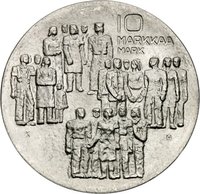
Obverse
Description:
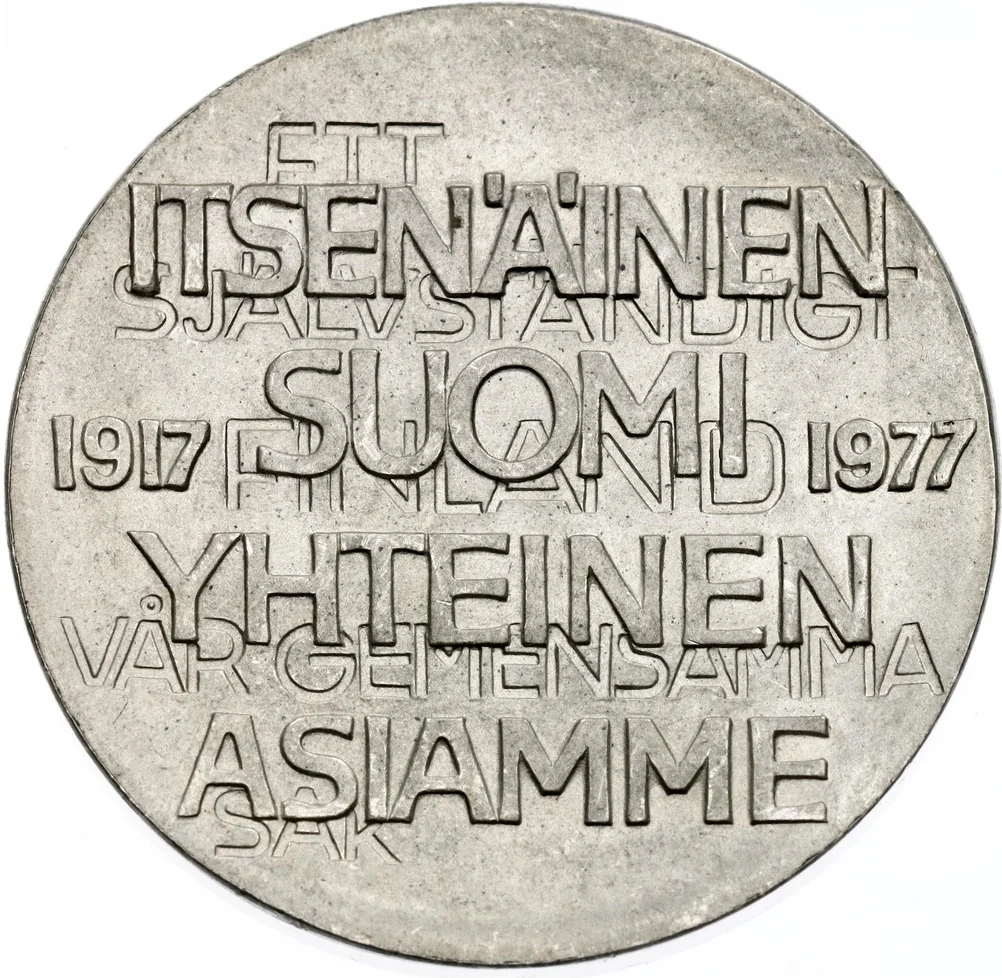
Four-line inscription over five-line, date at right.
Inscription:
ITSENAÏNEN SUOMI YHTEINEN ASIAMME
1917-1977
1917-1977
Translation:
OUR FINLAND INDEPENDENT OUR CAUSE COMMON
1917-1977
1917-1977
Script: Latin
Language: Finnish
Engraver: Heikki Häiväoja
Reverse
Description:
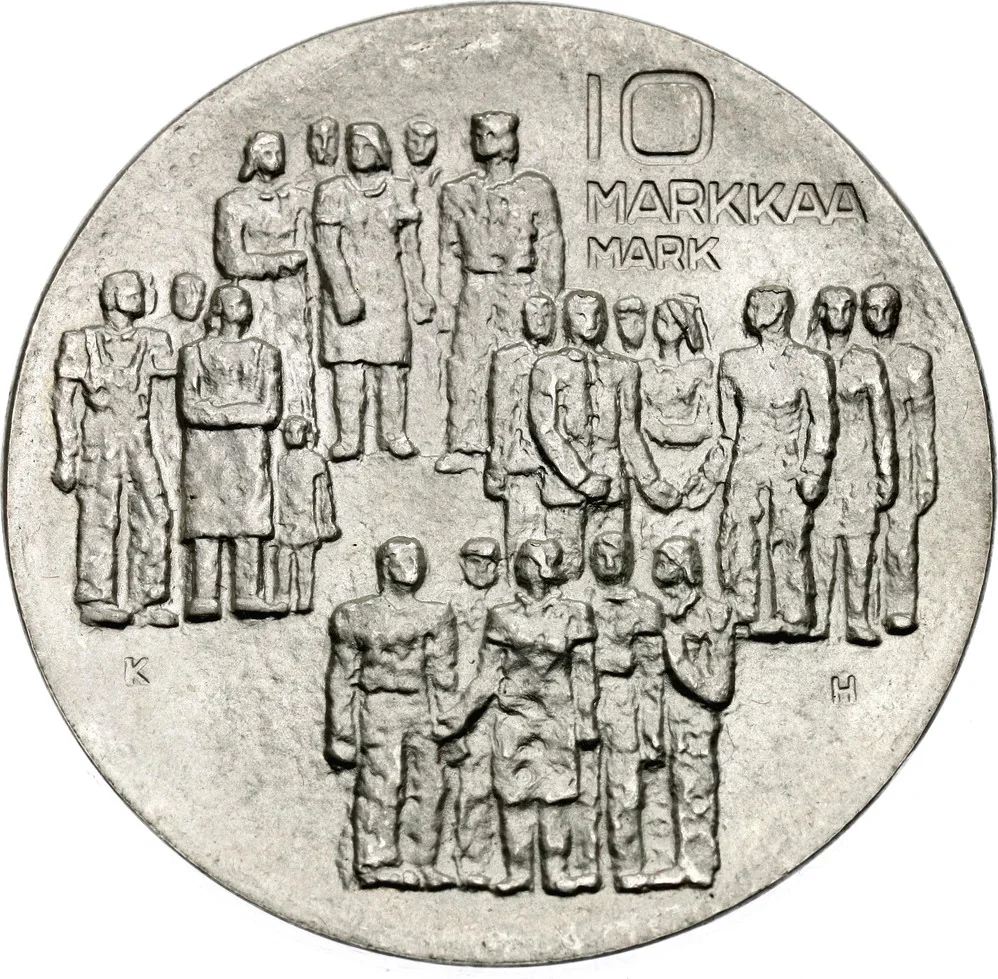
Denomination upper right.
Inscription:
10
MARKKAA
MARK
K H
MARKKAA
MARK
K H
Script: Latin
Engraver: Heikki Häiväoja
Edge
Plain
Categories
| Event> Independence |
Mints
| Name | Mark |
|---|---|
| Mint of Finland | — |
Mintings
| Year | Mint Mark | Mintage | Quality | Collection |
|---|---|---|---|---|
| 1977 | H | 383,000 |
Historical background
In 1977, Finland's currency situation was defined by its membership in the Nordic Currency Union (with Sweden, Denmark, and Norway), a system that had officially ended in 1924 but whose legacy continued through a fixed exchange rate peg. The Finnish markka (FIM) was tightly pegged to a trade-weighted basket of currencies, primarily reflecting the value of the Soviet ruble, the German Deutsche Mark, and the Swedish krona. This "basket peg" was a cornerstone of Finland's economic policy, designed to provide stability for its heavily export-dependent economy, which relied on both Western markets and significant bilateral trade with the Soviet Union.
Domestically, this period was marked by the aftermath of the 1973 oil crisis and a series of competitive devaluations. To maintain export competitiveness amid global inflation and rising costs, Finland had devalued the markka in 1967 and again in 1977 itself. The devaluation of 1977, by approximately 5.6%, was a deliberate policy tool to boost Finnish exports by making them cheaper abroad, while also addressing a growing current account deficit. However, this came at the cost of making imports more expensive, contributing to domestic inflation.
Overall, the currency regime in 1977 was one of managed stability with strategic interventions. The Bank of Finland actively maintained the peg through foreign exchange controls and market operations. While successful in providing a predictable framework for trade, the system was inherently rigid, limiting independent monetary policy and making the economy vulnerable to external shocks. This period represented the later stages of the Bretton Woods era's influence, preceding the financial deregulation and eventual float of the markka that would occur in the early 1990s.
Domestically, this period was marked by the aftermath of the 1973 oil crisis and a series of competitive devaluations. To maintain export competitiveness amid global inflation and rising costs, Finland had devalued the markka in 1967 and again in 1977 itself. The devaluation of 1977, by approximately 5.6%, was a deliberate policy tool to boost Finnish exports by making them cheaper abroad, while also addressing a growing current account deficit. However, this came at the cost of making imports more expensive, contributing to domestic inflation.
Overall, the currency regime in 1977 was one of managed stability with strategic interventions. The Bank of Finland actively maintained the peg through foreign exchange controls and market operations. While successful in providing a predictable framework for trade, the system was inherently rigid, limiting independent monetary policy and making the economy vulnerable to external shocks. This period represented the later stages of the Bretton Woods era's influence, preceding the financial deregulation and eventual float of the markka that would occur in the early 1990s.
🌱 Fairly Common