

10 dollars – United States
Add to wishlist
United States
Context
Years: 1797–1804
Issuer: United States
Period:
(since 1776)
Currency:
(since 1785)
Total mintage: 103,395
Material
References
KM: #
Numista: #25384
Value
Exchange value: 10 USD = $10.00
Bullion value: $2474.56
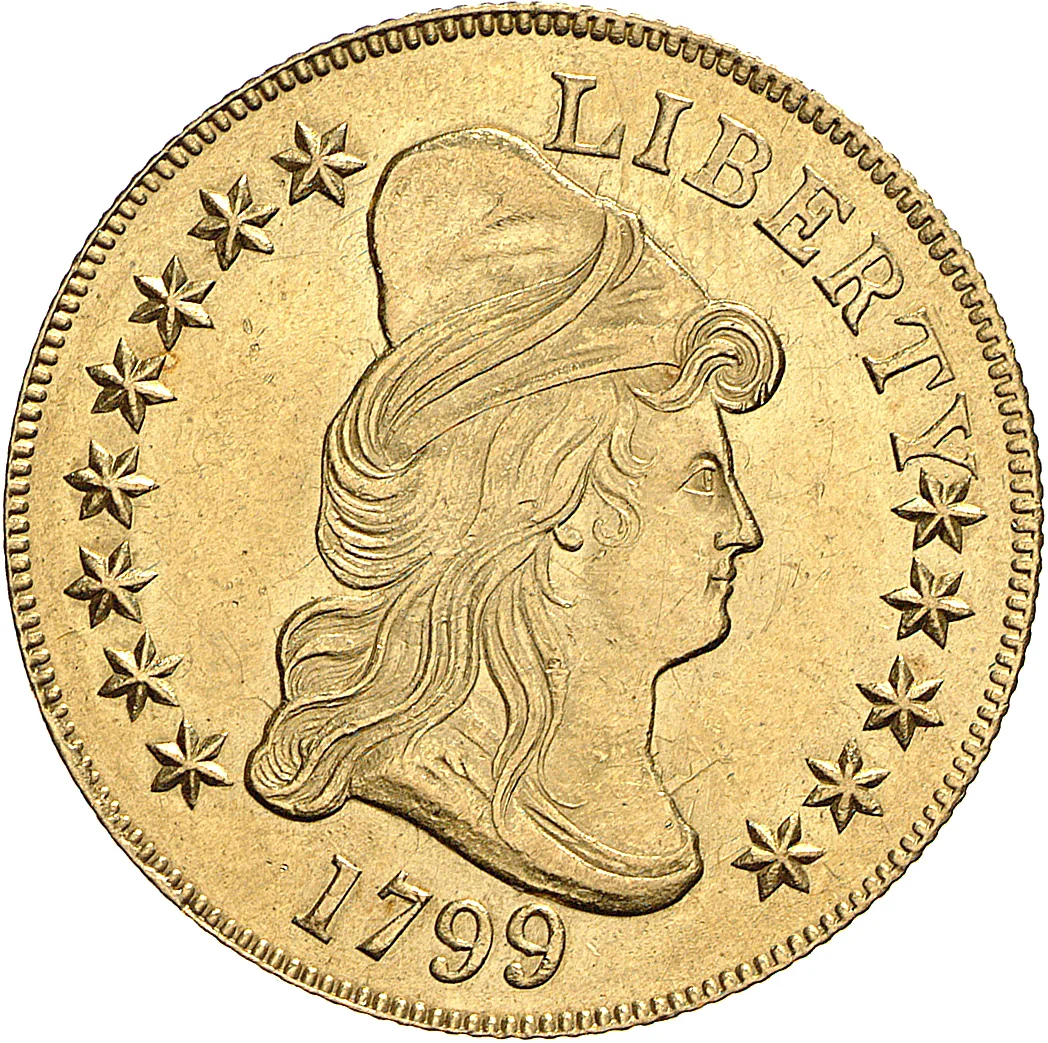
Obverse
Description:
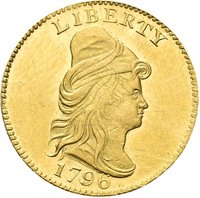
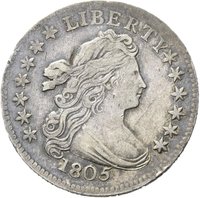
Capped bust right, 16 flanking stars.
Inscription:
LIBERTY
1797
1797
Script: Latin
Engraver: Robert Scot
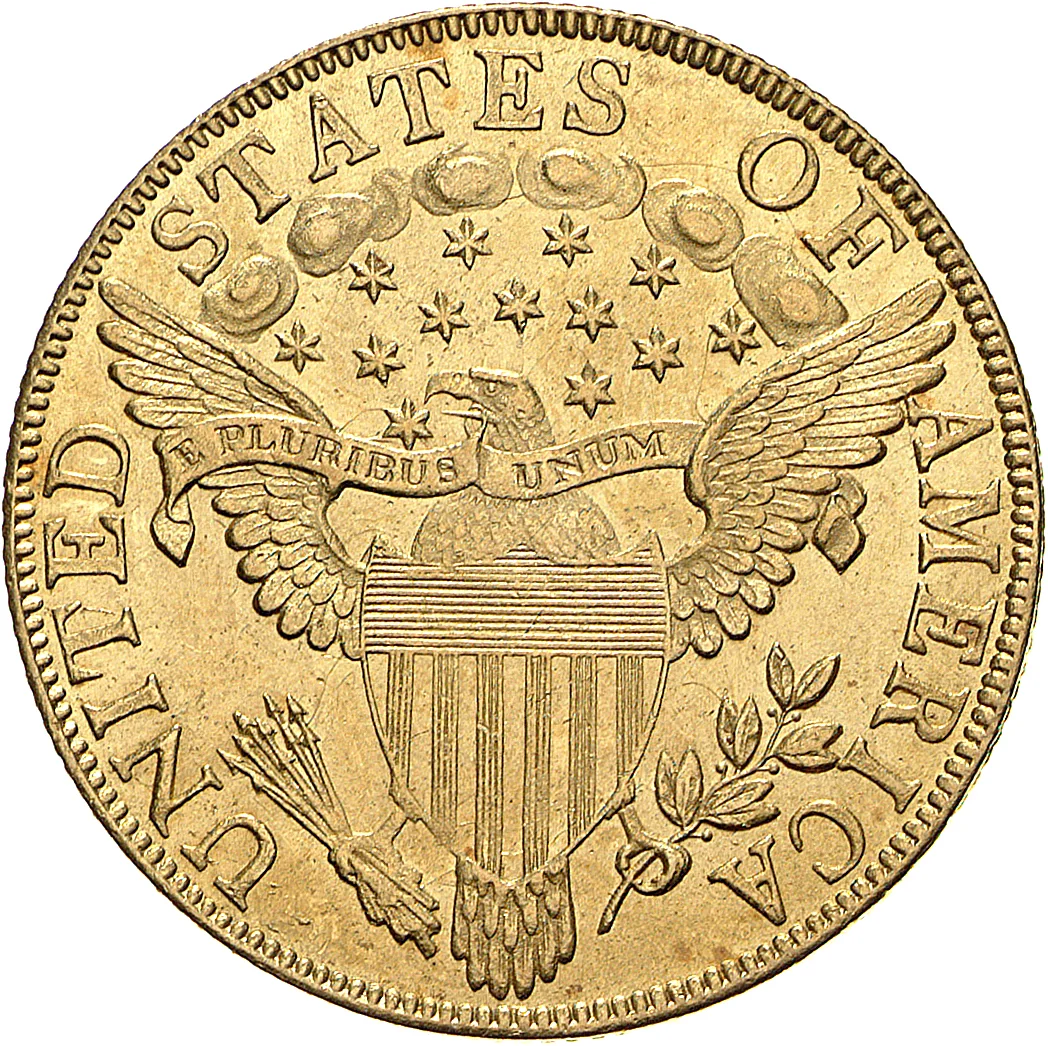
Reverse
Description:
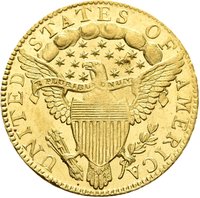
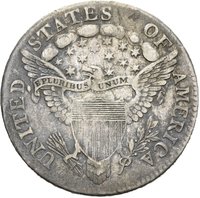
A left-facing bald eagle with outstretched wings. It holds arrows in its left talon, an olive branch in its right, and a motto ribbon in its beak. A shield is on its chest, with clouds and 13 stars above.
Inscription:
UNITED STATES OF AMERICA
E PLURIBUS UNUM
E PLURIBUS UNUM
Script: Latin
Engraver: Robert Scot
Edge
Reeded
Categories
| Animal> Bird> Eagle |
| Symbol> Allegory |
| Symbol> Phrygian cap |
| Object> Cold weapons |
Mints
| Name | Mark |
|---|---|
| United States Mint of Philadelphia | — |
Mintings
| Year | Mint Mark | Mintage | Quality | Collection |
|---|---|---|---|---|
| 1797 | — | 10,940 | ||
| 1798 | — | 900 | ||
| 1799 | — | 37,449 | ||
| 1800 | — | 5,999 | ||
| 1801 | — | 44,344 | ||
| 1803 | — | — | ||
| 1804 | — | 3,757 | ||
| 1804 | — | 6 | Proof |
Historical background
In 1797, the United States faced a significant currency crisis that exposed the fragility of its nascent financial system. The nation operated without a central bank, as the charter for the First Bank of the United States had expired in 1811. Instead, the money supply consisted of a confusing mix of foreign coins, state-chartered banknotes, and limited federal coinage. The value of a banknote was only as good as the reputation of the issuing bank, leading to widespread counterfeiting and wild fluctuations in value, especially for notes from distant or dubious institutions. This chaotic system, combined with a lack of uniform national currency, severely hampered interstate trade and economic stability.
The immediate trigger for the panic was a collapse in land speculation, particularly following the bursting of the real estate bubble associated with the Yazoo Land Fraud in Georgia. As asset prices plummeted, borrowers defaulted on loans, causing a cascade of failures among the state banks that had over-issued notes to finance the speculation. Simultaneously, international pressures exacerbated the crisis. The Napoleonic Wars in Europe led British creditors to call in loans to American merchants, while French privateers attacked American shipping, disrupting commerce. This caused a severe drain of gold and silver specie (hard currency) from the United States to Europe, leaving banks with insufficient reserves to redeem their paper notes.
The crisis of 1797, often called the Panic of 1797, resulted in a sharp economic depression, numerous bank failures, and a profound loss of public confidence in paper money. It starkly revealed the dangers of a decentralized and unregulated banking system and became a pivotal argument in the political debates between Federalists and Democratic-Republicans. The hardship underscored for many the necessity for stronger federal financial institutions, ultimately contributing to the political momentum that would lead to the chartering of the Second Bank of the United States in 1816. The panic thus stands as a critical early test of the American republic's economic resilience and a catalyst for the development of a more robust financial framework.
The immediate trigger for the panic was a collapse in land speculation, particularly following the bursting of the real estate bubble associated with the Yazoo Land Fraud in Georgia. As asset prices plummeted, borrowers defaulted on loans, causing a cascade of failures among the state banks that had over-issued notes to finance the speculation. Simultaneously, international pressures exacerbated the crisis. The Napoleonic Wars in Europe led British creditors to call in loans to American merchants, while French privateers attacked American shipping, disrupting commerce. This caused a severe drain of gold and silver specie (hard currency) from the United States to Europe, leaving banks with insufficient reserves to redeem their paper notes.
The crisis of 1797, often called the Panic of 1797, resulted in a sharp economic depression, numerous bank failures, and a profound loss of public confidence in paper money. It starkly revealed the dangers of a decentralized and unregulated banking system and became a pivotal argument in the political debates between Federalists and Democratic-Republicans. The hardship underscored for many the necessity for stronger federal financial institutions, ultimately contributing to the political momentum that would lead to the chartering of the Second Bank of the United States in 1816. The panic thus stands as a critical early test of the American republic's economic resilience and a catalyst for the development of a more robust financial framework.
💎 Extremely Rare