

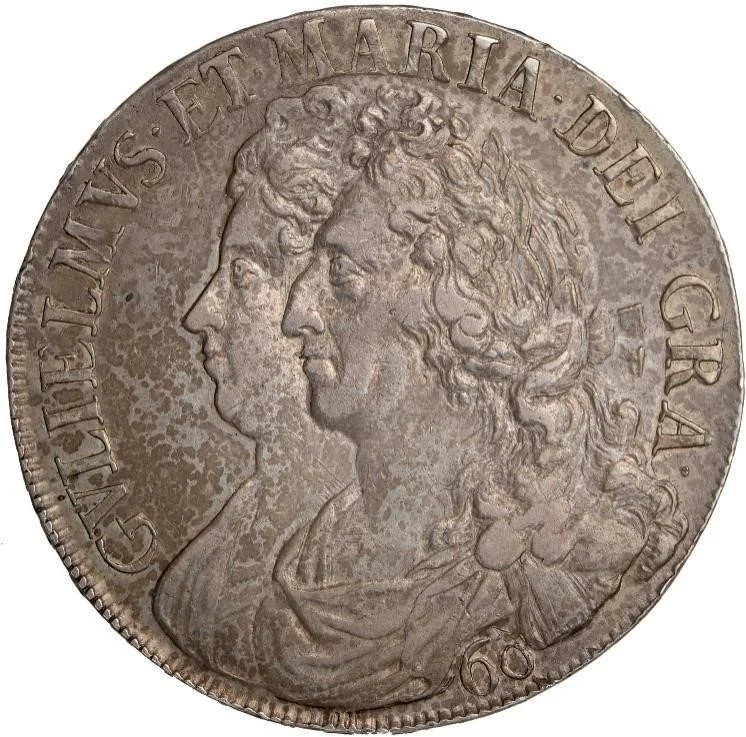
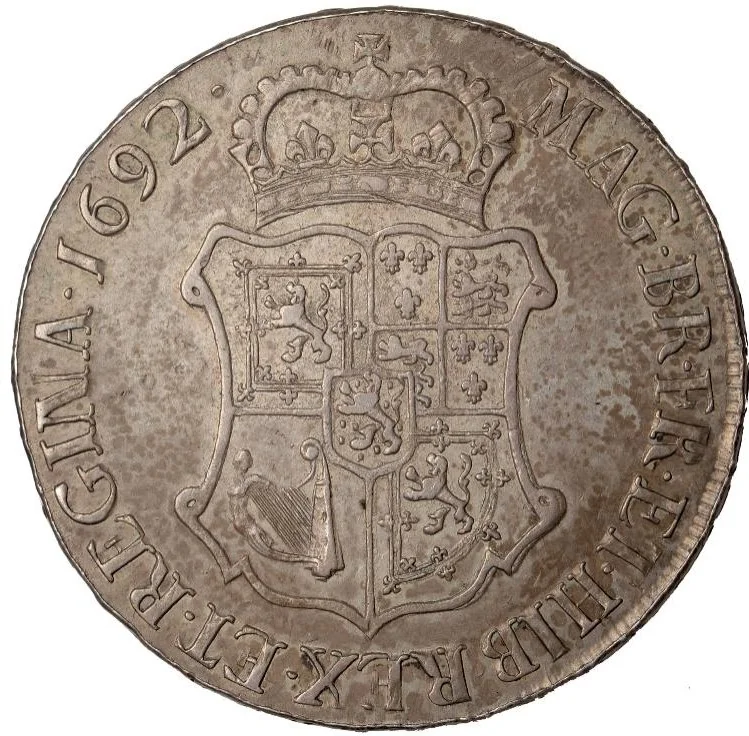
60 Shillings – Scotland
United Kingdom
Context
Years: 1691–1692
Country: United Kingdom 
Issuer: Scotland 
Ruler: Mary II
Currency:
(1136—1707)
Demonetized: Yes
Material
References
KM: #Click to copy to clipboard134
Numista: #25007
Obverse
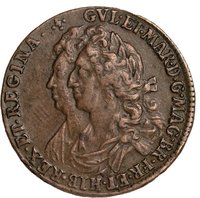
Description:
Conjoined busts of William and Mary facing left, value mark below.
Inscription:
GVLIELMVS · ET · MARIA · DEI · GRA ·
Script: Latin
Reverse
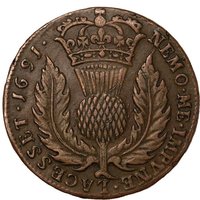
Description:
Royal coat of arms.
Inscription:
MAG · BR · FR · ET · HIB · REX · ET · REGINA · 1691
Script: Latin
Edge
Lettering:PROTEGIT ET ORNAT ANNO REGNI TERTIO
Legend:
PROTEGIT ET ORNAT ANNO REGNI TERTIO
Mints
| Name | Mark |
|---|---|
| Edinburgh | — |
Mintings
| Year | Mint Mark | Mintage | Quality | Collection |
|---|---|---|---|---|
| 1691 | — | — | ||
| 1692 | — | — |
Historical background
In 1691, Scotland existed as an independent kingdom with its own parliament, but it was in a precarious monetary and economic state, deeply entangled with yet separate from its southern neighbour, England. The nation operated on a bimetallic system of silver pounds, shillings, and pence, but the coinage in circulation was notoriously poor. Decades of economic hardship, including the famines of the "Seven Ill Years," had led to a severe shortage of official coin. This vacuum was filled by a chaotic mix of underweight and clipped Scottish coins, alongside a multitude of foreign currencies—primarily French louis d’ors, Dutch guilders, and Spanish pieces of eight—which circulated at fluctuating values set by the Scottish Privy Council. The monetary system was unstable, confusing, and a significant barrier to trade.
This situation was exacerbated by the wider European currency crisis of the late 17th century, where the official silver content of coins often exceeded their face value, leading to hoarding and the export of bullion. For a small, trade-dependent nation like Scotland, this was particularly damaging. The economic woes fueled a growing desire among powerful mercantile and political factions to secure greater access to England's larger, more stable markets and its burgeoning colonial trade. However, the English Alien Act of 1705 would later threaten devastating economic sanctions, making monetary union a key lever in the political push for a fuller union.
Thus, the currency chaos of 1691 was not merely a financial issue but a fundamental political driver. It laid bare Scotland's economic vulnerabilities and became a central argument for those advocating political union with England. The eventual solution, embedded in the Treaty of Union of 1707, was the creation of a single Great British currency based on the English sterling standard. Therefore, the monetary disarray of 1691 represents a critical backdrop to the end of Scottish sovereignty, as the need for a stable and credible currency system was a powerful force propelling the nation toward parliamentary union.
This situation was exacerbated by the wider European currency crisis of the late 17th century, where the official silver content of coins often exceeded their face value, leading to hoarding and the export of bullion. For a small, trade-dependent nation like Scotland, this was particularly damaging. The economic woes fueled a growing desire among powerful mercantile and political factions to secure greater access to England's larger, more stable markets and its burgeoning colonial trade. However, the English Alien Act of 1705 would later threaten devastating economic sanctions, making monetary union a key lever in the political push for a fuller union.
Thus, the currency chaos of 1691 was not merely a financial issue but a fundamental political driver. It laid bare Scotland's economic vulnerabilities and became a central argument for those advocating political union with England. The eventual solution, embedded in the Treaty of Union of 1707, was the creation of a single Great British currency based on the English sterling standard. Therefore, the monetary disarray of 1691 represents a critical backdrop to the end of Scottish sovereignty, as the need for a stable and credible currency system was a powerful force propelling the nation toward parliamentary union.
✨ Legendary