

60 Shillings – Scotland
United Kingdom
Context
Years: 1605–1609
Country: United Kingdom 
Issuer: Scotland 
Ruler: James VI
Currency:
(1136—1707)
Demonetized: Yes
Material
References
KM: #Click to copy to clipboard11
Numista: #25006
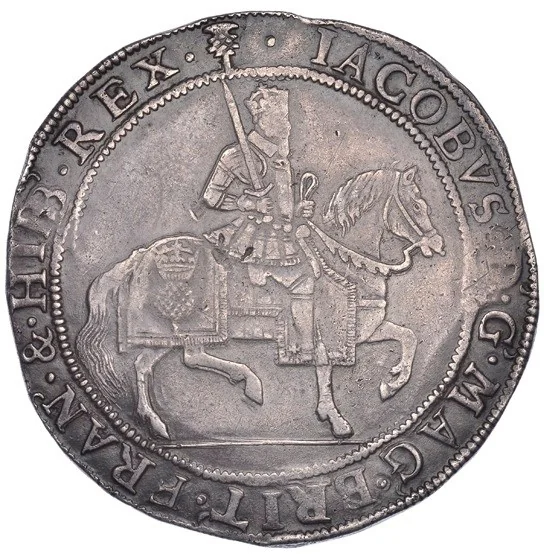
Obverse
Description:
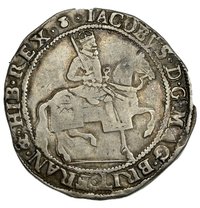
King James VI on horseback, facing right with a raised sword.
Inscription:
· IACOBVS · D · G · MAG · BRIT · FRAN · & · HIB · REX ·
Script: Latin
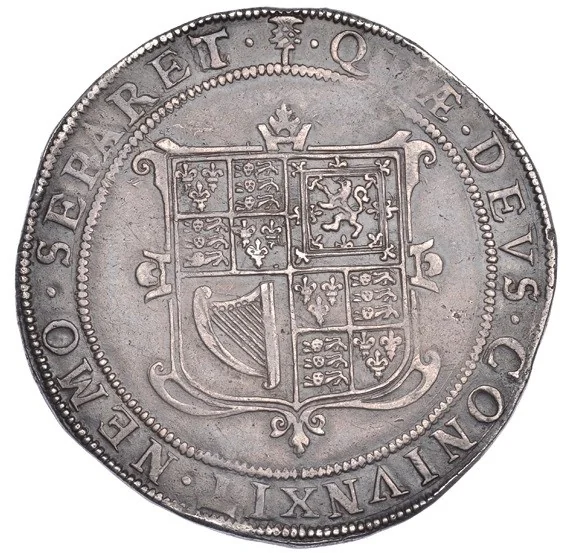
Reverse
Description:
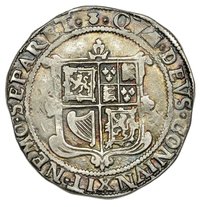
Royal arms with English arms in the first and fourth quarters.
Inscription:
· QVÆ · DEVS · CONIVNXIT · NEMO · SEPARET ·
Script: Latin
Edge
Mints
| Name | Mark |
|---|---|
| Edinburgh | — |
Mintings
| Year | Mint Mark | Mintage | Quality | Collection |
|---|---|---|---|---|
| — | — | — |
Historical background
In 1605, Scotland’s currency situation was complex and unstable, a legacy of its status as an independent kingdom with its own monetary system. The primary unit was the Pound Scots (£Scots), but its value had drastically depreciated against the English Pound Sterling, with an exchange rate of approximately £1 Sterling to £12 Scots. This devaluation was the result of centuries of coinage debasement, where Scottish monarchs reduced the silver content in coins to fund state expenses, eroding public confidence and causing inflation. The coinage in circulation was a mixture of underweight domestic issues and a flood of foreign coins, particularly French écus and Dutch leeuwendaalders, which were essential for international trade but added to the monetary confusion.
The situation was further complicated by the Union of the Crowns in 1603, when King James VI of Scotland also became James I of England. While the kingdoms remained politically separate, the monarch now resided in London, creating a de facto economic pull toward the stronger English currency. In daily commerce, people had to navigate a dual-currency reality: rents and large transactions were often calculated in the stable Pound Sterling, while physical payment might be made in the fluctuating Pound Scots. This created practical burdens for trade and debt settlement between the two nations, highlighting the growing economic disparity.
Despite the political union, no monetary union was established in 1605. James I had proposed a uniform coinage for both kingdoms, but this was met with resistance from the English Parliament, which feared the weaker Scottish currency would destabilise their economy. Consequently, Scotland continued to operate with its fragile and heterogeneous monetary system. The inherent instability and the king’s absence from Edinburgh hindered effective fiscal reform, leaving Scotland in a financially subordinate position and setting the stage for future economic pressures that would culminate in the full Parliamentary Union of 1707.
The situation was further complicated by the Union of the Crowns in 1603, when King James VI of Scotland also became James I of England. While the kingdoms remained politically separate, the monarch now resided in London, creating a de facto economic pull toward the stronger English currency. In daily commerce, people had to navigate a dual-currency reality: rents and large transactions were often calculated in the stable Pound Sterling, while physical payment might be made in the fluctuating Pound Scots. This created practical burdens for trade and debt settlement between the two nations, highlighting the growing economic disparity.
Despite the political union, no monetary union was established in 1605. James I had proposed a uniform coinage for both kingdoms, but this was met with resistance from the English Parliament, which feared the weaker Scottish currency would destabilise their economy. Consequently, Scotland continued to operate with its fragile and heterogeneous monetary system. The inherent instability and the king’s absence from Edinburgh hindered effective fiscal reform, leaving Scotland in a financially subordinate position and setting the stage for future economic pressures that would culminate in the full Parliamentary Union of 1707.
✨ Legendary