

1 Sestino – Milan
Italy

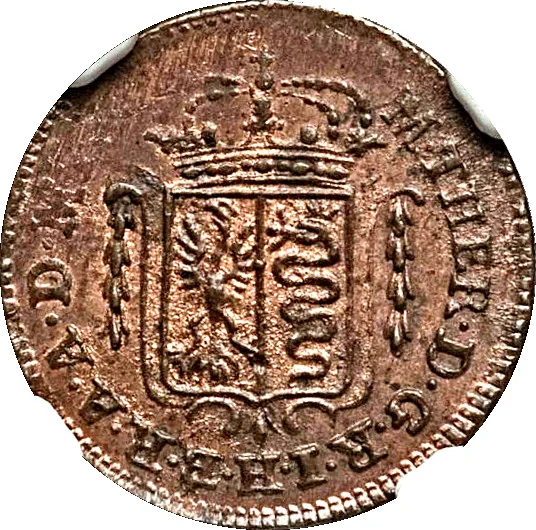
Obverse
Description:
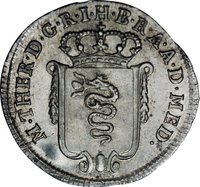
Shield with two-fold arms, crowned and garlanded.
Inscription:
M · THER · D · G · R · I · H · B · R · A · A · D · MED ·
Script: Latin
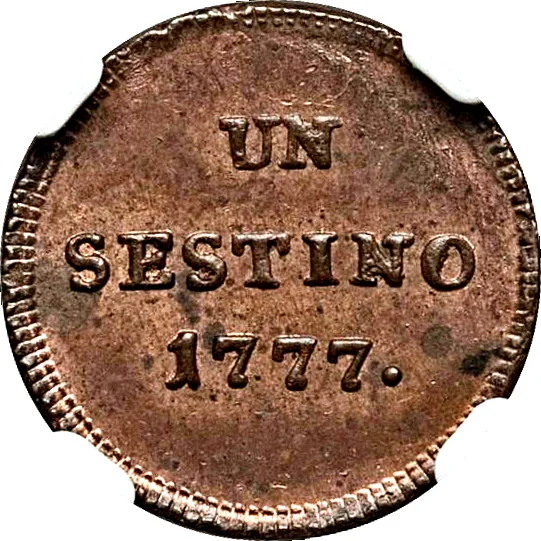
Reverse
Edge
Leaves
Categories
| Object> Armour |
| Symbols> Coat of Arms |
Mints
| Name | Mark |
|---|---|
| Milan | — |
Mintings
| Year | Mint Mark | Mintage | Quality | Collection |
|---|---|---|---|---|
| 1777 | — | — | ||
| 1779 | — | — |
Historical background
In 1777, Milan operated under a complex and strained monetary system, a legacy of its position as the capital of the Duchy of Milan within the Habsburg Austrian Empire. The official currency was the Milanese lira (divided into 20 soldi or 240 denari), which was tied to the Conventionsthaler, a large silver coin used across the Habsburg territories. However, the reality in daily commerce was far from uniform. A multitude of foreign coins circulated freely, including Spanish doubloons, Venetian sequins, French louis d'or, and various Italian state currencies, their value determined by fluctuating silver and gold content rather than fixed decree.
This proliferation of specie created chronic instability. Exchange rates between gold, silver, and the myriad of coins were volatile and set by private money-changers (banchieri), leading to confusion, frequent disputes, and opportunities for fraud. The system was further burdened by a severe shortage of small-denomination coins for everyday transactions, which hampered trade and exacerbated social tensions as the working poor struggled with inconvenient and devalued token coinage.
The Austrian authorities, recognizing the economic drag, were in a period of attempted reform. The policies of Empress Maria Theresa aimed at centralizing and rationalizing the monetary system across her domains. In Milan, this meant ongoing efforts to standardize the coinage, control the influx of foreign specie, and assert state authority over the valuation of money. Thus, the currency situation in 1777 was one of transition—caught between a chaotic, medieval past of diverse currencies and a modern, state-controlled system that was proving difficult to implement fully.
This proliferation of specie created chronic instability. Exchange rates between gold, silver, and the myriad of coins were volatile and set by private money-changers (banchieri), leading to confusion, frequent disputes, and opportunities for fraud. The system was further burdened by a severe shortage of small-denomination coins for everyday transactions, which hampered trade and exacerbated social tensions as the working poor struggled with inconvenient and devalued token coinage.
The Austrian authorities, recognizing the economic drag, were in a period of attempted reform. The policies of Empress Maria Theresa aimed at centralizing and rationalizing the monetary system across her domains. In Milan, this meant ongoing efforts to standardize the coinage, control the influx of foreign specie, and assert state authority over the valuation of money. Thus, the currency situation in 1777 was one of transition—caught between a chaotic, medieval past of diverse currencies and a modern, state-controlled system that was proving difficult to implement fully.
💎 Very Rare