

1 Pagoda – Yanam
India

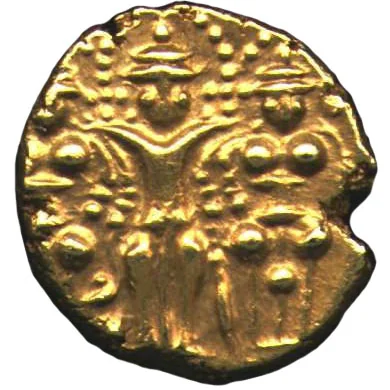
Obverse
Description:
Vishu flanked by two figures.
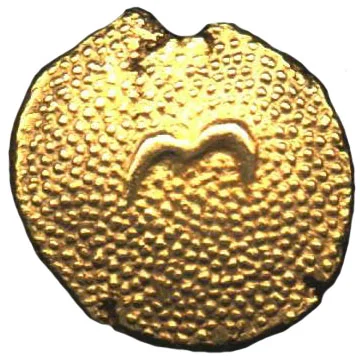
Reverse
Description:
Crescent in a grain field.
Edge
Mintings
| Year | Mint Mark | Mintage | Quality | Collection |
|---|---|---|---|---|
| — | — | — |
Historical background
In 1715, Yanam, a small coastal enclave on India's Coromandel Coast, was under the control of the French East India Company (Compagnie des Indes Orientales). The currency situation was complex and reflected its position at the crossroads of European colonial trade and powerful local economies. Officially, the French administration sought to impose a monetary system based on French livres and their colonial derivatives for official accounts and trade with other European settlements. However, this system struggled for dominance in the vibrant local bazaar.
The real engine of Yanam's economy was its weaving industry, producing fine textiles for export, and its role as a minor port in regional networks. Consequently, the daily currency in use was a heterogeneous mix of widely accepted silver coins from neighboring Indian powers, particularly the Mughal rupee and its Arcot and Hyderabad variants. Alongside these, other European currencies like Portuguese xerafins and Dutch stuivers circulated freely, their value determined by their intrinsic silver weight and the fluctuating rates set by local money-changers (shroffs).
Thus, Yanam in 1715 operated under a dual monetary system. The French Company's ledger books recorded transactions in livres, but the actual purchase of cloth, payment of weavers, and local trade were conducted in a babel of silver coins. The French authorities had to constantly publish conversion tariffs (tarifs) to fix exchange rates between the rupee and the livre, a tacit acknowledgment of the rupee's supremacy in the practical economy of their own settlement. This unstable duality highlighted the limits of European mercantile power and the deep-rooted integration of Yanam into the indigenous monetary sphere of South India.
The real engine of Yanam's economy was its weaving industry, producing fine textiles for export, and its role as a minor port in regional networks. Consequently, the daily currency in use was a heterogeneous mix of widely accepted silver coins from neighboring Indian powers, particularly the Mughal rupee and its Arcot and Hyderabad variants. Alongside these, other European currencies like Portuguese xerafins and Dutch stuivers circulated freely, their value determined by their intrinsic silver weight and the fluctuating rates set by local money-changers (shroffs).
Thus, Yanam in 1715 operated under a dual monetary system. The French Company's ledger books recorded transactions in livres, but the actual purchase of cloth, payment of weavers, and local trade were conducted in a babel of silver coins. The French authorities had to constantly publish conversion tariffs (tarifs) to fix exchange rates between the rupee and the livre, a tacit acknowledgment of the rupee's supremacy in the practical economy of their own settlement. This unstable duality highlighted the limits of European mercantile power and the deep-rooted integration of Yanam into the indigenous monetary sphere of South India.
✨ Legendary