Logo Title
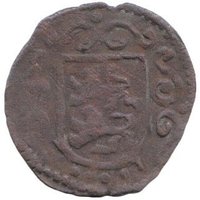
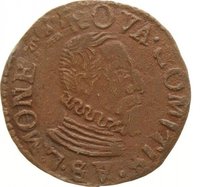
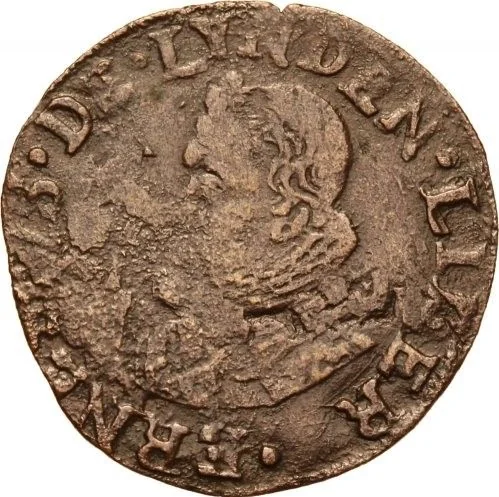
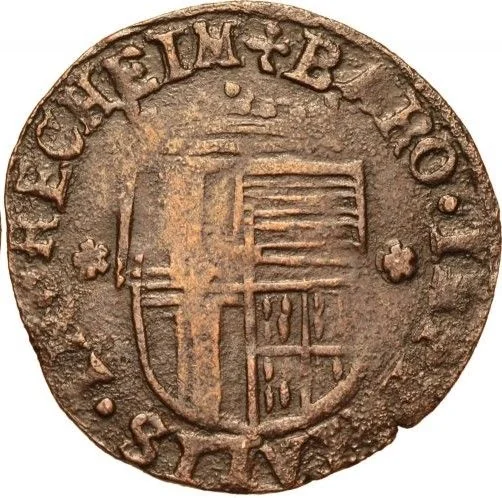
obverse
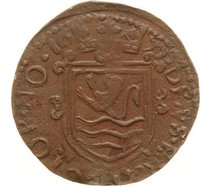
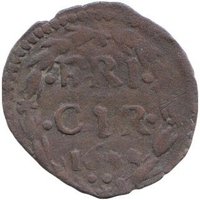
reverse
Numis.be - Joselito Eeckhout

1 Oord – Lordship of Reckheim

Belgium
Context
Years: 1623–1636
Country: Belgium Country flag
Currency:
(1553—1665)
Demonetized: Yes
Material
Diameter: 25 mm
Weight: 2.55 g
Composition: Copper
Magnetic: No
Technique: Hammered
References
KM: #Click to copy to clipboard15
Numista: #242385

Obverse

Description:
Baron's bust left, encircled by legend.
Inscription:
ERNESTVS•DE•LYNDEN•LIBER•
Script: Latin

Reverse

Description:
Quartered coat of arms under a crown.
Inscription:
BARO•IMPERIALIS•IN•RECHEIM•
Script: Latin

Edge
Mints

NameMark
Rekem, Reckheim

Mintings

YearMint MarkMintageQualityCollection

Historical background

In the year 1623, the Lordship of Reckheim, a minor German territory within the fractious Holy Roman Empire, finds its currency in a state of profound instability, mirroring the wider economic chaos of the early Thirty Years' War. The primary circulating coin is the Reichsthaler, an imperial silver coin mandated by the Reichsmünzordnung (Imperial Coinage Ordinance). However, the authority of this ordinance has collapsed, and Reckheim, like countless other lordships, cities, and bishoprics, exercises its right to mint its own subsidiary coins—primarily Groschen, Kreuzers, and Pfennigs. The value of these coins is not tied to a strong central reserve but to the fluctuating personal wealth and ambitions of the ruling Lord, who views the mint as a crucial source of revenue for maintaining his household guard and fortifications.

This situation has led to a severe debasement of Reckheim's coinage. Facing the relentless financial pressures of a continent at war, the Lord’s mint-masters are regularly ordered to reduce the silver content in coins while maintaining their face value, a practice known as Kipper und Wipper (clipping and culling). Consequently, a Reckheim Groschen from 1623 contains significantly less silver than one minted a decade prior. This debasement is not a secret; merchants and peasants alike are acutely aware, leading to widespread suspicion and the routine weighing and biting of coins in every market transaction. "Good" pre-war coins are hoarded, disappearing from circulation, while newly minted "bad" coins flood the local economy, driving inflation.

The result is a chaotic multi-currency environment where daily commerce is a struggle. Alongside the debased local coins, older imperial Reichsthalers, heavier regional coins from neighboring territories, and even foreign currency like Dutch Leeuwendaalders circulate at negotiated rates, creating a bewildering exchange for common folk. Prices for essential goods—especially grain and salt—are volatile and rising, as the unreliable currency compounds shortages caused by troop movements and requisitions. For the people of Reckheim, money itself has become an untrustworthy and oppressive instrument, reflecting the broader collapse of order and certainty in a war-torn land.
Legendary