

1 Dollar – United States
United States
Context
Years: 1798–1804
Issuer: United States 
Period:
(since 1776)
Currency:
(since 1785)
Total mintage: 54,454
Material
References
KM: #Click to copy to clipboard32
Numista: #23359
Value
Exchange value: 1 USD = $1.00
Bullion value: $67.03
Obverse
Description:
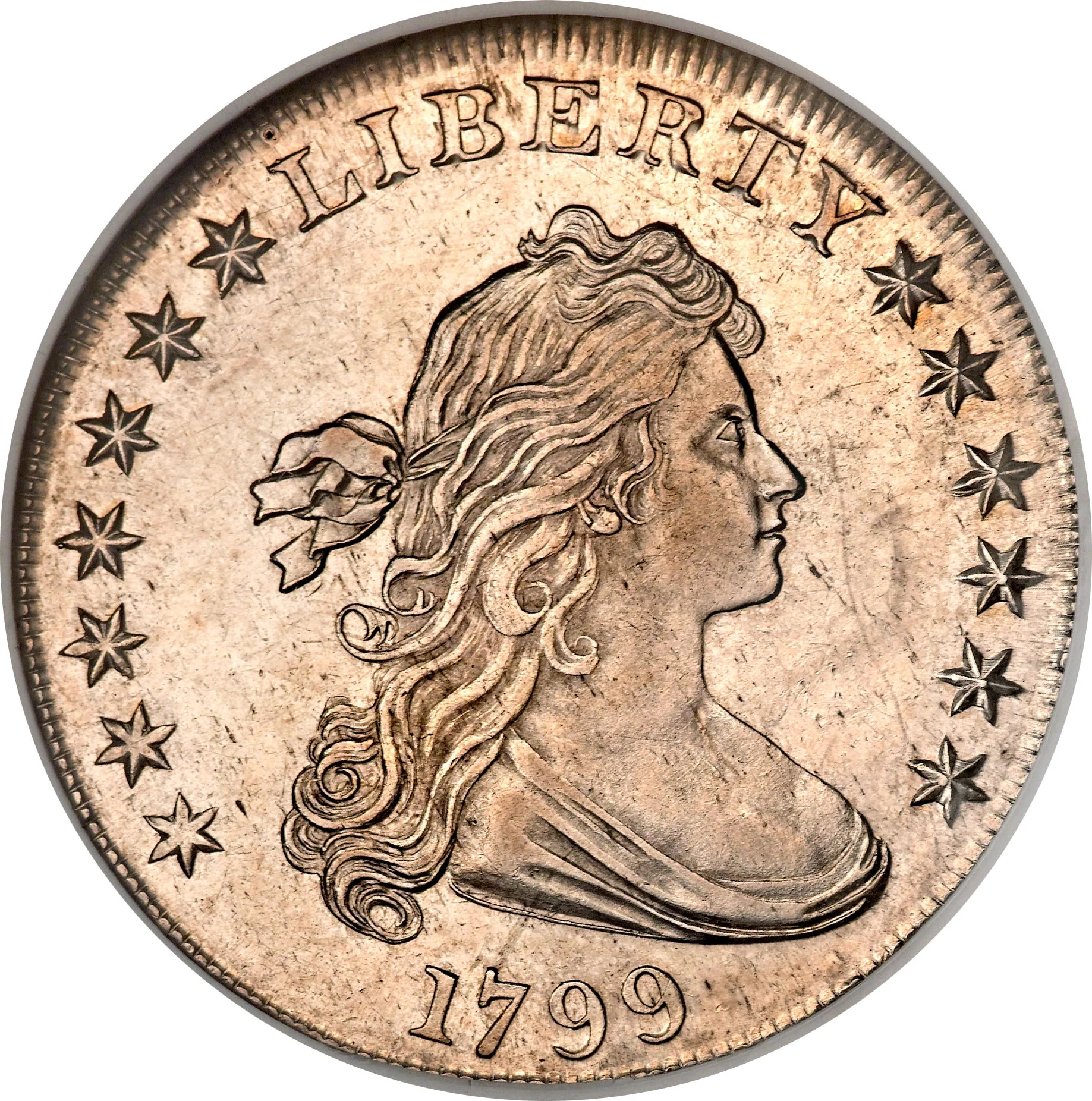
Draped bust right, 13 stars.
Inscription:
LIBERTY
1799
1799
Script: Latin
Engraver: Robert Scot
Reverse
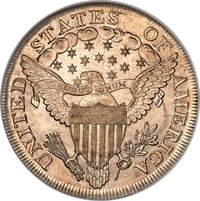
Description:
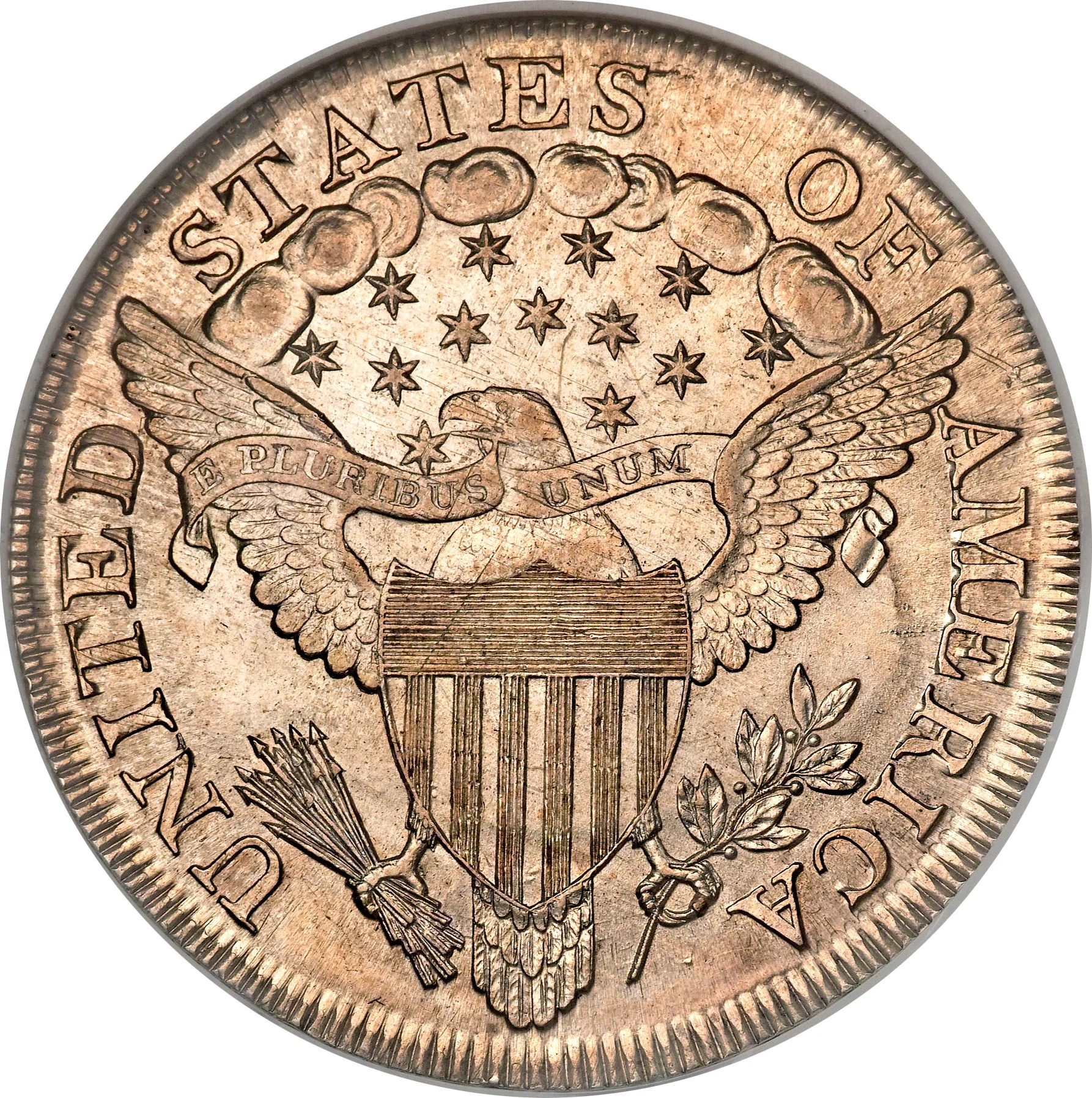
Bald eagle facing left, wings spread, holding arrows and an olive branch. A shield is on its chest, with a ribbon in its beak and 13 stars above.
Inscription:
UNITED STATES OF AMERICA
E PLURIBUS UNUM
E PLURIBUS UNUM
Script: Latin
Engraver: Robert Scot
Edge
Lettered with decorations between words
Legend:
HUNDRED CENTS ONE DOLLAR OR UNIT
Mints
| Name | Mark |
|---|---|
| United States Mint of Philadelphia | — |
Mintings
| Year | Mint Mark | Mintage | Quality | Collection |
|---|---|---|---|---|
| 1798 | — | — | ||
| 1799 | — | — | ||
| 1800 | — | — | ||
| 1801 | — | 54,454 | ||
| 1801 | — | — | Proof | |
| 1802 | — | — | ||
| 1802 | — | — | Proof | |
| 1803 | — | — | Proof | |
| 1803 | — | — | ||
| 1804 | — | — |
Historical background
In 1798, the United States operated under a monetary system established by the Coinage Act of 1792, which created a bimetallic standard based on gold and silver. The U.S. Mint produced coins—the eagle ($10), half eagle, and quarter eagle in gold, and the dollar, half dollar, dime, and half dime in silver—with their values fixed by law. However, the young nation faced a chronic shortage of specie (coin), as much of it flowed overseas to pay for imports. This scarcity meant that in daily commerce, a confusing mix of foreign coins (primarily Spanish dollars and bits), banknotes from a handful of state-chartered banks, and even barter were commonly used alongside the limited supply of official U.S. currency.
The financial landscape was still deeply influenced by the aftermath of the American Revolution and the policies of Alexander Hamilton. To consolidate national debt and create a stable financial foundation, Hamilton had championed the First Bank of the United States, which operated from 1791 until its charter lapsed in 1811. In 1798, this federally-chartered bank, along with a growing number of state banks, issued paper banknotes. These notes were promises to pay the bearer in specie upon demand, but their value and acceptance fluctuated based on public trust in the issuing bank's solvency, leading to a heterogeneous and often unstable paper currency in circulation.
Politically and economically, the year 1798 was dominated by the Quasi-War with France, an undeclared naval conflict. This crisis placed significant strain on federal finances, requiring increased taxation (including the controversial Direct Tax of 1798) and government borrowing to fund naval expansion. While the conflict did not cause a domestic financial panic, it underscored the federal government's still-limited fiscal tools and the fragility of a monetary system reliant on multiple, often unreliable, sources of currency. The situation highlighted the ongoing tension between a desire for a uniform national currency and the practical reality of a decentralized and imperfect monetary environment.
The financial landscape was still deeply influenced by the aftermath of the American Revolution and the policies of Alexander Hamilton. To consolidate national debt and create a stable financial foundation, Hamilton had championed the First Bank of the United States, which operated from 1791 until its charter lapsed in 1811. In 1798, this federally-chartered bank, along with a growing number of state banks, issued paper banknotes. These notes were promises to pay the bearer in specie upon demand, but their value and acceptance fluctuated based on public trust in the issuing bank's solvency, leading to a heterogeneous and often unstable paper currency in circulation.
Politically and economically, the year 1798 was dominated by the Quasi-War with France, an undeclared naval conflict. This crisis placed significant strain on federal finances, requiring increased taxation (including the controversial Direct Tax of 1798) and government borrowing to fund naval expansion. While the conflict did not cause a domestic financial panic, it underscored the federal government's still-limited fiscal tools and the fragility of a monetary system reliant on multiple, often unreliable, sources of currency. The situation highlighted the ongoing tension between a desire for a uniform national currency and the practical reality of a decentralized and imperfect monetary environment.
🌟 Uncommon