

1 gold louis – France
Add to wishlist
France
Context
Material
Diameter: 24 mm
Weight: 7.65 g
Gold Weight:: 7.02 g
Shape: Round
Composition: 91.7% Gold
Standard: Silver quarter ounce
Magnetic: No
Technique: Milled
Alignment: Coin alignment
flip
References
KM: #
Numista: #10936
Value
Bullion value: $1069.48
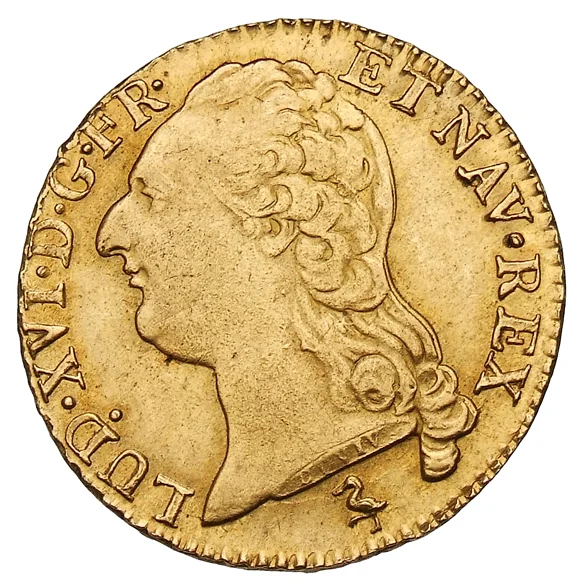
Obverse
Description:
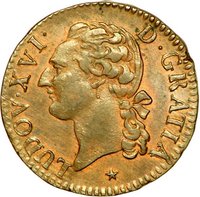
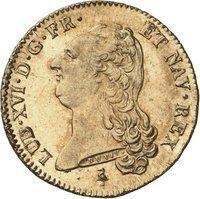
Turn left.
Inscription:
LUD·XVI·D·G·FR·ET NAV·REX
DUVIV
DUVIV
Script: Latin
Engraver: Pierre-Benjamin Duvivier
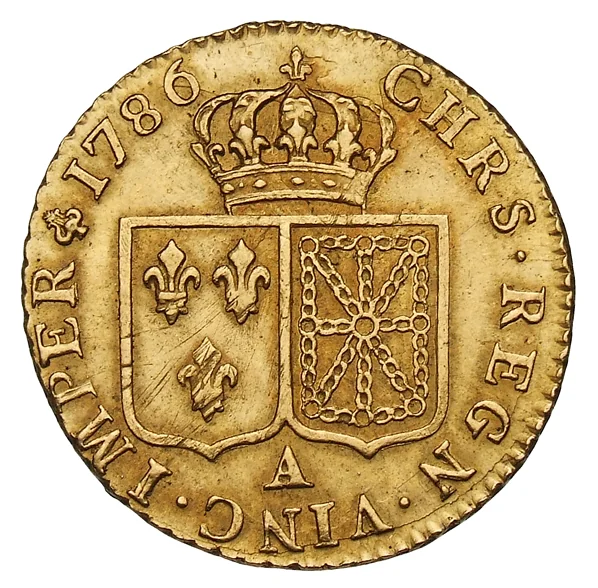
Reverse
Description:
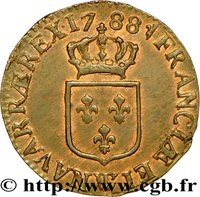
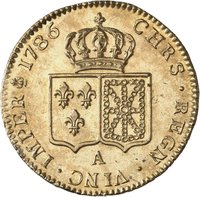
Arms of France and Navarre.
Inscription:
CHRS·REGN·VINC·IMPER 1786
W
W
Script: Latin
Engraver: Pierre-Benjamin Duvivier
Edge
Chain.
Categories
| Symbol> Crown |
| Person> Monarch |
| Symbols> Coat of Arms |
| Symbol> Fleur-de-lis |
Mints
| Name | Mark |
|---|---|
| Monnaie de Paris | A |
| Metz | AA |
| Rouen | B |
| Strasbourg | BB |
| Lyon | D |
| La Rochelle | H |
| Limoges | I |
| Bordeaux | K |
| Toulouse | M |
| Marseille | MA |
| Montpellier | N |
| Perpignan | Q |
| Orléans | R |
| Nantes | T |
| Lille | W |
Mintings
| Year | Mint Mark | Mintage | Quality | Collection |
|---|---|---|---|---|
| 1785 | A | 49,805 | ||
| 1785 | AA | — | ||
| 1785 | D | 57,938 | ||
| 1785 | K | 38,304 | ||
| 1785 | T | 450 | ||
| 1785 | W | — | ||
| 1786 | B | 418,848 | ||
| 1786 | AA | 597,170 | ||
| 1786 | D | 899,000 | ||
| 1786 | A | 5,370,000 | ||
| 1786 | BB | 248,000 | ||
| 1786 | H | 366,506 | ||
| 1786 | I | 750,523 | ||
| 1786 | K | 503,763 | ||
| 1786 | N | 284,372 | ||
| 1786 | T | 829,986 | ||
| 1786 | W | 1,298,715 | ||
| 1787 | B | 99,086 | ||
| 1787 | D | 423,885 | ||
| 1787 | H | 64,928 | ||
| 1787 | I | 108,936 | ||
| 1787 | K | 18,531 | ||
| 1787 | MA | — | ||
| 1787 | N | 44,140 | ||
| 1787 | R | — | ||
| 1787 | T | 221,101 | ||
| 1787 | W | 304,000 | ||
| 1787 | A | 1,926,791 | ||
| 1787 | AA | 119,365 | ||
| 1788 | A | 837,000 | ||
| 1788 | AA | 72,826 | ||
| 1788 | B | 30,229 | ||
| 1788 | D | 256,218 | ||
| 1788 | H | 23,029 | ||
| 1788 | I | 35,629 | ||
| 1788 | N | 28,844 | ||
| 1788 | T | 50,382 | ||
| 1788 | W | 173,761 | ||
| 1789 | A | — | ||
| 1789 | AA | — | ||
| 1789 | B | — | ||
| 1789 | D | 89,381 | ||
| 1789 | H | 16,638 | ||
| 1789 | I | 21,968 | ||
| 1789 | K | — | ||
| 1789 | M | 18,682 | ||
| 1789 | MA | — | ||
| 1789 | N | 17,174 | ||
| 1789 | Q | 20,170 | ||
| 1789 | R | 9,502 | ||
| 1789 | T | 59,276 | ||
| 1789 | W | 104,400 | ||
| 1790 | T | 22,297 | ||
| 1790 | W | 132,974 | ||
| 1790 | A | 163,884 | ||
| 1790 | AA | 12,933 | ||
| 1790 | B | 23,784 | ||
| 1790 | D | 40,852 | ||
| 1790 | H | 7,530 | ||
| 1790 | I | 7,622 | ||
| 1790 | K | — | ||
| 1790 | MA | 12,933 | ||
| 1790 | N | 9,683 | ||
| 1790 | R | 6,819 | ||
| 1791 | D | — | ||
| 1791 | H | 3,113 | ||
| 1791 | I | — | ||
| 1791 | MA | 2,073 | ||
| 1791 | N | 1,389 | ||
| 1791 | R | 4,359 | ||
| 1791 | W | 2,562 | ||
| 1792 | A | — | ||
| 1792 | D | — | ||
| 1792 | M | — | ||
| 1792 | W | 1,983 |
Historical background
In 1785, France stood on the precipice of financial collapse, a crisis rooted in decades of structural deficit and exacerbated by its costly involvement in the American Revolutionary War. The state treasury was burdened by an enormous debt, serviced by a complex and archaic fiscal system riddled with exemptions for the nobility and clergy. King Louis XVI's ministers, most notably Charles Alexandre de Calonne, who became Controller-General in 1783, were grappling with the impossibility of raising sufficient revenue through traditional means. The fundamental issue was not a shortage of physical coinage, but a catastrophic shortfall in royal credit and a political inability to reform the tax system.
The currency in circulation itself, the livre tournois, was theoretically backed by silver (écus) and gold (louis d'or) coins, but its value and stability were undermined by repeated manipulations. The government had a long history of secretly debasing the coinage or officially altering the official exchange rates between gold and silver to create short-term liquidity, eroding public trust. By the mid-1780s, these accounting tricks had been largely exhausted, and France was locked into a rigid bimetallic system that struggled with international currency fluctuations. This unstable monetary environment created uncertainty for merchants, creditors, and the growing banking sector.
Calonne's response in 1785 was to authorize the minting of new gold coins with a slightly reduced gold content, a subtle form of devaluation intended to generate seigniorage revenue for the crown without causing immediate public alarm. This technical maneuver, however, was a mere stopgap. It failed to address the core insolvency of the monarchy and instead highlighted the regime's reliance on financial expedients over principled reform. The currency situation of 1785 was thus a symptom of the broader fiscal paralysis that would soon force the calling of the Estates-General in 1789, setting the stage for the French Revolution.
The currency in circulation itself, the livre tournois, was theoretically backed by silver (écus) and gold (louis d'or) coins, but its value and stability were undermined by repeated manipulations. The government had a long history of secretly debasing the coinage or officially altering the official exchange rates between gold and silver to create short-term liquidity, eroding public trust. By the mid-1780s, these accounting tricks had been largely exhausted, and France was locked into a rigid bimetallic system that struggled with international currency fluctuations. This unstable monetary environment created uncertainty for merchants, creditors, and the growing banking sector.
Calonne's response in 1785 was to authorize the minting of new gold coins with a slightly reduced gold content, a subtle form of devaluation intended to generate seigniorage revenue for the crown without causing immediate public alarm. This technical maneuver, however, was a mere stopgap. It failed to address the core insolvency of the monarchy and instead highlighted the regime's reliance on financial expedients over principled reform. The currency situation of 1785 was thus a symptom of the broader fiscal paralysis that would soon force the calling of the Estates-General in 1789, setting the stage for the French Revolution.
⭐ Somewhat Rare