

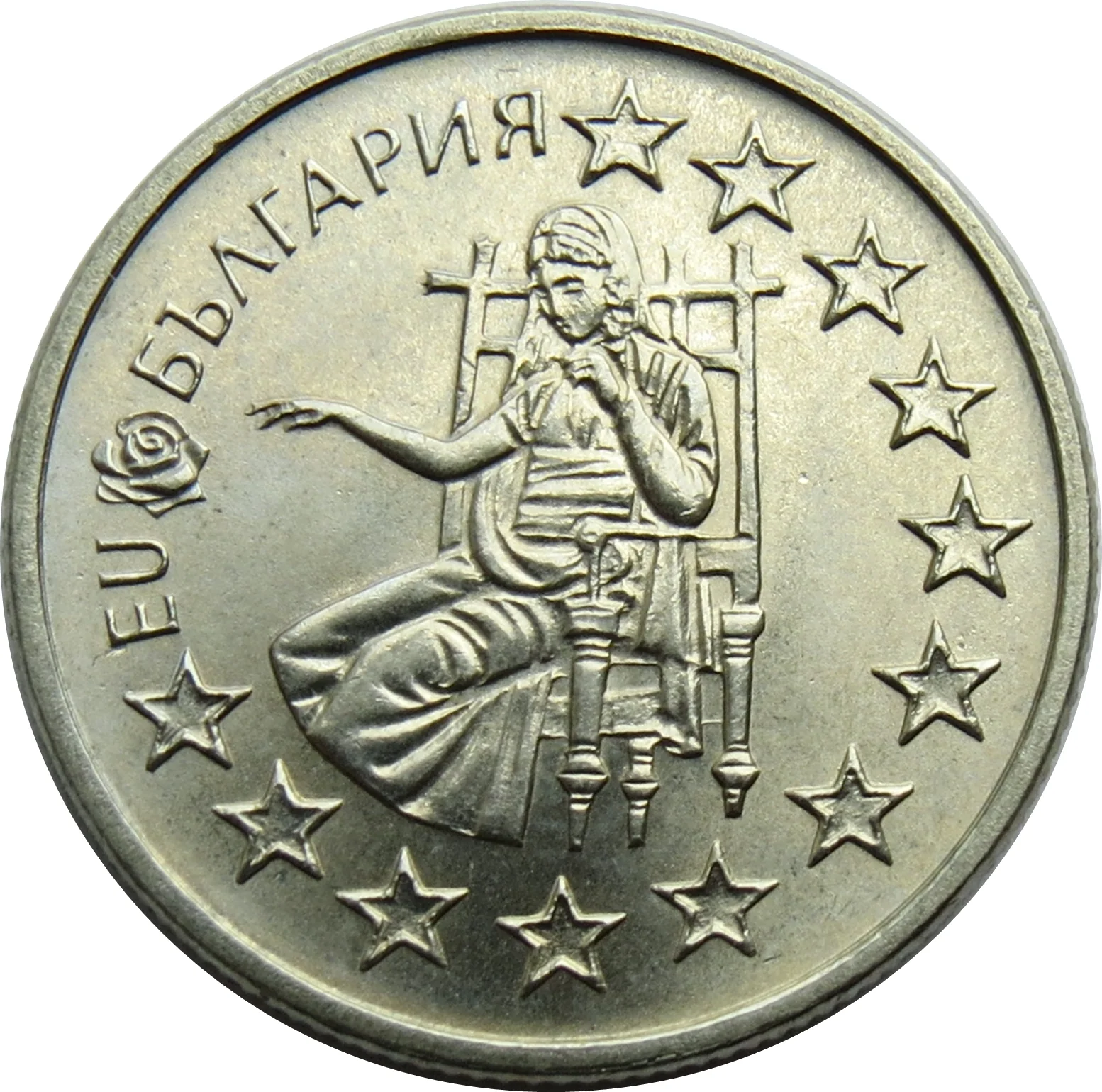
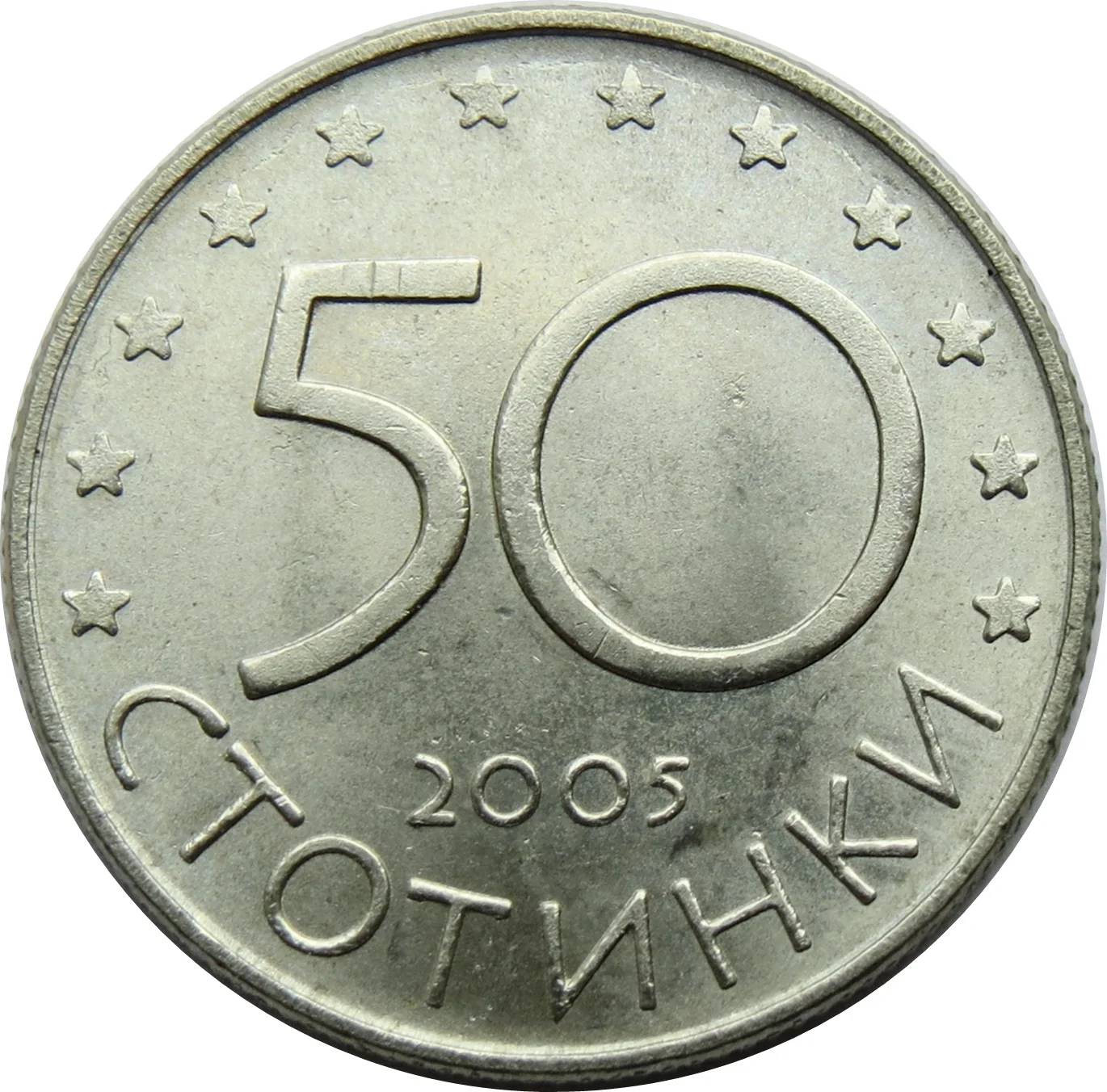
50 Stotinki – Bulgaria
Circulating commemorative coins
Commemoration: European Union
Bulgaria
Context

Material
Diameter: 22.5 mm
Weight: 5 g
Thickness: 1.75 mm
Shape: Round
Composition: Copper-nickel
Technique: Milled
Alignment: Medal alignment
flip
References
KM: #Click to copy to clipboard282
Numista: #12342
Value
Exchange value: 0.50 BGN
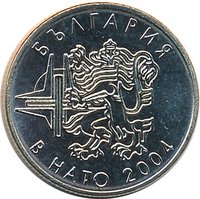
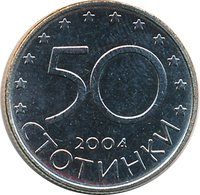
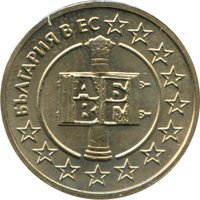
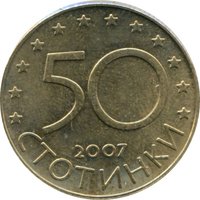
Obverse
Reverse
Edge
Reeded
Mints
| Name | Mark |
|---|---|
| Bulgarian Mint | — |
Mintings
| Year | Mint Mark | Mintage | Quality | Collection |
|---|---|---|---|---|
| 2005 | — | 500,000 |
Historical background
In 2005, Bulgaria was operating under a unique and highly successful currency board arrangement, established in 1997 following a severe financial and hyperinflation crisis. This system rigidly fixed the Bulgarian lev (BGN) to the German Deutsche Mark and, after its introduction, to the euro at a rate of 1.95583 leva for 1 euro. The currency board mandated that every lev in circulation be fully backed by foreign reserves, primarily euros, which imposed strict fiscal discipline by eliminating the central bank's ability to print money and finance government deficits. This framework was the cornerstone of Bulgaria's macroeconomic stability throughout the early 2000s, fostering low inflation, restoring public confidence in the national currency, and creating a predictable environment for foreign investment.
The year 2005 was a period of consolidation and anticipation regarding Bulgaria's European Union accession path. The country's economic performance was strong, with robust GDP growth and continued inflows of foreign direct investment. The fixed exchange rate provided stability but also meant that Bulgaria had relinquished independent monetary policy; interest rates effectively mirrored those of the Eurozone. A key focus was maintaining the strict criteria necessary for eventual Eurozone membership, as outlined in the EU's Maastricht Treaty. While not yet a formal member of the Exchange Rate Mechanism (ERM II), the lev's de facto peg to the euro was seen as a preparatory step, with the government expressing its ambition to adopt the euro as soon as possible after EU entry.
However, this rigid system also presented challenges. The currency board limited the Bulgarian National Bank's capacity to act as a lender of last resort, making the banking sector's health critically dependent on effective supervision. Furthermore, the fixed exchange rate could not adjust to correct external imbalances, meaning that competitiveness had to be maintained through internal adjustments like wage and productivity growth rather than currency devaluation. In 2005, these were manageable concerns against a backdrop of strong economic expansion, but they underscored the long-term necessity of structural reforms to ensure a smooth future transition into the Eurozone.
The year 2005 was a period of consolidation and anticipation regarding Bulgaria's European Union accession path. The country's economic performance was strong, with robust GDP growth and continued inflows of foreign direct investment. The fixed exchange rate provided stability but also meant that Bulgaria had relinquished independent monetary policy; interest rates effectively mirrored those of the Eurozone. A key focus was maintaining the strict criteria necessary for eventual Eurozone membership, as outlined in the EU's Maastricht Treaty. While not yet a formal member of the Exchange Rate Mechanism (ERM II), the lev's de facto peg to the euro was seen as a preparatory step, with the government expressing its ambition to adopt the euro as soon as possible after EU entry.
However, this rigid system also presented challenges. The currency board limited the Bulgarian National Bank's capacity to act as a lender of last resort, making the banking sector's health critically dependent on effective supervision. Furthermore, the fixed exchange rate could not adjust to correct external imbalances, meaning that competitiveness had to be maintained through internal adjustments like wage and productivity growth rather than currency devaluation. In 2005, these were manageable concerns against a backdrop of strong economic expansion, but they underscored the long-term necessity of structural reforms to ensure a smooth future transition into the Eurozone.
🌱 Common