

20 Schilling (First Austrian Postage Stamp) – Austria
Circulating commemorative coins
Commemoration: 150th Anniversary of the First Austrian Postage Stamp
Austria

Obverse
Description:
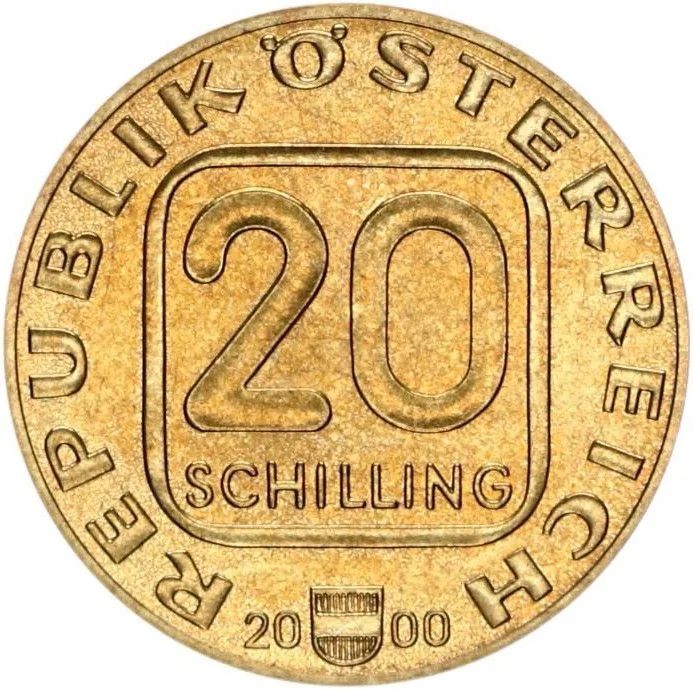
Austrian shield above date in rounded square frame.
Inscription:
REPUBLIK ÖSTERREICH
20
SCHILLING
19 95
20
SCHILLING
19 95
Translation:
REPUBLIC OF AUSTRIA
20
SCHILLING
19 95
20
SCHILLING
19 95
Script: Latin
Language: German
Engraver: Kurt Bodlak
Reverse
Description:
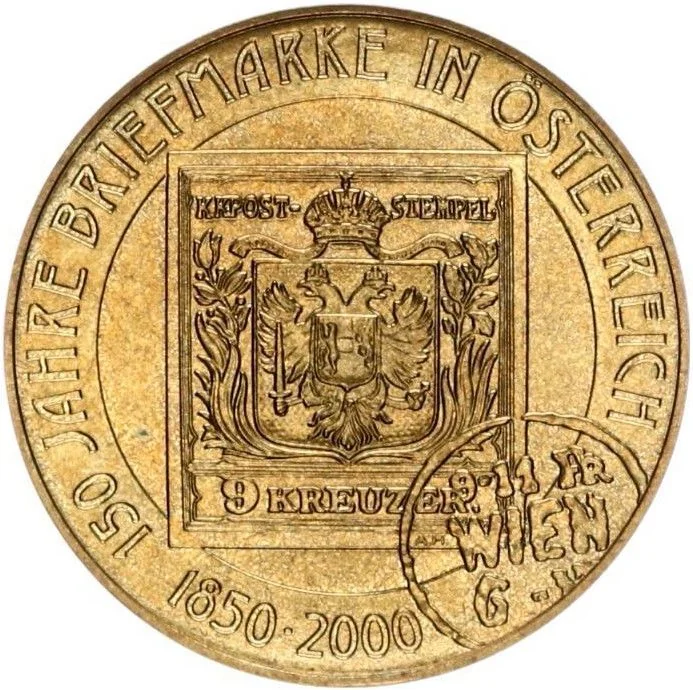
A "9 Kreutzer" stamp encircled by event text.
Inscription:
150 JAHRE BRIEFMARKE IN ÖSTERREICH
KKPOST- STEMPEL
9 KREUZER.
A.H.
9-11 PR
WIEN
G-
1850·2000
KKPOST- STEMPEL
9 KREUZER.
A.H.
9-11 PR
WIEN
G-
1850·2000
Translation:
150 YEARS OF POSTAGE STAMPS IN AUSTRIA
IMPERIAL ROYAL POST - STAMP
9 KREUZER.
A.H.
9-11 PR
VIENNA
G-
1850·2000
IMPERIAL ROYAL POST - STAMP
9 KREUZER.
A.H.
9-11 PR
VIENNA
G-
1850·2000
Script: Latin
Language: German
Engraver: Andreas Zanaschka
Designer: Helmut Andexlinger
Edge
Categories
| Currency> Stamp depiction |
Mints
| Name | Mark |
|---|---|
| Münze Österreich | — |
Mintings
| Year | Mint Mark | Mintage | Quality | Collection |
|---|---|---|---|---|
| 2000 | — | 400,000 | ||
| 2000 | — | 75,000 | Proof |
Historical background
In the year 2000, Austria was in a pivotal transitional phase regarding its currency, operating as a full member of the European Union's Economic and Monetary Union (EMU) but still using its national currency, the Austrian schilling. The country had successfully met the Maastricht convergence criteria and, alongside ten other EU members, had irrevocably fixed its exchange rate to the new European currency on January 1, 1999. This meant the schilling's value was permanently locked at approximately 13.7603 schillings to one euro, which became a virtual accounting currency for financial markets and public debt.
Domestically, however, the physical schilling remained the sole legal tender for everyday cash transactions throughout 2000. This period was characterized by a "dual display" practice, where prices were increasingly shown in both schillings and euros to prepare the public for the imminent changeover. The Austrian National Bank, along with businesses and government agencies, engaged in extensive public information campaigns to ensure a smooth transition, focusing on the conversion rate and the security features of the forthcoming euro banknotes and coins.
Thus, 2000 was a year of anticipation and final preparation. The Austrian economy and financial systems were already functioning on a euro basis in many electronic and accounting senses, while the public continued using schilling notes and coins. This careful and managed lead-up culminated on January 1, 2002, when euro cash was officially introduced and the schilling began its phased withdrawal, marking the end of an era for Austria's national currency.
Domestically, however, the physical schilling remained the sole legal tender for everyday cash transactions throughout 2000. This period was characterized by a "dual display" practice, where prices were increasingly shown in both schillings and euros to prepare the public for the imminent changeover. The Austrian National Bank, along with businesses and government agencies, engaged in extensive public information campaigns to ensure a smooth transition, focusing on the conversion rate and the security features of the forthcoming euro banknotes and coins.
Thus, 2000 was a year of anticipation and final preparation. The Austrian economy and financial systems were already functioning on a euro basis in many electronic and accounting senses, while the public continued using schilling notes and coins. This careful and managed lead-up culminated on January 1, 2002, when euro cash was officially introduced and the schilling began its phased withdrawal, marking the end of an era for Austria's national currency.
🌱 Fairly Common