

20 schilling (Michael Pacher) – Austria
Add to wishlist
Circulating commemorative coins
Commemoration: 500th Anniversary of the death of Michael Pacher
Austria
Obverse
Description:
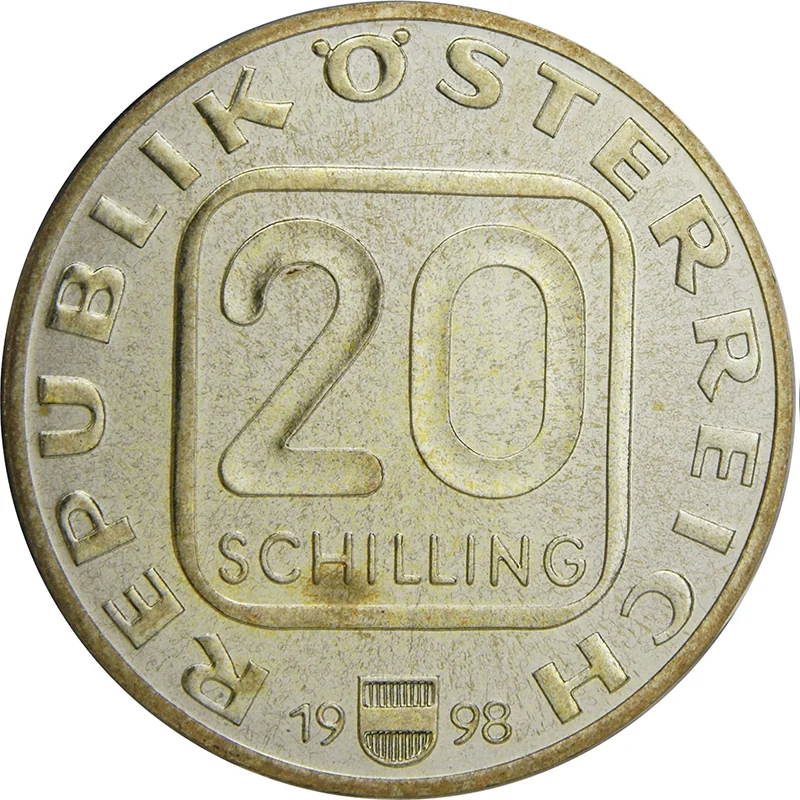
Austrian shield above date in rounded square frame.
Inscription:
REPUBLIK ÖSTERREICH
20 SCHILLING
19 98
20 SCHILLING
19 98
Translation:
REPUBLIC OF AUSTRIA
20 SCHILLING
19 98
20 SCHILLING
19 98
Script: Latin
Language: German
Engraver: Kurt Bodlak
Reverse
Description:
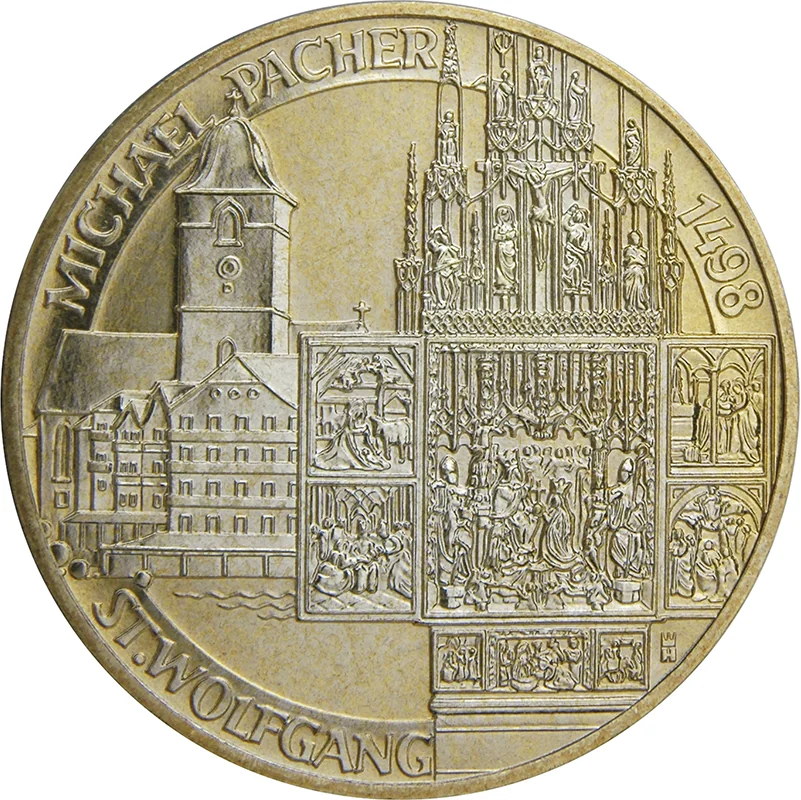
Michael Pacher’s Late Gothic altarpiece in St. Wolfgang church, shown on the coin's right. The left side depicts the lakeside church view, encircled by the event description.
Inscription:
MICHAEL PACHER 1498
ST.WOLFGANG
ST.WOLFGANG
Script: Latin
Engraver: Herbert Wähner
Edge
Plain
Categories
| Altar |
| Building> Religious building |
| Event> Death anniversary |
Mints
| Name | Mark |
|---|---|
| Münze Österreich | — |
Mintings
| Year | Mint Mark | Mintage | Quality | Collection |
|---|---|---|---|---|
| 1998 | — | 200,000 | ||
| 1998 | — | 25,000 | Proof |
Historical background
In 1998, Austria was in a pivotal phase of monetary transition, fully integrated into the European Union's economic structures but still using its national currency, the Austrian Schilling (ATS). The country was a founding member of the European Economic and Monetary Union (EMU) and had successfully met the strict Maastricht convergence criteria, including low inflation, sound public finances, and stable exchange rates. Consequently, Austria was among the first wave of nations approved to adopt the euro on January 1, 1999, with the Schilling's irrevocable conversion rate set at 1 EUR = 13.7603 ATS.
Domestically, the Schilling in 1998 was a symbol of post-war economic stability and prosperity, often referred to as the "hard Schilling." It enjoyed strong public confidence due to decades of prudent monetary policy by the Austrian National Bank (OeNB). While the legal framework for the euro changeover was being finalized, the physical Schilling remained in everyday use. However, a dual-display practice—showing prices in both Schilling and euros—began in preparation for the public, ensuring a smooth psychological and practical transition for consumers and businesses ahead of the physical introduction of euro banknotes and coins in 2002.
Thus, the currency situation in 1998 was one of anticipatory stasis. The Schilling operated normally but with its fate sealed, functioning within the new framework of the European System of Central Banks. The year was marked by final technical preparations, public information campaigns, and the quiet certainty that Austria's monetary sovereignty was being pooled within the Eurosystem, aligning its economic future more deeply with the core of Europe.
Domestically, the Schilling in 1998 was a symbol of post-war economic stability and prosperity, often referred to as the "hard Schilling." It enjoyed strong public confidence due to decades of prudent monetary policy by the Austrian National Bank (OeNB). While the legal framework for the euro changeover was being finalized, the physical Schilling remained in everyday use. However, a dual-display practice—showing prices in both Schilling and euros—began in preparation for the public, ensuring a smooth psychological and practical transition for consumers and businesses ahead of the physical introduction of euro banknotes and coins in 2002.
Thus, the currency situation in 1998 was one of anticipatory stasis. The Schilling operated normally but with its fate sealed, functioning within the new framework of the European System of Central Banks. The year was marked by final technical preparations, public information campaigns, and the quiet certainty that Austria's monetary sovereignty was being pooled within the Eurosystem, aligning its economic future more deeply with the core of Europe.
🌟 Uncommon